JENSEN HUANG: FROM THE KING OF AI TO A CORPORATE SCANDAL — AND AN EXTRAORDINARY COMEBACK
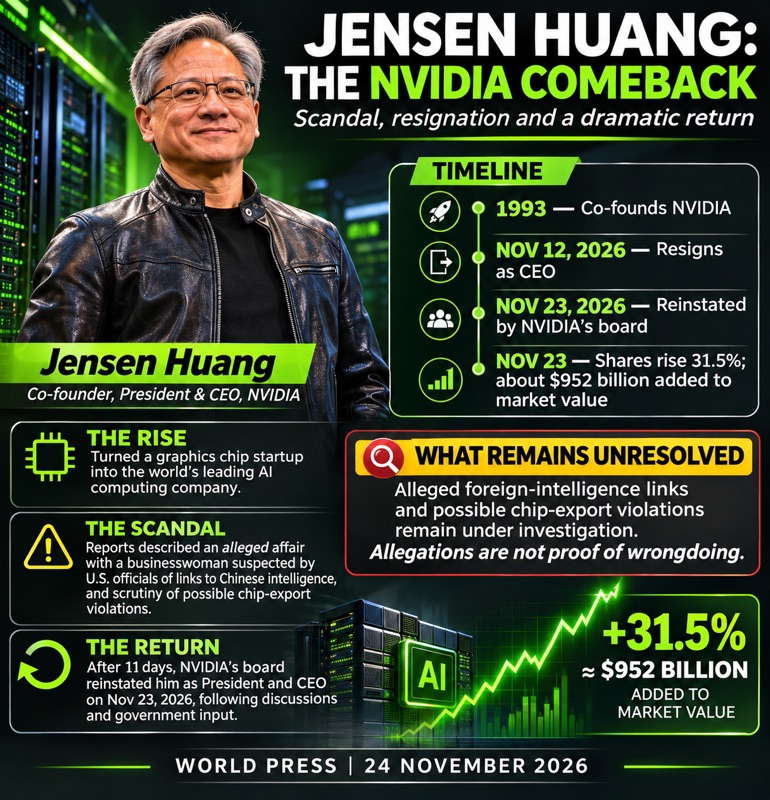
JENSEN HUANG: FROM THE KING OF AI TO A CORPORATE SCANDAL — AND AN EXTRAORDINARY COMEBACK
How Nvidia’s Billionaire Founder Faced a Personal Crisis, National Security Questions, an 11-Day Exit and a Dramatic Return to Power
By World Press | November 24, 2026
Introduction: The Man Behind the AI Revolution
For more than three decades, Jensen Huang has been one of the most influential figures in the global technology industry. As the co-founder and longtime chief executive of NVIDIA, he transformed a graphics-chip company into the world’s leading force in artificial intelligence computing.
His company’s technology powers some of the world’s most advanced AI systems, including the infrastructure used to train and operate large language models, autonomous machines, scientific computing platforms and modern data centres.
But November 2026 brought an extraordinary crisis to Huang’s career.
A controversy involving his personal relationships, a businesswoman suspected by American authorities of having links to Chinese intelligence, and concerns surrounding the possible transfer of restricted AI technology to China placed both Huang and Nvidia under intense scrutiny.
On November 12, Nvidia announced his resignation. Just eleven days later, on November 23, the company reversed course and reinstated him as President and CEO.
His return followed intense public and political attention, including intervention by US President Donald Trump.
The episode raised a fundamental question: How dependent has one of the world’s most valuable technology companies become on a single individual?
1. Who Is Jensen Huang?
Jen-Hsun “Jensen” Huang was born on February 17, 1963, in Tainan, Taiwan.
He moved to the United States during his childhood and eventually established himself as an electrical engineer and technology entrepreneur.
Huang earned a bachelor’s degree in electrical engineering from Oregon State University in 1984 and a master’s degree in electrical engineering from Stanford University in 1992.
Before establishing Nvidia, he worked at technology companies including LSI Logic and Advanced Micro Devices (AMD).
In 1993, Huang joined Chris Malachowsky and Curtis Priem to establish Nvidia.
His early ambition was to develop powerful graphics-processing technology for personal computers and video games. However, his long-term vision extended far beyond gaming.
He recognised that GPUs could perform thousands of calculations simultaneously, making them valuable for scientific research, advanced computing and eventually artificial intelligence.
That decision would fundamentally change the technology industry.
2. The Birth of Nvidia: A $40 Billion Vision That Changed the World
Nvidia was founded in April 1993 in California.
Initially, the company concentrated on graphics processing technology, competing in a challenging semiconductor market.
Its early history was not without difficulties. The company faced product challenges, financial pressure and fierce competition.
The introduction of the GeForce graphics platform helped establish Nvidia as a major force in the gaming industry.
However, one of the most important strategic decisions came in 2006, when Nvidia introduced CUDA.
CUDA allowed developers to use GPUs for general-purpose parallel computing rather than restricting them to graphics processing.
This decision opened the door to applications in scientific research, financial modelling, engineering and deep learning.
At the time, artificial intelligence was not yet the commercial phenomenon it would become.
Huang was investing in a computing architecture whose full economic potential would emerge years later.
3. How Nvidia Became the Engine of Artificial Intelligence
The explosion of artificial intelligence transformed Nvidia’s position in the global economy.
Modern AI models require enormous computing power. Training advanced systems involves processing vast amounts of data through billions or even trillions of mathematical operations.
Nvidia’s GPUs became central to this process.
Its technological ecosystem includes:
- Graphics Processing Units (GPUs).
- CUDA software and developer tools.
- High-speed networking technologies.
- AI servers and complete computing systems.
- Data-centre infrastructure.
- Robotics and autonomous-machine platforms.
The company’s H100 and H200 processors, followed by its Blackwell architecture, became important products in the rapidly expanding AI infrastructure market.
Major technology companies, cloud providers and research organisations became customers.
Nvidia was no longer simply a graphics-card manufacturer. It had become a central supplier of the infrastructure supporting the AI revolution.
This transformation also made Jensen Huang one of the world’s wealthiest technology entrepreneurs.
4. The November 2026 Scandal: When Personal Relationships Became a National Security Issue
The controversy surrounding Huang escalated in November 2026.
Reports by major American media organisations described an alleged relationship between Huang and Alice Huang, a Singapore-linked businesswoman and former executive associated with Megaspeed.
The relationship attracted extraordinary attention because American intelligence sources reportedly believed Alice Huang had maintained contact with an official connected to China’s Ministry of State Security.
The alleged contacts reportedly overlapped with the period of her relationship with Jensen Huang.
The situation raised concerns about whether a senior executive of one of America’s most strategically important technology companies could have been exposed to foreign intelligence activity.
It is essential to distinguish between allegations and established facts.
The available reporting does not establish that Jensen Huang knowingly participated in espionage or that he deliberately transferred confidential information to China.
The US Justice Department had not reached a final conclusion on whether Alice Huang was a Chinese intelligence operative.
China has also rejected allegations of espionage.
Nevertheless, the controversy created a serious corporate governance and national security challenge for Nvidia.
5. The Megaspeed Connection and the China Chip Controversy
The controversy became even more complicated because of Megaspeed’s business activities.
The company was associated with cloud computing infrastructure and Nvidia technology.
US authorities have been investigating concerns about whether advanced Nvidia chips subject to American export restrictions could have reached Chinese customers through intermediary arrangements.
Washington has imposed restrictions on the export of certain advanced semiconductor technologies to China because of concerns involving military applications and national security.
Investigators have been examining whether restricted computing hardware could have been diverted through third-party companies.
The questions surrounding Megaspeed and Alice Huang therefore became part of a much wider geopolitical issue.
Three major questions emerged:
- Were restricted Nvidia processors transferred to Chinese customers through indirect channels?
- Did any foreign intelligence organisation attempt to obtain confidential information from Nvidia?
- Were the company’s internal compliance and oversight systems sufficiently strong?
These are serious questions, but an investigation is not proof of wrongdoing.
Nvidia has said it will cooperate with government inquiries and strengthen its compliance and national security oversight.
6. A Personal Admission and an Unprecedented Corporate Crisis
The controversy was not limited to questions about international security.
Reports also focused on Huang’s personal relationships.
According to reporting by American media, Huang acknowledged an extramarital relationship and admitted that he had made serious mistakes in his personal life.
Additional allegations involving relationships with other individuals, including people connected with Nvidia, added to the controversy.
Huang publicly acknowledged that he had not lived up to the standards expected of everyone at Nvidia.
His personal conduct became a corporate issue because of his position as the company’s most influential executive.
For a global company operating in a highly regulated strategic industry, questions involving executive conduct, conflicts of interest and potential security exposure can have consequences far beyond an individual’s private life.
7. November 12: Jensen Huang Resigns
On November 12, 2026, Nvidia announced that Jensen Huang had resigned as President, Chief Executive Officer and a member of the company’s Board of Directors.
The decision was effective immediately.
Nvidia’s Chief Financial Officer, Colette Kress, was appointed interim CEO.
Harvey C. Jones was appointed the first-ever Chair of Nvidia’s Board.
The announcement marked a historic moment for a company that Huang had led since its founding in 1993.
His departure raised concerns among employees, investors, technology partners and customers.
Nvidia’s success had become closely associated with his leadership, product vision and relationships with major technology companies.
The company now faced an extraordinary leadership challenge.
8. The Board Initially Refuses to Bring Him Back
On November 17, the situation became even more dramatic.
During Nvidia’s financial results discussion, Board Chair Harvey Jones indicated that the company did not intend to reinstate Huang as CEO.
Huang, however, publicly stated that he would be honoured to return if the board requested him to do so.
The company was facing questions from investors and government authorities while the debate over its future leadership continued.
At the same time, reports emerged of investigations involving potential export-control violations and other corporate issues.
The possibility of Huang’s permanent departure appeared increasingly serious.
9. Donald Trump Enters the Picture
The controversy also attracted the attention of the White House.
US President Donald Trump publicly expressed support for Huang’s return.
Trump argued that America needed to retain leading technology entrepreneurs and protect its position in the global AI industry.
On November 22, Trump publicly urged Nvidia’s board to bring Huang back.
The following day, Trump told CNBC that he had spoken directly and indirectly with board members and had helped convince them to reinstate Huang.
His intervention became a significant part of the story.
The episode demonstrated how closely the American technology industry is connected with national economic strategy and geopolitical competition.
Nvidia is not simply another American corporation. Its technology has become strategically important to America’s position in artificial intelligence.
10. November 23: The Extraordinary Return
On November 23, 2026, Nvidia announced that its Board of Directors had unanimously voted to reinstate Jensen Huang as President, CEO and Board Director, effective immediately.
The company said the board had held a series of discussions and meetings with Huang and was satisfied with his candour and ability to lead Nvidia.
The board also stated that it had received input from senior levels of the US government and was confident that his reinstatement posed no national security risk.
Huang expressed gratitude to the board, employees, investors, business partners and his family.
His return came only eleven days after his resignation.
However, reinstatement did not mean that all investigations had ended.
Nvidia confirmed that its independent board investigation would continue.
The company also established a National Security and Export Control Committee and announced plans to recruit a Chief Compliance Officer.
These measures indicate that the company intends to strengthen its oversight systems while Huang resumes leadership.
11. The Financial Shock: What Happened to Nvidia’s Market Value?
The controversy had an immediate impact on investor confidence.
During the period surrounding Huang’s resignation, Nvidia shares experienced significant pressure.
His return on November 23 was followed by a sharp recovery in the company’s stock price.
Reuters reported that Nvidia shares rose by approximately 33% during Monday’s trading session.
The rebound demonstrated how strongly investors associate Huang’s leadership with Nvidia’s future.
However, a distinction must be made between market capitalisation and actual cash.
When Nvidia’s market value rises by hundreds of billions of dollars, it does not mean the company receives that amount in cash.
Market capitalisation is calculated by multiplying the company’s share price by its outstanding shares.
A change in market value reflects changing investor expectations and share prices.
The reaction also exposed a significant weakness: investors may be concerned about how dependent Nvidia’s future appears to be on its founder.
12. The Man Behind the Leather Jacket: Understanding Jensen Huang’s Personality
Jensen Huang has developed a distinctive public identity.
His black leather jacket has become one of the most recognisable personal trademarks in the technology industry.
Unlike some corporate executives who maintain a highly formal public image, Huang often presents himself as an energetic, technically informed and direct leader.
Several characteristics have shaped his public reputation.
Long-term thinking: His decision to invest in GPU computing and CUDA long before the AI boom demonstrated a willingness to pursue opportunities that required years of patience.
Technical understanding: Huang frequently discusses hardware architecture, computing systems and software rather than limiting his public role to financial performance.
High expectations: His management style has been described as demanding, fast-moving and intensely focused on execution.
Personal branding: His keynote presentations, distinctive clothing and direct communication style have made him an internationally recognised technology personality.
His supporters see him as a visionary entrepreneur who transformed an entire industry.
Critics, meanwhile, argue that the latest controversy demonstrates why corporate leadership requires strong accountability, transparency and independent oversight.
His personal achievements and the allegations surrounding his conduct must be examined separately.
13. What Has Jensen Huang Lost and What Has He Gained?
The November crisis had several dimensions.
What he lost:
- His position as CEO for eleven days.
- A degree of public confidence and reputational security.
- The perception that Nvidia’s leadership was insulated from personal controversy.
- The appearance of uninterrupted corporate stability.
- Time and attention that would otherwise have been devoted to Nvidia’s technology strategy.
What he regained or retained:
- His position as Nvidia’s President and CEO.
- His seat on the Board of Directors.
- The confidence expressed by the board in its reinstatement announcement.
- Support from sections of the technology industry and investor community.
- His central role in directing Nvidia’s future.
But the return does not erase the questions surrounding his personal conduct, corporate governance or the investigations.
The longer-term consequences will depend on the outcomes of those investigations and the company’s ability to maintain investor and government confidence.
14. Nvidia’s Global Rivals: The Battle for AI Supremacy
Nvidia’s position is powerful, but its future is not without competition.
Major technology companies are investing billions of dollars in alternative AI computing systems.
Its competitors and challengers include:
- AMD, which is expanding its AI accelerator business.
- Google, which develops its own Tensor Processing Units.
- Amazon, which is investing in its Trainium AI processors.
- Intel, which continues to compete in advanced computing.
- Huawei, which is developing domestic semiconductor technologies for China’s technology industry.
Nvidia’s advantage is not limited to its physical processors.
Its CUDA software ecosystem, networking products, hardware integration and developer community create substantial advantages.
However, the industry is changing rapidly.
Large cloud companies are increasingly interested in developing their own chips to reduce costs and dependence on external suppliers.
The competition will therefore involve not only faster processors but also software, energy efficiency, networking, manufacturing capacity and access to advanced semiconductor production.
15. The US-China Technology War: Why Nvidia Matters to Washington
The Jensen Huang controversy cannot be fully understood without considering the broader US-China technology rivalry.
Artificial intelligence has become a major economic and strategic priority for both countries.
Advanced chips are essential for training large AI models, developing autonomous systems, conducting scientific research and supporting complex computing applications.
The United States has used export controls to restrict China’s access to certain advanced semiconductor technologies.
China, meanwhile, is investing heavily in domestic semiconductor production and AI infrastructure.
Nvidia operates at the centre of this geopolitical competition.
Its American identity, international customer base and dependence on global semiconductor supply chains place it in a complicated position.
The company must satisfy shareholders, maintain relationships with international customers, comply with US export restrictions and protect its technological advantages.
That is a difficult balancing act even without a leadership scandal.
16. What Comes Next for Jensen Huang and Nvidia?
Huang’s return restores the company’s familiar leadership structure, but it does not eliminate the challenges ahead.
Several developments will be particularly important:
First, the investigations: The outcome of government and independent corporate investigations will be essential in determining the long-term consequences of the controversy.
Second, corporate governance: Nvidia will need to demonstrate that its oversight systems can operate independently of its founder.
Third, US-China relations: Export restrictions and semiconductor policy will continue to shape the company’s international business.
Fourth, competition: Nvidia must maintain its technological advantage as rivals invest in alternative AI processors and computing systems.
Fifth, investor confidence: The company must demonstrate that its long-term success is supported by a strong organisation, not solely by one executive.
The coming months will reveal whether Huang can convert his dramatic return into a period of renewed stability.
Conclusion: A Comeback That Raises Bigger Questions
Jensen Huang’s November 2026 crisis is one of the most extraordinary corporate leadership episodes in recent technology history.
A man who spent more than thirty years building one of the world’s most influential companies resigned amid a deeply personal controversy connected to national security concerns.
Eleven days later, he returned with unanimous board approval.
The episode demonstrated his extraordinary importance to Nvidia, but it also exposed the risks of concentrating so much strategic influence in a single individual.
For Nvidia, the challenge is now larger than maintaining its leadership in AI chips.
It must demonstrate that innovation, corporate responsibility, national security and transparent governance can coexist.
For Jensen Huang, the next chapter will be about more than technology and market capitalisation.
It will be about trust.
The man who helped power the global AI revolution has returned to the top of Nvidia. Whether this comeback becomes a lasting victory or the beginning of a more difficult chapter will depend on what happens next.
Sources and Further Reading
- NVIDIA Investor Relations — November 23, 2026: Board Reinstates Jensen Huang as President, CEO and Board Director.
- Reuters — November 23, 2026: Nvidia reinstates Jensen Huang as CEO amid pressure from President Trump and investors.
- Associated Press — November 23, 2026: Nvidia’s board reverses its earlier decision and reinstates Huang.
- ABC News — November 23, 2026: Reporting on Alice Huang and alleged contacts with China’s intelligence agency.
- CBS News — November 23, 2026: Timeline of Jensen Huang’s resignation and return.
- Forbes — November 23, 2026: Timeline of the Nvidia scandal and Huang’s comeback.
Editorial note: Allegations concerning espionage, personal relationships and export-control violations are described as allegations or ongoing investigations, not established criminal findings. The article reflects reporting available as of November 24, 2026.


Comments
Post a Comment