New Provinces or Better Governance?
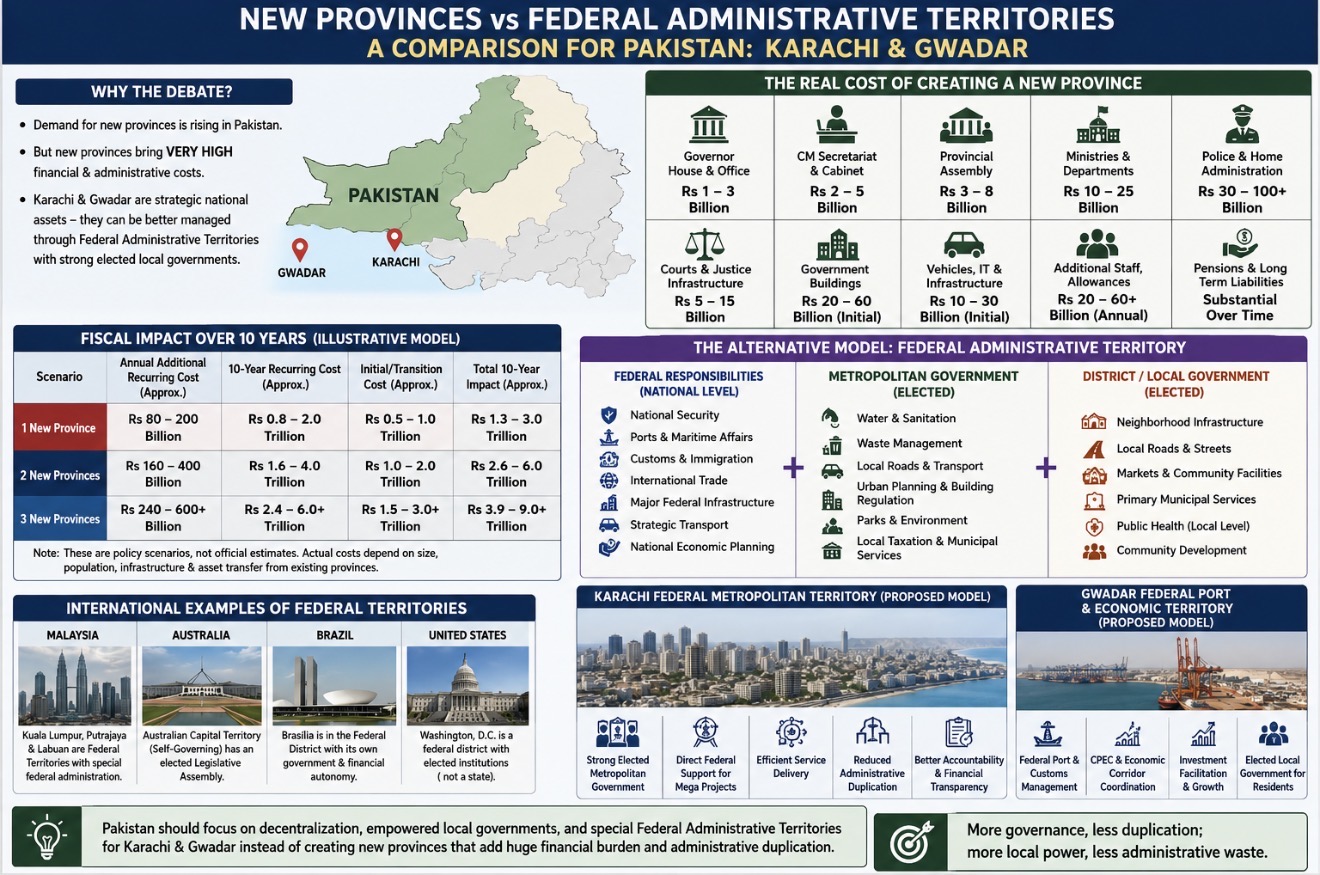
New Provinces or Better Governance?
Why Pakistan Should Consider Federal Administrative Territories for Karachi and Gwadar Instead of Creating More Provinces
A Fiscal, Administrative and International Perspective on Pakistan’s Debate Over New Provinces
Executive Summary
Pakistan is once again witnessing renewed debate over the creation of new provinces. Supporters argue that smaller provinces would bring government closer to the people, improve administrative efficiency, increase political representation and address regional grievances.
These objectives are legitimate. However, Pakistan must distinguish between administrative decentralisation and constitutional creation of new provinces.
Creating a new province does not merely redraw a map. It creates another complete layer of government—with a Chief Minister, Governor, Provincial Assembly, ministries, secretariat, police command, public service structure, planning and finance departments, courts, housing, vehicles, offices, pensions and other institutional costs.
At a time when Pakistan faces fiscal constraints, high public debt, a large recurrent expenditure burden and significant development needs, the country should first ask a fundamental question:
Can the same objective be achieved by decentralising administrative and financial powers without creating another full provincial government?
This article proposes that Pakistan should seriously examine a different model:
Four existing provinces + empowered local governments + Federal Administrative Territories for Karachi and Gwadar.
This would not necessarily mean removing democratic representation. Instead, Karachi could have a powerful elected metropolitan government with substantial fiscal and administrative authority, while strategic federal responsibilities could remain with the federal government.
Gwadar, because of its strategic location, port and CPEC-related importance, could similarly be considered for a special federal administrative and economic framework.
International experience demonstrates that this concept is neither unusual nor impractical. Kuala Lumpur, Putrajaya and Labuan in Malaysia are Federal Territories; Canberra operates as the Australian Capital Territory; Brasília is governed as Brazil’s Federal District; and Washington, D.C. is a federally created district with its own elected institutions but without the constitutional status of a U.S. state. (MKN)
The objective should therefore not be to create more political offices.
The objective should be:
More governance, less duplication; more local power, less administrative waste.
1. Pakistan’s Renewed Debate Over New Provinces
The question of creating new provinces has been part of Pakistan’s political discourse for many years. The National Assembly itself passed a resolution in 2012 supporting the creation of a proposed South Punjab province and referred to the constitutional procedure required under Article 239. (National Assembly of Pakistan)
The debate has now resurfaced with renewed intensity.
In February 2026, the Sindh Assembly passed a resolution declaring Karachi an “integral and inseparable” part of Sindh and rejecting the creation of a separate Karachi province. The resolution was formally transmitted to federal and provincial institutions. (Pakistan Administrative Service)
At the same time, MQM-P has continued to advocate federal intervention in Karachi and has called for the metropolis to be made a Federal Territory rather than simply creating another province. (Dawn)
This distinction is extremely important.
The debate should not be limited to:
“Karachi should be a province” versus “Karachi should remain in Sindh.”
There is a third possibility:
Karachi can remain outside the provincial structure while becoming a constitutionally protected Federal Administrative Territory with strong elected local government.
That option deserves serious economic and constitutional examination.
2. The Real Cost of Creating a New Province
It is sometimes argued that the creation of a province would only require a few additional offices—a Governor House, Chief Minister Secretariat and Provincial Assembly.
This understates the actual cost.
A province is a complete governmental structure.
It requires:
- Chief Minister and Cabinet
- Governor and Governor’s Secretariat
- Provincial Assembly
- Provincial Secretariat
- Finance Department
- Planning & Development Department
- Home Department
- Services & General Administration
- Revenue and Board of Revenue structures
- Police command
- Prisons
- Prosecution
- Public works
- Health administration
- Education administration
- Agriculture and livestock departments
- Local government department
- Irrigation where applicable
- Transport and communications
- Provincial regulatory institutions
- Courts and judicial infrastructure
- Public-sector housing
- Government vehicles
- IT and administrative infrastructure
- Human-resource and pension systems
The biggest expenditure is therefore not the salary of a Chief Minister.
The biggest expenditure is the institutional duplication created underneath the Chief Minister.
3. Pakistan’s Existing Provincial Fiscal Burden
Pakistan already operates four large provincial governments, and their financial requirements are substantial.
According to the Pakistan Economic Survey 2025-26, total provincial expenditure was budgeted at approximately Rs9.914 trillion for FY2026, including around Rs6.827 trillion in current expenditure and Rs3.086 trillion in development expenditure. (Finance Division)
For Sindh alone, the FY2026 budget figures cited by the Finance Division show approximately:
- Total revenue: Rs2.832 trillion
- Current expenditure: Rs2.142 trillion
- Development expenditure: Rs1.018 trillion
- Total expenditure: approximately Rs3.160 trillion. (Finance Division)
These figures demonstrate the scale of the existing provincial machinery.
Creating additional provinces does not automatically create additional national wealth.
It creates additional governments that must be financed.
4. An Illustrative Cost Model for New Provinces
There is currently no authoritative federal study establishing a fixed national cost for creating one new province.
Therefore, any precise figure should be treated cautiously.
However, a reasonable policy model should include the following categories:
|
Cost Category |
Indicative Initial / Recurring Burden |
|
Governor and constitutional offices |
Rs1–3 billion |
|
CM Secretariat, House and Cabinet structure |
Rs2–5 billion |
|
Provincial Assembly and Secretariat |
Rs3–8 billion |
|
New ministries and departments |
Rs10–25 billion |
|
Police/Home administration |
Rs30–100+ billion |
|
Courts, prosecution and justice infrastructure |
Rs5–15 billion |
|
Government buildings and offices |
Rs20–60 billion initial |
|
Housing, vehicles and IT infrastructure |
Rs10–30 billion initial |
|
Additional personnel and allowances |
Rs20–60+ billion annually |
|
Pension and long-term liabilities |
Potentially substantial over time |
These are scenario ranges, not official government estimates. Actual costs would depend heavily on the geographical size, population, existing infrastructure and whether assets and personnel are transferred from an existing province.
Nevertheless, they illustrate the central economic issue:
A new province can easily create tens of billions of rupees of additional recurring administrative expenditure every year, with potentially much larger transition and infrastructure costs.
If Pakistan were to create several new provinces, these costs would multiply.
5. The Ten-Year Fiscal Question
A government should not evaluate provincial restructuring on the basis of one year’s expenditure.
It should calculate the 10-year fiscal impact.
For example, if the additional administrative cost of two new provinces were ultimately to average approximately Rs160–400 billion annually after transition, then over ten years the recurring burden alone could reach roughly:
Rs1.6–4.0 trillion
Adding initial transition, buildings, offices, IT systems, vehicles, institutional restructuring and other one-time costs could push the overall ten-year impact substantially higher.
Again, this is a policy scenario rather than an official forecast.
The point is not that every new province would necessarily cost exactly this amount.
The point is that:
Pakistan should not create new provinces without first publishing a 10-year fiscal impact assessment.
Every proposed province should answer five questions:
- What will it cost to establish?
- What will it cost annually?
- How many new government employees will be created?
- What will happen to pensions and long-term liabilities?
- What measurable economic benefit will compensate for the additional administrative expenditure?
6. The Alternative: Administrative Decentralisation
Pakistan does not necessarily need more provincial governments to bring government closer to citizens.
It needs stronger local government.
A large province can decentralise power through:
- Divisional governments
- Metropolitan governments
- District governments
- Municipal governments
- Directly elected mayors
- Local taxation
- Local development authorities
- Digital public services
- Performance-based grants
This approach addresses the principal argument for new provinces—distance between citizens and government—without automatically creating another Chief Minister, Governor and Provincial Assembly.
The principle should be:
Decentralise functions before multiplying governments.
7. Why Karachi Is a Special Case
Karachi is not an ordinary district or city.
It is Pakistan’s largest metropolitan economy, a major port city, an international commercial centre and a critical source of national economic activity.
Its governance involves overlapping responsibilities involving:
- Federal Government
- Sindh Government
- Karachi Metropolitan Corporation
- District Municipal Corporations
- Cantonments
- Port authorities
- Development authorities
- Water and sanitation institutions
- Transport agencies
- Police
- Other federal and provincial departments
This fragmentation creates a governance problem that cannot necessarily be solved merely by changing the name of the administrative unit.
Creating a Karachi Province could actually create another layer of government.
The more fundamental question is:
How can Karachi receive metropolitan-level authority without creating unnecessary institutional duplication?
8. The Karachi Federal Administrative Territory Model
A possible solution would be to establish:
Karachi Federal Administrative Territory (KFAT)
under a specially designed constitutional and legal framework.
The model could include:
Federal responsibilities
- National security
- Ports and maritime affairs
- Customs
- Immigration
- International trade
- Major federal infrastructure
- Strategic transport
- National economic planning
Metropolitan responsibilities
An elected Mayor/Metropolitan Government could control:
- Municipal services
- Water and sanitation
- Waste management
- Local roads
- Public transport
- Urban planning
- Building regulation
- Parks
- Local taxation
- Municipal development
District/local responsibilities
Local governments could control:
- Neighborhood infrastructure
- Local roads
- Markets
- Parks
- Community facilities
- Primary municipal services
This would create a three-level governance structure without creating a new provincial government.
9. Karachi Should Not Become a Federal Territory Without Democracy
This is an essential condition.
Federal administration must not mean bureaucratic administration without accountability.
International experience shows that Federal Territories can have elected institutions.
For example, Washington, D.C. has legislative, executive and judicial institutions under its Home Rule framework, although it does not enjoy the same constitutional status as a U.S. state. (Statehood)
Similarly, the Australian Capital Territory has an elected 25-member Legislative Assembly and performs both territory-level and local-government functions. (ACT Legislative Assembly)
Therefore, Pakistan should not choose between:
Provincial Government OR Federal Bureaucracy.
There is another option:
Federal Territory + Elected Metropolitan Government + Strong Local Councils
10. Gwadar: A Different but Complementary Case
Gwadar should be considered separately from Karachi.
Its importance arises primarily from:
- Gwadar Port
- Arabian Sea access
- CPEC
- Regional connectivity
- International trade
- Energy and logistics
- Strategic geography
In May 2026, Pakistan and China again emphasised upgrading CPEC and transforming Gwadar Port into a regional connectivity hub. (Reuters)
This makes Gwadar more than an ordinary local administrative area.
Instead of creating a conventional province around Gwadar, Pakistan could consider a:
Gwadar Federal Port and Economic Territory
with a specialised governance structure.
The objective would be to coordinate:
Port + customs + security + infrastructure + investment + urban development + international logistics
under one strategic framework.
Local elected government would remain responsible for municipal and community matters.
11. International Example: Malaysia
Perhaps the strongest Asian example relevant to Pakistan is Malaysia.
Malaysia has three Federal Territories:
Kuala Lumpur
Putrajaya
Labuan
They are not governed as ordinary states.
Malaysia’s National Security Council describes the Federal Territories as being outside the jurisdiction of state governments and under federal administration. Kuala Lumpur is the national capital, Putrajaya is the federal administrative centre, and Labuan is an international business and financial centre. (MKN)
Putrajaya provides an especially interesting example.
The Perbadanan Putrajaya was established specifically to administer and manage the Federal Territory of Putrajaya and performs local-government functions within it. (PPJ)
The lesson for Pakistan is not that Malaysia should be copied exactly.
The lesson is:
A strategically important urban area does not necessarily need to become a full province in order to have a specialised administrative structure.
12. International Example: Canberra and the Australian Capital Territory
Canberra provides another useful model.
The Australian Capital Territory is simultaneously responsible for territory-level and local-government functions.
The Australian Capital Territory is particularly interesting because there is no separate city council or mayor for Canberra; the ACT Government and Legislative Assembly perform both territory and local-government functions. (ACT Legislative Assembly)
The ACT became self-governing under federal legislation in 1989 and today has a unicameral elected Legislative Assembly. (ACT Legislation Register)
This demonstrates an important principle:
Federal territories can evolve into democratic self-government without becoming full states/provinces.
13. International Example: Brasília, Brazil
Brazil provides perhaps an even more powerful example.
Brasília is located in Brazil’s Federal District, rather than being part of an ordinary state.
The Federal District has its own political, administrative and financial autonomy under its organic law. It also performs governmental functions that combine characteristics of state and local administration. (DFLegis)
The Brazilian federal government describes Brasília as the capital of Brazil and the seat of both the federal government and the Federal District government. (Serviços e Informações do Brasil)
This is relevant to Pakistan because it demonstrates how a strategically important metropolitan area can operate through a special federal territorial structure rather than a conventional state/province.
14. International Example: Washington, D.C.
Washington, D.C. provides another model.
The District of Columbia is not one of the 50 U.S. states.
Nevertheless, it has its own elected government and operates under a Home Rule framework.
Its constitutional and political position remains different from that of a state, particularly in congressional representation and federal oversight. (Statehood)
This example also teaches Pakistan an important warning:
Federal territory status must be accompanied by clear rules concerning political representation, taxation and democratic accountability.
Otherwise, residents can feel that they are being administered without adequate constitutional representation.
15. What These International Examples Have in Common
Malaysia, Australia, Brazil and the United States have very different constitutional systems.
Yet their experiences demonstrate a common principle:
There is no universal requirement that a major city must become a full province/state in order to receive effective government.
Different countries use:
- Federal Territories
- Federal Districts
- Capital Territories
- Self-governing Territories
- Metropolitan Governments
The institutional design depends on national circumstances.
Pakistan should therefore design a model suitable for Pakistan rather than simply copying another country.
16. Pakistan’s Constitutional Challenge
Creating a new province is not simply an administrative notification.
Article 239 of Pakistan’s Constitution establishes a special procedure where an amendment would alter the limits of a province.
Such an amendment cannot be presented to the President for assent unless it has been passed by the concerned Provincial Assembly by a two-thirds majority of its total membership. (Pakistani)
This makes provincial restructuring a major constitutional exercise.
A Karachi Federal Territory would therefore require careful constitutional design, particularly regarding:
- Territorial boundaries
- Representation in Parliament
- Revenue collection
- NFC arrangements
- Local taxation
- Police
- Courts
- Land
- Public employees
- Existing provincial assets
- Water
- Education
- Health
- Pension liabilities
It should not be presented as a simple administrative transfer.
17. The NFC Question
One of the most complicated aspects of any restructuring would be Pakistan’s National Finance Commission system.
Under the existing fiscal framework, provincial governments receive substantial transfers from the federal government.
For FY2026, federal transfers to provinces were budgeted at approximately Rs8.206 trillion, according to the Pakistan Economic Survey. (Finance Division)
Sindh’s budgeted share of federal taxes was approximately Rs1.927 trillion, while total federal transfers and other revenue sources form a major part of its fiscal structure. (Finance Division)
Therefore:
Removing Karachi from Sindh would not simply mean changing administrative boundaries.
It would require a carefully negotiated fiscal settlement.
Questions would include:
- What happens to Sindh’s NFC share?
- Does Karachi receive a direct federal allocation?
- How are federal taxes generated in Karachi credited?
- How are provincial liabilities divided?
- Who pays for inherited pension obligations?
- What happens to provincial employees working in Karachi?
- How are existing development projects divided?
- Who controls land and revenue authorities?
These questions should be answered before, not after, any constitutional restructuring.
18. The Fiscal Argument for Federal Territories
The strongest argument for a Federal Territory is therefore not:
“It will cost nothing.”
It will not.
Karachi will continue to require billions of rupees for:
- Water
- Transport
- Roads
- Sewerage
- Hospitals
- Schools
- Waste management
- Urban infrastructure
- Public safety
The potential advantage is different:
The government structure can be designed without duplicating an entire provincial government.
The savings would therefore come from avoided institutional duplication, not from eliminating public services.
This is a much more defensible economic argument.
19. A Comparative Governance Model
Pakistan could consider the following structure:
|
Model |
Political Structure |
Administrative Duplication |
Fiscal Complexity |
Local Representation |
|
Existing Province |
Province + Local Government |
High |
Existing |
Often weak |
|
New Province |
New CM + Governor + Assembly + Departments |
Very High |
Very High |
Potentially strong |
|
Federal Bureaucratic Territory |
Federal Government |
Medium |
High |
Potentially weak |
|
Federal Territory + Elected Metropolitan Government |
Federal + Metro + Local |
Medium/Low |
Manageable |
Strong |
|
Metropolitan Government within Province |
Sindh + Metro + Local |
Medium |
Existing system |
Strong if properly empowered |
The fourth option deserves serious attention.
20. The Biggest Mistake: Confusing Political Representation With Administrative Efficiency
A new province can certainly create political representation.
It may provide:
- A new Chief Minister
- A new Cabinet
- New ministers
- New Assembly members
- New bureaucratic leadership
But political representation alone does not guarantee:
- Better schools
- Better hospitals
- Better roads
- Better water supply
- Better policing
- Better investment
- Better economic productivity
Pakistan should therefore measure governance by outcomes, not by the number of political offices created.
21. What Pakistan Should Do Instead
Before creating any new province, the federal government should establish an independent:
National Commission on Administrative and Fiscal Restructuring
The Commission should include:
- Economists
- Constitutional experts
- Public-finance specialists
- Urban planners
- Local-government experts
- Civil-service experts
- Representatives of provinces
- Representatives of local governments
- Business community
- Civil society
It should publish a 10-year fiscal impact assessment for every proposed province.
No new province should be approved without answering:
The Five-Year Test
- What will the province cost?
- What will it produce economically?
- How many new jobs will be genuine public-service jobs rather than administrative posts?
- What measurable improvement will citizens receive?
- Why cannot the same outcome be achieved through decentralisation?
22. A Possible National Administrative Reform
Pakistan could retain its four provinces but create stronger intermediate administrative units.
For example:
Federal Government
↓
Province
↓
Metropolitan / Divisional Government
↓
District Government
↓
Municipal / Local Government
↓
Union / Community Government
Each level should have:
- Defined responsibilities
- Defined revenue sources
- Defined performance indicators
- Audited accounts
- Digital procurement
- Public disclosure
- Citizen complaint mechanisms
This would bring government closer to citizens without continuously redrawing provincial boundaries.
23. A Special Model for Karachi
A possible Karachi framework could be:
Karachi Federal Metropolitan Territory
Federal Government
Responsible for:
- Port
- Customs
- Immigration
- Strategic infrastructure
- National security
- International trade
- Federal roads and major transport links
Elected Karachi Metropolitan Government
Responsible for:
- Water
- Sewerage
- Waste
- Public transport
- Roads
- Urban planning
- Building control
- Municipal taxation
- Parks
District Governments
Responsible for:
- Local roads
- Community infrastructure
- Markets
- Local facilities
- Neighborhood services
This model could provide Karachi with direct political and administrative accountability without automatically creating another provincial government.
24. A Special Model for Gwadar
Gwadar should have a different structure because of its strategic and economic significance.
A possible:
Gwadar Federal Port & Economic Territory
could combine:
- Federal port administration
- Customs
- Investment facilitation
- Special economic-zone management
- Strategic security
- International logistics
- CPEC coordination
- Urban development
- Local elected government
The local population should retain meaningful democratic representation.
The objective should be to make Gwadar:
A gateway to Pakistan—not merely another government headquarters.
25. The Counterargument: Could Smaller Provinces Actually Save Money?
Yes, potentially.
Supporters of new provinces have a legitimate argument.
Smaller administrative units can:
- Reduce geographical distance
- Improve access to government
- Increase regional political representation
- Improve planning
- Create competition among governments
- Give neglected regions greater political attention
These benefits cannot simply be dismissed.
But they must be measured against the costs.
A smaller province may save money if it eliminates inefficient layers of administration.
It may cost more if it simply duplicates the same layers of government.
Therefore:
The question is not whether smaller provinces are good or bad. The question is whether the proposed institutional design produces more benefits than costs.
26. The Principle Pakistan Should Adopt
Pakistan should adopt a simple fiscal principle:
“No New Government Without a Demonstrated Public Benefit.”
Before creating another province, the government should demonstrate:
Administrative Benefit > Administrative Cost
and
Development Benefit > Institutional Duplication
If those conditions cannot be demonstrated, decentralisation should be preferred.
27. A Practical Ten-Year Reform Strategy
Phase I — 1 to 2 Years
- Audit existing provincial departments
- Strengthen local governments
- Transfer selected functions downward
- Establish metropolitan fiscal systems
- Digitise land and municipal administration
- Publish provincial and local government expenditure
Phase II — 3 to 5 Years
- Establish empowered metropolitan governments
- Introduce performance-based federal transfers
- Reform police governance
- Strengthen local taxation
- Establish unified urban planning authorities
Phase III — 5 to 10 Years
Evaluate whether constitutional restructuring is still necessary.
If a region still demonstrates a compelling case for provincial status, then the proposal should proceed on the basis of:
- Population
- Geography
- Economic viability
- Revenue potential
- Administrative capacity
- Public demand
- Constitutional feasibility
- Ten-year fiscal sustainability
28. Conclusion: Pakistan Needs Better Governance, Not More Government
Pakistan’s debate over new provinces should not become a contest over political offices, boundaries or slogans.
The country faces enormous development requirements.
Every rupee spent on a new government structure is a rupee that cannot simultaneously be spent elsewhere.
Pakistan already has four provincial governments, hundreds of departments, thousands of administrative offices and a substantial public-sector wage and pension burden.
The country therefore needs to ask a more fundamental question:
Do we need more provinces—or do we need better government?
For Karachi, the answer may lie in a Federal Metropolitan Territory with a powerful elected metropolitan government, rather than another conventional province.
For Gwadar, the answer may lie in a Federal Port and Economic Territory integrated with national strategic, trade and CPEC objectives while preserving democratic local government.
International examples show that such arrangements are not theoretical. Malaysia operates Federal Territories including Kuala Lumpur, Putrajaya and Labuan; Australia has the Australian Capital Territory; Brazil has the Federal District containing Brasília; and Washington, D.C. operates under a distinct federal territorial framework. (MKN)
Pakistan should learn from these examples while designing its own constitutional solution.
The ultimate objective should be neither centralisation nor fragmentation.
It should be:
Decentralised power, accountable government, fewer duplicated institutions and maximum value for every rupee of public money.
Pakistan does not need to create a new Chief Minister merely to bring government closer to the people.
It needs to bring decision-making, resources and accountability closer to the people.
That is the real meaning of administrative reform.
Policy Recommendation in One Sentence
Pakistan should retain its existing provincial structure for the time being, pursue genuine local-government devolution, and seriously examine Karachi and Gwadar as constitutionally protected Federal Administrative Territories with elected metropolitan/local governments rather than automatically creating additional provinces.


Comments
Post a Comment