TODAY NEWS FLASH — SPECIAL
THE WORLD & HUMANITY (TWH)
TODAY NEWS FLASH — SPECIAL NEWS ARTICLE
Sunday, 11 October 2026
By Syed Ali Raza | Editor & Publisher
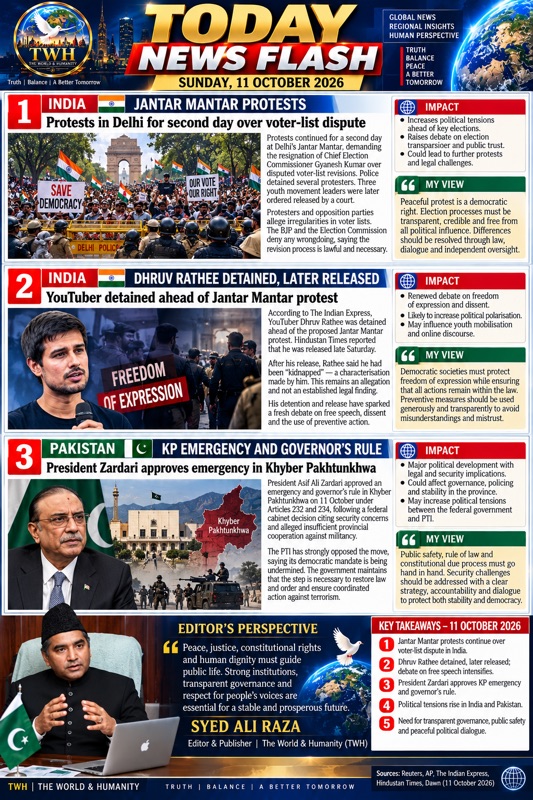
Jantar Mantar Protests, Dhruv Rathee’s Detention and Emergency Rule in Khyber Pakhtunkhwa: A Day of Political Turmoil
Sunday’s major political developments in South Asia have brought democratic rights, freedom of expression, electoral transparency and constitutional governance into sharp focus. In India, protests over voter-list revisions continued in New Delhi, while YouTuber Dhruv Rathee was released after being detained ahead of a planned demonstration. In Pakistan, the federal government imposed emergency measures and governor’s rule in Khyber Pakhtunkhwa, citing security concerns and disagreements over counterterrorism policy. These developments have prompted debate about the balance between public order, constitutional authority and citizens’ rights.
1. India: Jantar Mantar Protests Continue Over Voter-List Dispute
Protests continued in New Delhi on Sunday as demonstrators demanded the resignation of Chief Election Commissioner Gyanesh Kumar over disputed revisions to electoral rolls. Critics argue that the voter-list revision process could unfairly affect political representation and benefit the ruling Bharatiya Janata Party (BJP). The BJP and the Election Commission have denied allegations of electoral manipulation.
Reuters reported that police detained hundreds of protesters for a second consecutive day. The demonstrations followed a wider security operation in the capital, where authorities had restricted access to protest areas and detained political activists and other demonstrators. Opposition groups have called for greater transparency and independent scrutiny of the electoral process.
World Impact: The dispute highlights the importance of public confidence in electoral institutions. Allegations concerning voter eligibility and electoral fairness can intensify political polarisation if they are not addressed transparently.
My View — Syed Ali Raza: “Peaceful protest is a democratic right, and credible elections require public confidence. Electoral disputes should be resolved through transparent procedures, independent oversight and constitutional mechanisms. Both demonstrators and authorities should avoid violence and respect the rule of law.”
2. India: Dhruv Rathee Released After Detention Ahead of Protest
Indian YouTuber and political commentator Dhruv Rathee was released late Saturday after being detained ahead of a planned protest at Jantar Mantar, according to Indian media reports. The demonstration was linked to the broader movement challenging voter-list revisions and demanding accountability from electoral authorities.
Rathee subsequently described his experience as a kidnapping in a social-media post, while reports from officials described his custody as a detention. His account and the official characterisation should be distinguished; the circumstances and legal basis of the incident remain important questions for public scrutiny.
The incident has renewed debate about freedom of expression, preventive detention and the rights of journalists, commentators and political activists. Authorities have a responsibility to maintain public order, but restrictions on peaceful political activity also raise questions about proportionality and due process.
World Impact: The treatment of political commentators and protesters can influence international perceptions of democratic freedoms and institutional accountability.
My View — Syed Ali Raza: “Freedom of expression is essential in a democratic society, but it must operate within a fair legal framework. Any detention should have a clear legal basis, appropriate safeguards and access to due process. Peaceful criticism should not be confused with violence.”
3. Pakistan: Emergency and Governor’s Rule Imposed in Khyber Pakhtunkhwa
Pakistan’s federal government imposed emergency measures and governor’s rule in Khyber Pakhtunkhwa on Sunday, following approval by President Asif Ali Zardari. The federal government cited deteriorating security and concerns over the provincial administration’s response to militancy. The move was taken under Articles 232 and 234 of Pakistan’s Constitution.
The decision marks a major escalation in tensions between the federal government and the Pakistan Tehreek-e-Insaf (PTI), which governs the province. Federal officials have argued that stronger intervention is required to address security challenges. PTI representatives have opposed the move, raising concerns about provincial autonomy, political representation and the constitutional implications of federal intervention.
Pakistan’s constitutional framework sets out specific procedures and limits for emergency proclamations and governor’s rule. The legal validity, duration and parliamentary oversight of the measures will therefore be central to the debate surrounding their implementation.
National Impact: The decision could significantly affect provincial administration, political stability, counterterrorism coordination and relations between federal and provincial institutions. It also creates an urgent need for clarity about constitutional procedures and public accountability.
My View — Syed Ali Raza: “Public safety and constitutional democracy must be protected together. Security challenges require effective action, but extraordinary powers should be exercised within the Constitution, with transparent oversight and respect for citizens’ rights. Dialogue between political stakeholders is essential to prevent further instability.”
4. Regional Perspective: Democratic Rights, Security and Institutional Trust
The developments in India and Pakistan reflect different political situations, but both raise a common question: how can governments maintain public order while protecting constitutional rights and institutional credibility?
In India, the central issue is public confidence in electoral procedures and the handling of peaceful demonstrations. In Pakistan, the immediate challenge concerns security in Khyber Pakhtunkhwa and the constitutional consequences of federal intervention. The circumstances are not identical, and each must be assessed according to its own legal framework and independently verified facts.
Across the region, lasting stability depends on credible institutions, transparent decision-making, peaceful political participation and accountability under the law. Security measures can address immediate threats, but public trust is also necessary for sustainable peace.
Editorial Perspective: A Call for Responsible Leadership
Political disagreement is a normal feature of democratic life. The challenge for governments is to manage disagreement without undermining public confidence or weakening constitutional safeguards. Likewise, opposition groups and demonstrators have a responsibility to pursue their demands peacefully and respect lawful procedures.
In both countries, independent scrutiny, accurate reporting and meaningful dialogue can help prevent political disputes from becoming prolonged crises. Security concerns should be addressed seriously, while emergency powers and restrictions on public activity should remain subject to legal limits and appropriate oversight.
My Final Message
Syed Ali Raza
Editor & Publisher — The World & Humanity (TWH)
“Democracy is strengthened when institutions earn public trust, governments remain accountable and citizens can express their concerns peacefully. Security and freedom should not be treated as opposing goals. Responsible leadership must protect human dignity, uphold constitutional principles and resolve political differences through dialogue rather than confrontation.
Our objective should be a region where justice, public safety, democratic participation and respect for the law reinforce one another.”
THE WORLD & HUMANITY (TWH)
Understanding the World, Promoting Humanity.
Sources and further reading
- Reuters: India: Jantar Mantar protests and detentions
- Associated Press: India: Protest leaders released from detention
- Dawn: Pakistan: Emergency and governor’s rule in KP
- Dawn explainer: Constitutional implications of emergency rule


Comments
Post a Comment