TODAY NEWS FLASH , Pakistan and India: Eight Major Developments and My Editorial Perspective
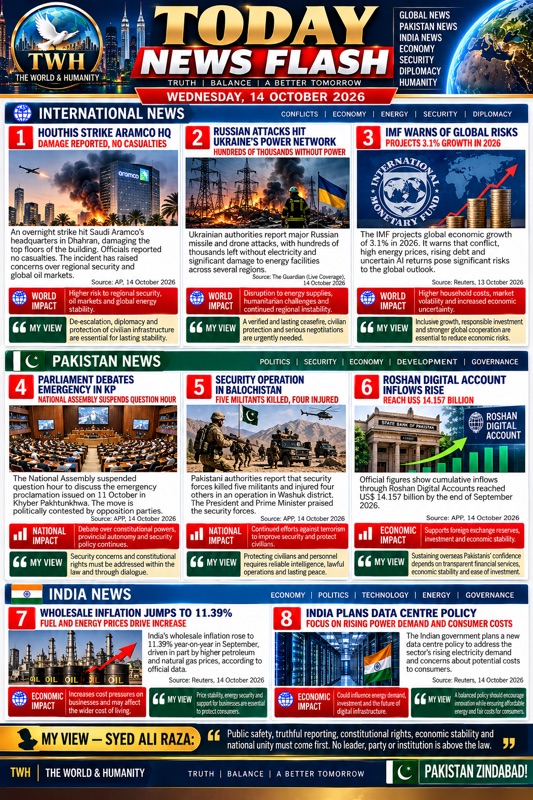
TODAY NEWS FLASH
, Pakistan and India: Eight Major Developments and My Editorial Perspective
Wednesday, 14 October 2026
The World & Humanity (TWH)
Truth | Balance | A Better Tomorrow
Introduction: A World Facing Security and Economic Challenges
Today’s headlines reflect a world dealing with escalating regional conflicts, pressure on energy infrastructure, economic uncertainty, security challenges, and rising living costs. Developments in the Middle East and Ukraine highlight the human and economic consequences of conflict, while Pakistan faces important questions about security, constitutional governance, and economic confidence. In India, rising wholesale inflation and a proposed policy for data centres underline the connection between energy, technology, and everyday life.
This report examines eight major stories featured in today’s TWH News Flash, their wider implications, and my perspective on the issues.
1. Houthi Attack Damages Saudi Aramco Headquarters in Dhahran
A Houthi attack on 13 October reportedly damaged several upper floors of Saudi Aramco’s headquarters in Dhahran, Saudi Arabia. Reports indicated that a limited fire occurred but that no casualties were reported at the headquarters. The incident forms part of a wider escalation involving attacks on Saudi infrastructure and growing concerns about regional security. Source: Financial Times.
World Impact
Saudi Arabia is a major energy producer, so attacks on its infrastructure can influence oil-market expectations, regional investment, aviation, and international security. Further escalation could also threaten civilians and disrupt trade.
My View
Military escalation should not become a permanent substitute for diplomacy. Regional governments and international stakeholders should prioritise civilian protection, de-escalation, and negotiations. Protecting energy infrastructure is important, but lasting stability requires political solutions as well as security measures.
2. Russian Attacks Damage Ukraine’s Power Infrastructure
Ukraine reported further Russian attacks on energy infrastructure, including a strike on a power plant in Kyiv. Reports published on 14 October described deaths and injuries following the attacks, alongside renewed concerns about electricity supplies and the security of essential civilian infrastructure. Ukrainian President Volodymyr Zelenskyy also criticised the lack of advance warning about a strike. Source: The Guardian.
World Impact
Damage to electricity infrastructure affects hospitals, homes, businesses, communications, and public services. Prolonged disruption can also increase humanitarian needs and put additional pressure on neighbouring countries.
My View
Energy infrastructure is essential to civilian life. All parties should take meaningful steps to protect civilians and essential services. A sustainable ceasefire, credible negotiations, and international efforts to reduce escalation are necessary to prevent further suffering.
3. IMF Projects 3.1% Global Economic Growth in 2026
The International Monetary Fund’s latest World Economic Outlook projects global economic growth of 3.1% in 2026 and 3.4% in 2027. Investment in artificial intelligence is supporting growth in several economies, but the IMF has warned that geopolitical conflict, high oil prices, rising public debt, and the possibility of a correction in AI-related investment could weaken the outlook. Source: Reuters.
World Impact
Global growth figures do not tell the whole story. Higher energy prices can increase transport and production costs, while financial uncertainty can discourage investment. The benefits of technological growth may also remain concentrated in countries with advanced infrastructure and skilled workforces.
My View
Economic progress should be measured not only by GDP growth but also by employment, purchasing power, access to education, and improvements in living standards. Governments should invest in digital skills, modern infrastructure, and productive businesses while maintaining responsible fiscal policies. Technology should create opportunities for ordinary people, not just profits for a limited number of companies.
4. Pakistan’s National Assembly Approves Emergency Measures in Khyber Pakhtunkhwa
Pakistan’s National Assembly passed a resolution on 14 October endorsing the presidential proclamation of emergency in Khyber Pakhtunkhwa. The federal government cited internal disturbances, rising terrorist incidents, and concerns about counterterrorism coordination. The decision remains politically contested, particularly regarding provincial autonomy and the constitutional basis for exceptional measures. Sources: Dawn, Associated Press of Pakistan.
National Impact
The decision could significantly affect relations between the federal and provincial governments, public confidence in democratic institutions, and the coordination required to combat terrorism.
My View
National security is a serious responsibility, but it must be addressed within constitutional and legal limits. Emergency measures should have a clear legal basis, be supported by credible evidence, and remain subject to appropriate scrutiny. Political disagreement alone should never be treated as sufficient justification for extraordinary action.
The federal government and provincial leadership should pursue dialogue and cooperation on counterterrorism while protecting citizens’ rights and democratic representation.
5. Five Militants Reportedly Killed in Security Operation in Balochistan
Pakistani authorities reported that security forces killed five militants and injured four others during an intelligence-based operation in the Palantak area of Washuk district, Balochistan, on 14 October. According to state media reports, the operation was conducted under Operation Radd-ul-Fitna 3, and weapons and ammunition were recovered. These details have been reported by Pakistani authorities and state media. Sources: Associated Press of Pakistan, Dawn.
National Impact
Counterterrorism operations are part of Pakistan’s continuing effort to address militant violence and protect communities. However, lasting security also depends on effective intelligence, civilian protection, public trust, and addressing the conditions that allow violence to persist.
My View
The safety of civilians and security personnel must remain a priority. Operations should be conducted lawfully, with appropriate safeguards and accountability. The ultimate objective should be sustainable peace, secure communities, and the restoration of normal economic and social life.
6. Roshan Digital Account Inflows Reach US$14.157 Billion
Cumulative inflows through Pakistan’s Roshan Digital Account programme reached US$14.157 billion by the end of September 2026, according to figures from the State Bank of Pakistan reported on 14 October. The total was US$13.906 billion at the end of August. September inflows amounted to US$251 million, while the number of registered accounts increased to 975,602. Sources: State Bank of Pakistan, Associated Press of Pakistan.
National Impact
The programme gives overseas Pakistanis a digital route to banking, payments, and investment in Pakistan. Continued participation can support financial activity and provide an additional channel for engagement with the domestic economy.
However, cumulative inflows should not be confused with the amount of new money received in a single month or with funds permanently available to the government.
My View
Overseas Pakistanis are an important part of the country’s economic network. Maintaining their confidence requires transparent financial services, predictable regulations, reliable digital access, and wider economic stability. The long-term success of the programme depends on trust and the availability of credible investment opportunities.
7. India’s Wholesale Inflation Rises to 11.39%
India’s wholesale price inflation rose to 11.39% year-on-year in September 2026, compared with 9.92% in August, according to provisional data released by India’s Ministry of Commerce and Industry on 14 October. The increase reflected higher prices across several categories, including fuel and power, food-related goods, and manufactured products. Inflation in the fuel and power group reached 25.85%. Sources: Government of India, Press Information Bureau, Reuters.
National and Economic Impact
Wholesale inflation measures changes in prices at the producer and wholesale level; it is not the same as retail inflation paid directly by households. Nevertheless, sustained increases in fuel, food, and manufacturing costs can eventually put pressure on businesses and consumers.
My View
Price stability is essential for economic confidence. Policymakers should monitor energy costs, food supplies, production expenses, and the effects on small businesses. Targeted support for vulnerable households and a stable economic environment can help reduce the burden of inflation without creating additional long-term imbalances.
8. India Prepares a Dedicated Policy for Data Centres
India is preparing a dedicated policy for data centres as the country’s digital infrastructure expands. On 14 October, Minister of State for Information Technology Jitin Prasada said the government wanted to address the sector’s growing electricity demand and avoid a situation in which data-centre expansion pushes up power costs for ordinary consumers. The minister did not announce a detailed implementation timetable. Sources: Reuters, Moneycontrol.
World Impact
Data centres support cloud computing, artificial intelligence, digital services, and online business. They can attract investment and create employment, but they also require substantial electricity, cooling, water, and infrastructure. Poor planning could increase pressure on local resources.
My View
Digital development should be encouraged, but it must be sustainable and inclusive. Governments should promote energy-efficient data centres, responsible water use, investment in cleaner energy, and transparent rules for infrastructure development. Technological progress should strengthen economic competitiveness without placing an unfair burden on households.
My Editorial Perspective: Security, Economic Stability and Responsible Governance
These eight developments point to a common lesson: a country’s progress depends on the safety of its people, the credibility of its institutions, and the strength of its economy.
Internationally, conflict threatens lives and critical infrastructure. Economically, energy costs and financial uncertainty can affect countries far beyond the areas where crises begin. In Pakistan, counterterrorism and constitutional governance must proceed together, while confidence in the economy depends on transparent policies and productive investment. In India, inflation and data-centre development demonstrate the need to balance economic growth with affordability and resource management.
I believe that governments, political leaders, and public institutions should be evaluated through evidence, performance, transparency, and respect for the law. Security measures should protect citizens, economic policies should create meaningful opportunities, and technological progress should benefit society broadly.
Conclusion: Truth, Balance and a Better Tomorrow
The purpose of The World & Humanity is not merely to report events but to encourage informed discussion, accountability, and constructive reform. Journalism should help people understand what has happened, why it matters, and what responsible solutions may be available.
We should support peace over unnecessary conflict, facts over misinformation, constitutional governance over arbitrary power, and public welfare over narrow interests. Political and national differences must not prevent us from recognising our shared responsibility to protect human dignity and build a better future.
My central message is simple: public safety, truth, constitutional rights, economic stability, and human dignity must come first.
Truth. Balance. A Better Tomorrow.
Pakistan Zindabad!
Syed Ali Raza Naqvi Bukhari
Editor & Publisher — The World & Humanity (TWH)


Comments
Post a Comment