TODAY NEWS FLASH — BREAKING EDITION Thursday, 15 October 2026 | The World & Humanity (TWH)
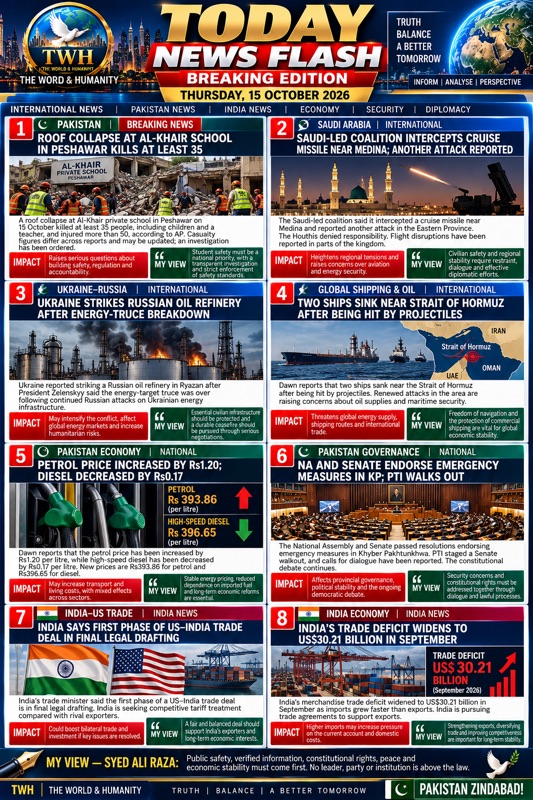
TODAY NEWS FLASH — BREAKING EDITION
Thursday, 15 October 2026 | The World & Humanity (TWH)
International Affairs, Pakistan and India: Eight Major Stories and My Editorial Perspective
The latest developments highlight serious concerns about civilian safety, regional conflict, maritime security, rising fuel costs, constitutional governance, and international trade. Below is the English article based on the eight stories in your Breaking News Flash, with factual reporting, wider implications, and your editorial perspective.
Introduction: A World at a Critical Crossroads
The world is experiencing a period of growing uncertainty. Conflicts are threatening civilian lives and energy infrastructure, tensions in the Middle East are raising concerns about international shipping, and governments are facing difficult decisions involving economic stability and national security.
Pakistan is confronting a tragic school-building collapse in Peshawar, changing fuel prices, and an ongoing constitutional dispute over emergency measures in Khyber Pakhtunkhwa. Meanwhile, India is moving forward with trade negotiations with the United States while dealing with a widening merchandise trade deficit.
These developments demonstrate why responsible journalism must go beyond headlines. Citizens need verified information, balanced analysis, and constructive debate about the consequences of political and economic decisions.
1. Tragedy in Peshawar: School Roof Collapse Kills Children and a Teacher
A devastating roof collapse at Al-Khair private school in Peshawar, Khyber Pakhtunkhwa, on 15 October has claimed numerous lives, including those of children and a female teacher. Emergency services and rescue teams worked to recover victims from the debris, while injured students were taken to hospitals. Authorities ordered an investigation into the incident, and reports indicated that the school owner had been arrested.
Initial reports gave differing casualty figures as rescue operations and hospital assessments continued. The Associated Press reported at least 35 deaths and more than 50 injuries, while other reports initially published lower figures. The final verified toll should therefore be confirmed through updated official and hospital statements. <Cite refs={[“turn224840news96”,“turn224840search2”,“turn224840search9”]}/>
National Impact
The tragedy raises serious questions about building safety, construction standards, private-school regulation, inspections, and accountability. Schools must provide children with a safe environment in which to learn.
My View
Student safety must be a national priority, not merely a regulatory formality.
Every school building should undergo proper structural inspections, and unsafe buildings should not be permitted to operate until the necessary repairs are completed. Where negligence is established, those responsible must face the law.
The government should review safety standards for schools across Pakistan, publish inspection findings, and ensure that emergency procedures are in place. The families of the victims deserve compassion, timely assistance, and a transparent investigation.
No parent should have to fear sending a child to school.
2. Saudi Arabia Reports Interception of a Cruise Missile Near Medina
On 15 October, the Saudi-led coalition reported that it had intercepted and destroyed a cruise missile in the Medina region. The coalition also reported intercepting a drone over Saudi Arabia’s Eastern Province. The Houthis denied carrying out an attack on Saudi territory that day and had previously stated that they would not target the holy cities of Mecca and Medina. Regional aviation disruptions and heightened security concerns have accompanied the wider escalation. <Cite refs={[“turn434362news49”,“turn434362search10”]}/>
International Impact
Any reported missile threat near a major civilian population centre or a city of immense religious significance raises serious concerns about civilian safety. Continued hostilities may also disrupt air travel, weaken regional confidence, and increase pressure on energy markets.
My View
The protection of civilians and sacred places must be an overriding priority. Governments should communicate verified information promptly, avoid unnecessary escalation, and pursue diplomatic channels to prevent further attacks.
Claims about responsibility should be assessed carefully, particularly when the parties involved offer conflicting accounts. Responsible reporting requires distinguishing confirmed events from allegations and denials.
The region needs effective diplomacy and de-escalation, not an expanding cycle of retaliation.
3. Ukraine Strikes Russian Oil Infrastructure as Energy Truce Breaks Down
The proposed energy ceasefire between Russia and Ukraine has failed to halt attacks on critical infrastructure. On 15 October, reports said Ukraine had struck an oil refinery in Russia’s Ryazan region following renewed Russian attacks on Ukrainian energy facilities. The developments came amid continuing disagreement over the terms of a possible halt to strikes on energy infrastructure. <Cite refs={[“turn224840news97”]}/>
International Impact
Attacks on refineries, power facilities, and other energy infrastructure can affect fuel supplies, electricity generation, transport, and industrial production. Continued escalation may also increase volatility in global oil markets and deepen the humanitarian consequences of the war.
My View
Energy infrastructure is essential to civilian life and economic stability. Both sides should take meaningful steps to protect civilians and essential services.
A ceasefire must be more than a public announcement. It needs clear terms, credible monitoring, and a genuine commitment to implementation. International diplomacy should focus on reducing attacks, protecting civilians, and creating conditions for sustained negotiations.
The longer the conflict continues, the greater the human and economic cost.
4. Two Ships Reportedly Sink Near the Strait of Hormuz
Reports published on 14–15 October said two vessels had sunk amid attacks near the Strait of Hormuz, one of the world’s most strategically important maritime corridors. The Washington Post reported that a Singapore-registered container ship, the GFS Pride, caught fire following an attack and was evacuated, while another bulk carrier sank after sustaining damage in an earlier incident. The reporting linked these events to the wider regional conflict, although the circumstances and timing differed between the vessels. <Cite refs={[“turn224840news98”]}/>
International Impact
The Strait of Hormuz is a critical route for global oil and gas shipments. Threats to commercial vessels can raise insurance costs, delay cargo, disrupt energy supplies, and increase the cost of international trade.
The consequences can reach far beyond the Gulf, affecting fuel prices and the cost of goods in countries that depend on imported energy.
My View
Freedom of navigation and the safety of civilian shipping must be protected.
All parties should avoid actions that endanger commercial crews or threaten essential maritime routes. International cooperation, reliable maritime information, and effective de-escalation are necessary to prevent further disruption.
Energy security cannot be achieved through confrontation alone. It also requires stable trade routes, responsible diplomacy, and diversified energy supplies.
5. Pakistan Raises Petrol Prices Slightly While Reducing Diesel Rates
Pakistan’s government revised petroleum prices effective 15 October. Petrol increased by Rs1.20 per litre, from Rs392.66 to Rs393.86 per litre, while high-speed diesel decreased by Rs0.17, from Rs396.82 to Rs396.65 per litre. The Petroleum Division said the changes reflected movements in international petroleum prices and related costs. <Cite refs={[“turn224840search0”,“turn224840search1”,“turn224840search10”]}/>
National and Economic Impact
Petroleum prices affect transport, freight, agriculture, industrial production, and household budgets. Even relatively small changes can place additional pressure on families and businesses when overall living costs are already high.
Diesel prices are particularly important for goods transport and agricultural machinery, while petrol prices directly affect many private motorists and small businesses.
My View
Fuel pricing should be transparent, predictable, and supported by clear explanations of international prices, taxes, duties, and other costs.
The government should also pursue measures that reduce Pakistan’s vulnerability to imported energy, including energy efficiency, public transport improvements, and responsible investment in alternative energy sources.
Economic policy should protect public finances without placing an avoidable burden on ordinary citizens. Sustainable energy planning is essential for long-term economic stability.
6. Pakistan’s Parliament Endorses Emergency Measures in Khyber Pakhtunkhwa
Pakistan’s National Assembly and Senate passed resolutions endorsing the federal government’s emergency measures in Khyber Pakhtunkhwa. The federal government cited concerns about counterterrorism coordination and the provincial government’s alleged disengagement from the fight against militancy. PTI senators staged a walkout during the Senate proceedings, while the wider dispute continued to raise questions about provincial autonomy and constitutional authority. <Cite refs={[“turn434362search12”,“turn434362search5”]}/>
National Impact
The decision has implications for federal-provincial relations, democratic representation, security policy, and public confidence in constitutional institutions. Cooperation between the federal and provincial governments is particularly important when addressing terrorism and protecting citizens.
My View
National security and constitutional rights must be protected together. Emergency measures should have a clear constitutional basis, meet applicable legal requirements, and remain subject to appropriate scrutiny.
Political disagreement alone should not become a substitute for legal justification. Equally, provincial political differences should not prevent cooperation on the protection of citizens.
The federal government and provincial leadership should prioritise dialogue, parliamentary accountability, and a shared strategy against terrorism. Constitutional processes must be respected regardless of which political party holds power.
7. India Says First Phase of US Trade Deal Is in Final Legal Drafting
India’s trade secretary said on 15 October that the first phase of a proposed trade agreement between India and the United States had been finalised and was undergoing legal drafting. Indian officials said they hoped to conclude the agreement promptly while seeking preferential market access and greater tariff stability for Indian exporters. Some aspects of the broader relationship and trade arrangements remain subject to negotiation. <Cite refs={[“turn434362news50”,“turn434362search7”]}/>
International Impact
A trade agreement between two major economies could influence tariffs, investment, supply chains, and market access. Businesses may benefit from greater predictability, although the actual effects will depend on the final agreement’s terms and implementation.
Trade arrangements can also affect competition between exporters in different countries and shape future investment decisions.
My View
Trade agreements should be evaluated through their practical outcomes rather than political announcements alone.
A fair and balanced agreement should provide clear rules, encourage productive investment, support employment, and offer sustainable benefits to businesses and consumers. Governments must also ensure that domestic industries are prepared to compete and that smaller enterprises are not overlooked.
International trade works best when negotiations are transparent, commitments are credible, and the benefits are shared as widely as possible.
8. India’s Merchandise Trade Deficit Widens to US$30.21 Billion
India’s merchandise trade deficit widened to US$30.21 billion in September 2026, compared with US$26.86 billion in August, according to government data reported by Reuters. Merchandise exports reached US$44.40 billion, while imports increased to US$74.61 billion. Although exports rose year-on-year, imports remained substantially higher than exports, widening the monthly trade gap. <Cite refs={[“turn434362news48”,“turn434362search4”]}/>
International and Economic Impact
A widening merchandise trade deficit can put pressure on the external balance, particularly when a country relies heavily on imported energy and other essential goods. However, the deficit must be considered alongside export performance, services trade, investment flows, and broader economic conditions.
Higher imports may reflect strong domestic demand or investment, while stronger exports can support employment and foreign-exchange earnings.
My View
The objective should not simply be to reduce imports at any cost. Countries need to import essential energy, technology, and industrial inputs while strengthening their ability to produce competitive goods and services.
India’s challenge is to sustain export growth, diversify markets, improve industrial competitiveness, and manage exposure to global energy-price shocks.
For Pakistan, the wider lesson is equally relevant: sustainable economic progress requires productive exports, a stronger industrial base, stable energy supplies, and policies that encourage businesses to compete internationally.
My Editorial Perspective: Public Safety, Peace and Accountability Must Come First
These eight developments share several important themes.
First, public safety must never be neglected. The Peshawar school tragedy is a painful reminder that safety standards, inspections, and accountability are essential responsibilities, not optional administrative tasks.
Second, regional conflict has global consequences. Attacks on energy infrastructure and commercial shipping can affect fuel prices, supply chains, and household budgets thousands of kilometres away.
Third, security and constitutional governance must work together. Pakistan’s response to terrorism must protect citizens while respecting constitutional procedures and fundamental rights.
Fourth, economic policies should deliver tangible benefits. Fuel prices, international trade, and energy security are not merely statistics; they influence employment, business costs, household expenses, and the prospects of future generations.
Finally, responsible journalism requires accuracy and balance. Breaking-news reports can change quickly, and conflicting accounts should be identified rather than presented as settled facts. Public debate becomes more useful when it is grounded in credible evidence.
Conclusion: Truth, Balance, A Better Tomorrow
The purpose of The World & Humanity is not merely to report events but to encourage informed discussion, accountability, and constructive reform.
Governments must protect citizens. Political leaders must respect the law. International actors should work to reduce conflict, and economic policies should improve people’s lives. The public, in turn, deserves truthful information and institutions that are accountable for their decisions.
My message is simple: we should choose dialogue over unnecessary confrontation, facts over misinformation, accountability over impunity, and public welfare over narrow interests.
No political leader, party, or institution should be above the law. Human dignity, public safety, peace, and the national interest must come first.
Truth. Balance. A Better Tomorrow.
Pakistan Zindabad!
Syed Ali Raza Naqvi Bukhari
Editor & Publisher — The World & Humanity (TWH)


Comments
Post a Comment