TODAY NEWS FLASH 17 October 26
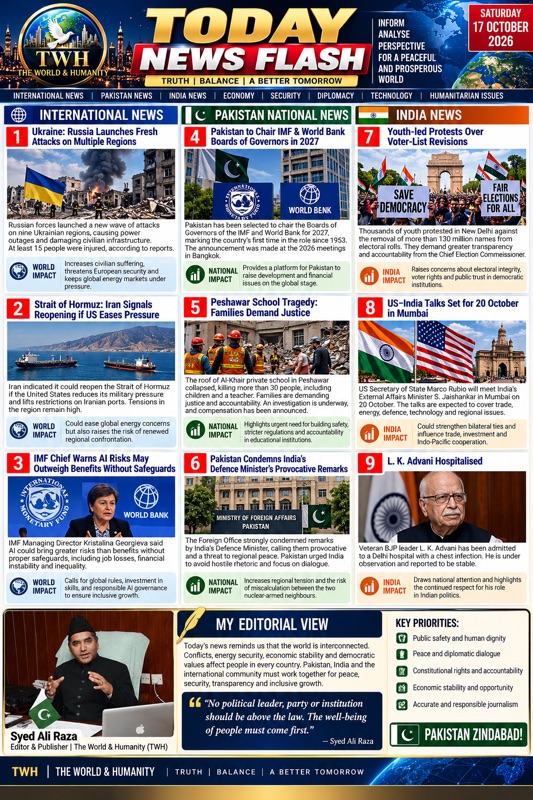
TODAY NEWS FLASH
Global Affairs, Pakistan and India: Nine Major Stories and My Editorial Views
Date: Saturday, 17 October 2026
Published by: The World & Humanity (TWH)
By: Syed Ali Raza
Editor & Publisher — The World & Humanity
Introduction: A World at a Critical Crossroads
The events of 17 October 2026 highlight a world facing multiple challenges, from armed conflicts and economic uncertainty to democratic accountability, regional tensions and technological change. Developments in Ukraine and the Middle East demonstrate the human cost of prolonged confrontation, while Pakistan’s international economic role and India’s political developments raise important questions about governance, stability and public trust.
In my view, responsible journalism must do more than report events. It must explain their consequences, distinguish verified facts from political claims, and encourage solutions that protect human dignity and the public interest.
1. Ukraine: Russian Attacks Disrupt Power and Endanger Civilians
Russian attacks across nine Ukrainian regions have damaged infrastructure, disrupted electricity supplies and caused civilian casualties. Reporting on 16–17 October indicated that more than one million consumers experienced power outages at some point, while Ukrainian officials reported deaths and injuries. The attacks have intensified concerns as winter approaches. Source: AP News and Reuters
International Impact: Damage to energy infrastructure threatens heating, water supplies, hospitals and essential public services. Continued fighting also places pressure on European security and international financial support for Ukraine.
My View: Military objectives must never overshadow the protection of civilians. All parties should respect international humanitarian law, and diplomatic efforts should aim at a just and sustainable peace. A settlement imposed without meaningful security guarantees may simply postpone another conflict. The international community should support humanitarian relief while continuing to pursue credible negotiations.
2. Strait of Hormuz: Tensions Threaten Global Energy Security
The Strait of Hormuz remains a strategically vital route for international energy shipments. Iran has indicated that reopening the waterway depends on changes to US military pressure and restrictions involving Iranian ports. Recent reporting has also highlighted attacks on vessels in the region. Source: CBS News
International Impact: Any prolonged disruption could increase oil and shipping costs, intensify inflation and place additional pressure on countries dependent on imported energy. Developing economies would be particularly vulnerable to higher fuel and transport bills.
My View: The security of international shipping should not become a bargaining tool that exposes civilians worldwide to economic hardship. The United States, Iran and regional powers should pursue de-escalation through diplomatic channels, clear maritime arrangements and credible guarantees. Dialogue is not a sign of weakness; it is often the most practical way to prevent a wider war.
3. Artificial Intelligence: IMF Warns of Risks Without Safeguards
At the IMF–World Bank annual meetings in Bangkok, IMF Managing Director Kristalina Georgieva warned that the risks of artificial intelligence could outweigh its benefits without adequate safeguards and an ethical framework. AI offers opportunities to improve productivity, investment and services, but it also creates concerns about financial stability, employment and inequality. Source: Reuters report
International Impact: Countries that invest in digital skills and responsible innovation may benefit from economic growth. Those without the necessary infrastructure and education risk falling further behind. Rapid automation may also put pressure on workers whose jobs can be replaced or substantially changed by technology.
My View: AI should serve humanity, not make people economically disposable. Governments, educational institutions and technology companies should cooperate on responsible regulation, data protection, cybersecurity and workforce training. Pakistan should invest in digital education, technical skills and innovation so that its young population can participate in the global digital economy.
4. Pakistan to Chair the IMF and World Bank Boards of Governors in 2027
Pakistan has been selected to assume the chairmanship of the Boards of Governors of the International Monetary Fund and World Bank Group for 2027. The announcement was made during the institutions’ annual meetings in Bangkok on 16 October. It marks Pakistan’s return to the position for the first time since 1953. Source: Pakistan’s Ministry of Economic Affairs
National and International Impact: The appointment provides Pakistan with greater diplomatic visibility and an opportunity to contribute to discussions on development finance, economic stability and the needs of developing countries. However, the chairmanship does not grant Pakistan additional voting power or control over IMF programmes and World Bank lending decisions. Source: Dawn
My View: This is an important diplomatic opportunity, but its value should be measured by constructive engagement rather than ceremony. Pakistan should advocate for fairer development financing, sustainable debt management, investment in education and health, and practical support for vulnerable economies. At home, international recognition must be matched by economic reform, transparency, stronger institutions and policies that improve ordinary citizens’ lives.
5. Peshawar School Tragedy: A Call for Justice and Safer Buildings
The collapse of the roof at Al-Khair private school in Peshawar has resulted in the deaths of dozens of people, including children and a female teacher. Reports published after the incident gave differing casualty totals, with figures varying as rescue and hospital information was updated. Authorities have called for an investigation into the disaster. Sources: AP News and Dawn
National Impact: The tragedy has raised serious questions about building standards, school inspections, construction quality and the enforcement of safety regulations. Families have suffered an immeasurable loss, while the wider community has been left demanding accountability and assurances that such incidents will not recur.
My View: No child should lose their life because a building was unsafe or regulations were ignored. A transparent investigation must establish the cause, identify any negligence and ensure that those responsible face the law. Authorities should conduct independent safety inspections of schools and other public buildings, publish their findings and take immediate action wherever serious risks are identified. Compensation may provide limited assistance, but it cannot replace justice or a child’s life.
6. Pakistan Condemns Indian Defence Minister’s Remarks
Pakistan’s Foreign Office has condemned remarks attributed to Indian Defence Minister Rajnath Singh, who warned that any fresh terrorist activity originating across the border would invite a strike greater than the previous one. Pakistan described the remarks as provocative and warned against threats of aggression. Source: Dawn
Regional Impact: Strong rhetoric between two nuclear-armed neighbours can increase the risk of miscalculation, undermine confidence and make diplomatic engagement more difficult. Security concerns and allegations of cross-border terrorism remain deeply sensitive issues for both countries.
My View: Pakistan has a legitimate interest in protecting its sovereignty and citizens, just as every country has a responsibility to address security threats. However, public threats and escalating rhetoric can make a dangerous situation even more difficult to control. Both governments should rely on verifiable evidence, credible investigations and established communication channels. Peace does not require either side to abandon its national interests; it requires both sides to pursue those interests responsibly.
7. India: Protests Over Voter-List Revisions Raise Democratic Concerns
India continues to face controversy over electoral-roll revisions that have resulted in the removal of more than 130 million names. Authorities say the exercise aims to remove deceased, duplicate or otherwise ineligible entries. Critics argue that legitimate voters may also have been excluded and are demanding greater transparency and accountability. Youth-led protests have called for action by the Election Commission. Sources: The Guardian and The Indian Express.
National and International Impact: Electoral credibility is fundamental to democratic legitimacy. If eligible citizens cannot confirm or restore their registration, public confidence in elections may suffer. The controversy also places pressure on election authorities to demonstrate that their procedures are fair, transparent and open to independent scrutiny.
My View: Every eligible citizen should be able to exercise the right to vote without unnecessary obstacles. At the same time, accurate electoral rolls are essential for credible elections. The solution is a transparent, independently reviewable process that provides clear notice, accessible appeals and prompt correction of errors. Peaceful protest must be respected, and allegations of wrongdoing should be investigated through lawful procedures rather than dismissed or accepted without evidence.
8. US–India Relations: Marco Rubio and S. Jaishankar Set for Talks
US Secretary of State Marco Rubio is scheduled to meet India’s External Affairs Minister S. Jaishankar in Mumbai on 20 October. The discussions are expected to cover the wider US–India strategic partnership, including trade, energy and regional cooperation, while negotiations on a bilateral trade arrangement continue. Source: The Economic Times
International Impact: Stronger economic and diplomatic ties between the United States and India could influence investment, technology cooperation, energy markets and the wider Indo-Pacific balance. The outcome will also depend on how both sides manage differences over trade and strategic priorities.
My View: Diplomatic engagement is most effective when it produces practical benefits rather than merely symbolic statements. The two countries should pursue cooperation in trade, education, technology and energy while remaining committed to regional stability. Their partnership should not add to the confrontation between major powers or undermine the legitimate security interests of other countries. Dialogue, predictability and respect for international law remain essential.
9. L. K. Advani Hospitalised: Attention on a Veteran Indian Leader
Veteran Bharatiya Janata Party leader and former Deputy Prime Minister L. K. Advani was admitted to a hospital in New Delhi with a chest infection. Reports on 16–17 October said that his condition was stable and that he was under medical observation. Source: India Today
National Impact: Advani has played a prominent role in Indian politics over several decades. News of his hospitalisation has attracted public attention and concern among political observers and supporters.
My View: Health concerns should be approached with compassion and respect for privacy, regardless of a person’s political position. Public figures may have important historical legacies, but their dignity as human beings comes first. I wish him a recovery and hope that public discussion remains respectful and based on confirmed medical information.
My Overall Editorial View: Peace, Accountability and Human Dignity
These nine stories demonstrate how closely connected security, economics, technology and democracy have become. A conflict thousands of kilometres away can raise fuel prices in Pakistan. A school-building failure can expose weaknesses in public oversight. An electoral dispute can challenge confidence in democratic institutions, while advances in AI can create both opportunities and new inequalities.
For Pakistan, the priorities should be clear: protect citizens, strengthen public institutions, expand educational and economic opportunities, improve building safety and use international engagement to promote development. Pakistan’s forthcoming chairmanship of the IMF and World Bank Boards of Governors should be used to contribute constructively to global economic discussions, particularly those affecting developing countries.
For India and Pakistan alike, responsible leadership means protecting national interests without turning every disagreement into a threat. Both countries have much to gain from regional stability, economic cooperation and credible channels of communication. International powers should likewise recognise that long-term security cannot be built on civilian suffering or perpetual confrontation.
Democracy requires more than elections; it requires fair procedures, accountable institutions and respect for citizens’ rights. Technological progress requires more than innovation; it requires ethical safeguards and investment in people. Economic growth requires more than statistics; it must improve living standards and create meaningful opportunities.
My central belief is simple: security matters, but justice, accountability and human dignity matter too. No political leader, party or institution should be above the law, and the well-being of ordinary people must remain the ultimate measure of public policy.
Syed Ali Raza
Editor & Publisher — The World & Humanity (TWH)
Truth | Balance | A Better Tomorrow
Pakistan Zindabad!


Comments
Post a Comment