TODAY NEWS FLASH 12 October 26
THE WORLD & HUMANITY (TWH)
TODAY NEWS FLASH
International • Pakistan • India
Monday, 12 October 2026
By Syed Ali Raza | Editor & Publisher
Global Tensions, Pakistan’s Political Crisis and India’s Electoral Dispute
Today’s major developments reflect growing concerns over regional security, constitutional governance, civilian protection and international stability. The continuing conflict in the Middle East, renewed attacks on Saudi Arabia, Russia–Ukraine tensions, Pakistan’s emergency measures in Khyber Pakhtunkhwa and India’s dispute over voter-list revisions are shaping the regional and international news agenda.
INTERNATIONAL NEWS
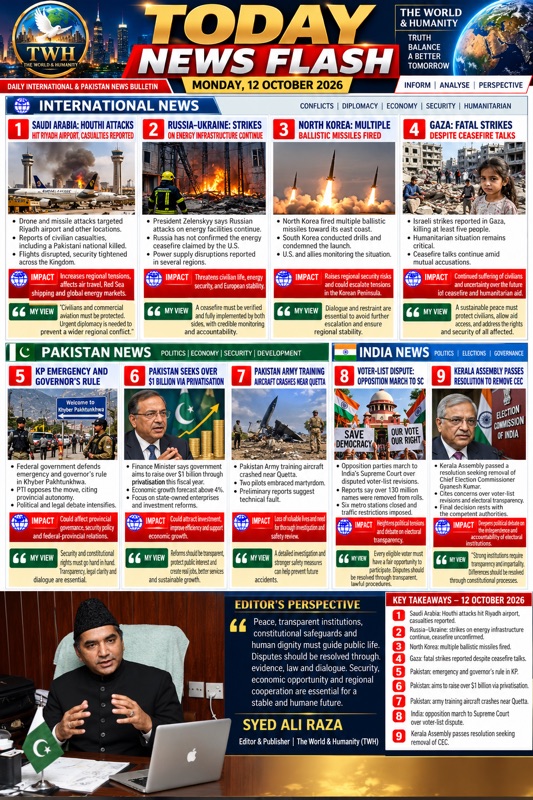
1. Saudi Arabia: Houthi Attacks Force Riyadh Airport Closure
Saudi Arabia has extended the suspension of operations at King Khalid International Airport in Riyadh following deadly attacks attributed to Yemen’s Houthi movement. Reuters reported that Saturday’s strike killed 13 people and injured more than 300, while another attack on Sunday killed one person and injured 11. The Saudi authorities have continued safety inspections, and several international airlines have suspended or altered services. Pakistan, Saudi Arabia, Türkiye and Egypt have condemned the attacks and called for an end to hostilities. citeturn323213news32turn323213news12turn323213search2
World Impact: The attacks threaten civilian aviation, regional security and commercial shipping through the Red Sea and Bab el-Mandeb Strait. Continued disruption could also affect energy prices and international trade.
My View — Syed Ali Raza: “Civilian lives and commercial aviation must be protected. Regional powers should use diplomacy and coordinated security measures to prevent further escalation and protect innocent people.”
2. Russia–Ukraine: Uncertainty Over an Energy Ceasefire
The war between Russia and Ukraine continues to threaten civilian infrastructure and energy supplies. US President Donald Trump announced an energy ceasefire, but Ukrainian President Volodymyr Zelenskyy has said attacks on energy infrastructure are continuing. The status and implementation of any ceasefire remain uncertain, and a durable agreement would require clear commitments and effective monitoring by both sides. citeturn323213search1turn323213news29
World Impact: Continued attacks could disrupt electricity supplies, increase humanitarian needs and prolong instability across Europe.
My View: “A ceasefire must be verified and implemented by both sides. Humanitarian protection, accountability and serious negotiations are essential to building lasting peace.”
3. North Korea: Multiple Ballistic Missiles Fired
South Korea’s military reported that North Korea fired multiple ballistic missiles towards the East Sea on Monday, renewing regional security concerns. The launches followed recent missile-related activity by Pyongyang and drew attention from neighbouring countries and the United States.
World Impact: Further missile tests could heighten tensions on the Korean Peninsula and increase the risk of military miscalculation.
My View: “Security concerns should be addressed through restraint, reliable communication and diplomatic engagement. Avoiding miscalculation is in the interest of every country in the region.”
4. Gaza: Civilian Suffering and Humanitarian Concerns Continue
Reports of further deadly strikes in Gaza have renewed concerns about civilian safety and the future of ceasefire efforts. Humanitarian access, medical services, food supplies and the protection of displaced families remain central issues. Claims surrounding individual incidents should be assessed using independently verified reporting and statements from the parties involved.
World Impact: Continued violence risks deepening the humanitarian emergency and undermining efforts to achieve a sustainable settlement.
My View: “A lasting peace must protect civilians, allow humanitarian assistance and address the rights and security concerns of all affected communities. Human dignity must remain central to every diplomatic effort.”
PAKISTAN NATIONAL NEWS
5. Khyber Pakhtunkhwa: Emergency and Governor’s Rule Trigger Political Dispute
Pakistan’s federal government has imposed emergency measures and governor’s rule in Khyber Pakhtunkhwa following President Asif Ali Zardari’s approval of the federal cabinet’s recommendation. The government has cited security concerns and what it describes as shortcomings in the provincial administration’s response to militancy. The PTI has rejected the move, arguing that it undermines provincial autonomy and democratic representation. The constitutional and political implications are now central to the national debate. citeturn323213search3turn323213search25
National Impact: The decision could affect provincial administration, counterterrorism coordination and relations between federal and provincial institutions. Its implementation and duration will be closely watched.
My View: “Public safety and constitutional democracy must be protected together. Extraordinary powers require clear legal grounds, transparent oversight and respect for citizens’ rights. Political dialogue is essential to prevent further instability.”
6. Pakistan Seeks More Than $1 Billion Through Privatisation
Finance Minister Muhammad Aurangzeb has said that Pakistan is seeking to raise more than $1 billion through privatisation as the government pursues economic reform. He has also expressed the expectation that the economy could grow by more than 4% during the current fiscal year, despite risks associated with elevated oil prices. The growth figure is a government expectation, not a confirmed outcome. citeturn323213news6turn323213news4
National Impact: Successful privatisation could attract investment and improve the performance of state-owned enterprises, but outcomes will depend on transparency, sound regulation and effective implementation.
My View: “Economic reform should protect the public interest, strengthen accountability and create productive employment. Investment targets matter, but their real value lies in sustainable growth and improved living standards.”
7. Pakistan Army Training Aircraft Crashes Near Quetta
A Pakistan Army PAC MFI-17 Mushshak training aircraft crashed near Nawan Killi in Balochistan on Monday, killing both pilots, according to the military. The initial statement attributed the accident to a technical fault, although detailed findings from an investigation have not yet been published. President Asif Ali Zardari and Prime Minister Shehbaz Sharif expressed condolences to the families of the deceased. citeturn323213news33turn323213news8
National Impact: The incident highlights the importance of aviation safety, technical inspections and thorough investigations into training accidents.
My View: “A detailed and transparent safety investigation can help identify the cause, strengthen preventive measures and honour the service of those who lost their lives.”
INDIA NATIONAL NEWS
8. Voter-List Dispute: Opposition Marches Towards the Supreme Court
India’s opposition parties marched towards the Supreme Court in New Delhi on Monday to protest revisions to electoral rolls that they say have removed eligible voters. The Associated Press reported that more than 130 million names were removed during the revision process. Opposition leaders allege that the exercise could disadvantage their supporters, while the Election Commission and the ruling BJP say the process is intended to remove duplicate and ineligible entries. Police restrictions and the closure of several metro stations added to the disruption in the capital. citeturn323213news17
World Impact: Disputes over electoral rolls can weaken public confidence in democratic institutions if questions about eligibility, accuracy and transparency are not resolved through credible procedures.
My View: “Every eligible citizen should have a fair opportunity to vote. Electoral disputes should be resolved through transparent verification, independent scrutiny and lawful procedures—not political confrontation.”
9. Kerala Assembly Passes Resolution Seeking Removal of Chief Election Commissioner
The Kerala Legislative Assembly has passed a resolution seeking the removal of India’s Chief Election Commissioner, Gyanesh Kumar, amid the wider dispute over special intensive revision of voter lists. The resolution reflects concerns raised by opposition representatives about electoral transparency and voting rights. The commissioner’s removal is governed by India’s constitutional and legal framework, and the resolution does not itself determine the final outcome. citeturn323213news5turn323213news21
World Impact: The dispute has intensified national debate about the independence of electoral institutions and the safeguards needed to maintain public trust.
My View: “Election authorities must be able to demonstrate impartiality and transparency. Allegations should be examined through evidence and established constitutional procedures, with equal protection for every eligible voter.”
EDITORIAL PERSPECTIVE
By Syed Ali Raza — The World & Humanity
Today’s headlines demonstrate how conflict, political decisions and institutional trust can affect millions of people. The attacks on Saudi Arabia threaten civilian travel and international trade, the Russia–Ukraine war continues to place energy infrastructure at risk, and Gaza remains a major humanitarian concern. Meanwhile, Pakistan faces serious security and constitutional challenges, while India’s electoral dispute has intensified debate about democratic accountability.
These developments are different in their causes and legal circumstances, but they share a common need for accurate information, transparent decision-making and responsible leadership. Governments must address genuine security threats without abandoning constitutional safeguards, and political movements should pursue their objectives through peaceful and lawful means.
My Final Message
“The world needs responsible leadership, not endless cycles of retaliation and confrontation. Peace, justice, public safety and human dignity must guide both international relations and national policy. In Pakistan and India, strong institutions, transparent procedures and respect for citizens’ rights are essential to lasting stability. Across the world, diplomacy and accountability offer a more sustainable path than escalating conflict.”
SYED ALI RAZA
Editor & Publisher | The World & Humanity (TWH)
Understanding the World, Promoting Humanity.


Comments
Post a Comment