PAKISTAN’S QUEST FOR PEACE
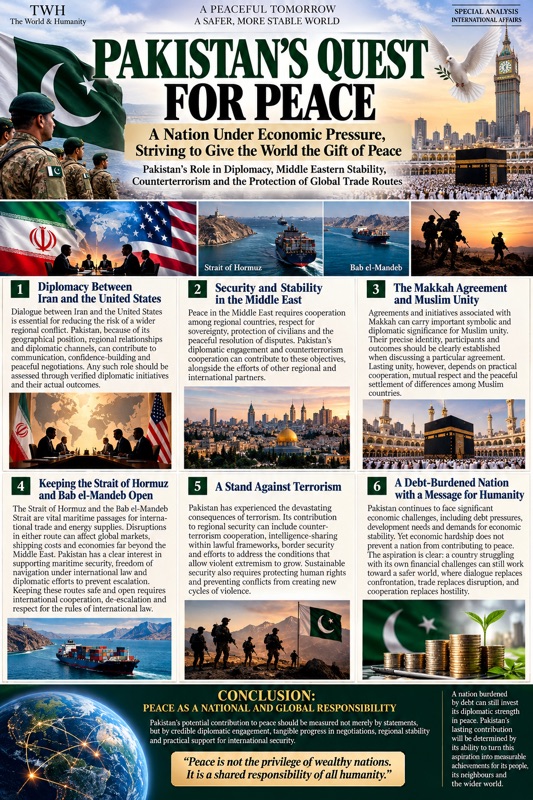
PAKISTAN’S QUEST FOR PEACE
A Nation Under Economic Pressure, Striving to Give the World the Gift of Peace
Pakistan’s Role in Diplomacy, Middle Eastern Stability, Counterterrorism and the Protection of Global Trade Routes
Pakistan occupies an important geopolitical position at a time when the Middle East faces serious security challenges and the world needs dialogue more than confrontation. Despite its economic difficulties and heavy debt burden, Pakistan has the opportunity to contribute to international peace through diplomacy, regional cooperation and responsible engagement.
Diplomacy Between Iran and the United States
Dialogue between Iran and the United States is essential for reducing the risk of a wider regional conflict. Pakistan, because of its geographical position, regional relationships and diplomatic channels, can contribute to communication, confidence-building and peaceful negotiations. Any such role should be assessed through verified diplomatic initiatives and their actual outcomes.
Security and Stability in the Middle East
Peace in the Middle East requires cooperation among regional countries, respect for sovereignty, protection of civilians and the peaceful resolution of disputes. Pakistan’s diplomatic engagement and counterterrorism cooperation can contribute to these objectives, alongside the efforts of other regional and international partners.
The Makkah Agreement and Muslim Unity
Agreements and initiatives associated with Makkah can carry important symbolic and diplomatic significance for Muslim unity. Their precise identity, participants and outcomes should be clearly established when discussing a particular agreement. Lasting unity, however, depends on practical cooperation, mutual respect and the peaceful settlement of differences among Muslim countries.
Keeping the Strait of Hormuz and Bab el-Mandeb Open
The Strait of Hormuz and the Bab el-Mandeb Strait are vital maritime passages for international trade and energy supplies. Disruptions in either route can affect global markets, shipping costs and economies far beyond the Middle East.
Pakistan has a clear interest in supporting maritime security, freedom of navigation under international law and diplomatic efforts to prevent escalation. Keeping these routes safe and open requires international cooperation, de-escalation and respect for the applicable rules of international law.
A Stand Against Terrorism
Pakistan has experienced the devastating consequences of terrorism. Its contribution to regional security can include counterterrorism cooperation, intelligence-sharing within lawful frameworks, border security and efforts to address the conditions that allow violent extremism to grow. Sustainable security also requires protecting human rights and preventing conflicts from creating new cycles of violence.
A Debt-Burdened Nation with a Message for Humanity
Pakistan continues to face significant economic challenges, including debt pressures, development needs and demands for economic stability. Yet economic hardship does not prevent a nation from contributing to peace.
The aspiration is clear: a country struggling with its own financial challenges can still work toward a safer world, where dialogue replaces confrontation, trade replaces disruption, and cooperation replaces hostility.
Conclusion: Peace as a National and Global Responsibility
Pakistan’s potential contribution to peace should be measured not merely by statements, but by credible diplomatic engagement, tangible progress in negotiations, regional stability and practical support for international security.
The message to the world is simple:
Peace is not the privilege of wealthy nations. It is a shared responsibility of all humanity.
A nation burdened by debt can still invest its diplomatic strength in peace. Pakistan’s lasting contribution will be determined by its ability to turn this aspiration into measurable achievements for its people, its neighbours and the wider world.


Comments
Post a Comment