Pakistan’s Politics of Power: Why Do We Fight to Govern Instead of Working Together to Build the Nation?
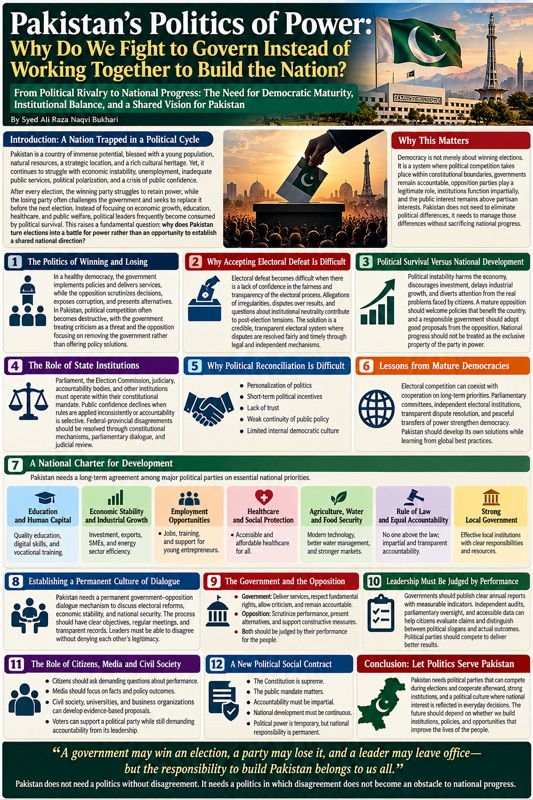
Pakistan’s Politics of Power: Why Do We Fight to Govern Instead of Working Together to Build the Nation?
From Political Rivalry to National Progress: The Need for Democratic Maturity, Institutional Balance, and a Shared Vision for Pakistan
By Syed Ali Raza Naqvi Bukhari
Introduction: A Nation Trapped in a Political Cycle
Pakistan is a country of immense potential, blessed with a young population, natural resources, agricultural strength, a strategic geographical location, a vibrant entrepreneurial community, and a rich cultural heritage. Yet, despite these advantages, the nation continues to struggle with economic instability, unemployment, inadequate public services, political polarization, and a persistent crisis of public confidence in its institutions.
One of the most troubling features of Pakistan’s political culture is the recurring confrontation that follows general elections. The party that wins struggles to retain power, while the party that loses often challenges the legitimacy of the government and seeks to replace it before the next election. Political leaders, instead of concentrating their collective energies on economic growth, education, healthcare, industrial development, and the welfare of ordinary citizens, frequently become consumed by political survival.
This raises a fundamental question:
Why does Pakistan repeatedly turn elections into a battle for power rather than an opportunity to establish a shared national direction?
Democracy is not merely the process of winning elections. It is a system of governance in which political competition operates within constitutional boundaries, governments remain accountable, opposition parties exercise their legitimate role, institutions function impartially, and the public interest remains above partisan interests.
Pakistan does not need to eliminate political differences. It needs to learn how to manage those differences without sacrificing national progress.
1. The Politics of Winning and Losing
In a healthy democracy, elections determine who receives the mandate to govern for a specified constitutional term. The winning party forms the government, while the losing parties assume the role of opposition. Both remain essential to the democratic system.
The government has the responsibility to implement policies, deliver public services, manage the economy, and fulfil its electoral commitments. The opposition has the responsibility to scrutinize government decisions, expose corruption, challenge ineffective policies, and present credible alternatives.
Unfortunately, political competition can become destructive when both sides view one another not as legitimate democratic opponents but as enemies who must be defeated at any cost.
The governing party may begin to treat criticism as an attempt to destabilize the state. Meanwhile, opposition parties may conclude that their political future depends on removing the government rather than holding it accountable through parliamentary and constitutional means.
As a result, the political system becomes trapped in a cycle of confrontation:
- The winning party focuses on protecting its government.
- The losing party focuses on bringing the government down.
- Political negotiations become instruments of short-term advantage.
- National policy becomes vulnerable to changes in political circumstances.
- Ordinary citizens continue waiting for improvements in their lives.
This approach weakens the foundations of democratic governance. A government should not be immune from criticism, and an opposition should not be expected to remain silent. However, neither side should place partisan victory above the constitutional order and the welfare of the people.
The real test of democratic leadership is not how effectively a party defeats its opponents, but how effectively it serves the people.
2. Why Do Political Parties Struggle to Accept Electoral Defeat?
Electoral defeat is a normal feature of democracy. Every political party must accept the possibility that voters may choose another party. However, accepting defeat becomes difficult when political actors lack confidence in the fairness, transparency, and independence of the electoral process.
In Pakistan, allegations of electoral irregularities, disputes over results, questions about the neutrality of institutions, and disagreements regarding political participation have repeatedly contributed to post-election tensions.
These concerns must be addressed through credible investigations, transparent electoral procedures, independent adjudication, and timely legal remedies.
There is an important distinction between challenging an election through lawful procedures and rejecting the democratic process altogether. If genuine irregularities occur, they must be investigated and corrected. If allegations are unsupported, they should not be treated as established facts.
Similarly, a government must not use its majority as justification for ignoring legitimate electoral complaints.
The solution is neither to demand unquestioning acceptance of every result nor to allow every defeated party to paralyse governance. The solution is to establish an electoral system in which citizens, candidates, and political parties have confidence that disputes will be resolved fairly.
When political parties believe that they can compete freely, challenge irregularities effectively, and seek power again through credible elections, the incentive to destabilize an existing government may diminish.
Electoral legitimacy is therefore not simply a matter of declaring results. It also depends on the credibility of the institutions and procedures through which those results are produced and challenged.
3. Political Survival Versus National Development
Pakistan’s political instability has consequences far beyond the corridors of power.
Consider the challenges facing an ordinary Pakistani family: rising living costs, limited employment opportunities, expensive education, inadequate healthcare, uncertain business conditions, and concerns about the future of its children.
These are not exclusively government problems or opposition problems. They are national problems requiring sustained attention from every political party.
When political leaders devote a disproportionate amount of their time to protests, counter-protests, political negotiations, accusations, and struggles for office, the country risks losing valuable time and policy continuity.
Investors may become reluctant to commit long-term capital when regulations, taxation policies, and economic priorities appear vulnerable to every political confrontation. Businesses may delay expansion. Industrial development can suffer from uncertainty, while skilled young people may increasingly look abroad for opportunities.
Political instability is not the only cause of Pakistan’s economic difficulties. Structural weaknesses, debt obligations, productivity challenges, external economic shocks, governance problems, and inconsistent policies also matter. Nevertheless, persistent political uncertainty can make these problems harder to address.
A nation cannot build a strong economy if every government begins by reversing its predecessor’s policies and every opposition considers the government’s failure a political achievement.
The failure of a government is ultimately a failure of public service, not a trophy for its political opponents.
A mature opposition should welcome policies that benefit the country, even when the government receives credit for them. Equally, a responsible government should be willing to adopt constructive proposals from the opposition, even when doing so strengthens its political standing.
National progress should not be treated as the exclusive property of the party in power.
4. The Role of State Institutions and the Constitution
Political instability cannot be understood solely by examining the behaviour of political parties. The wider institutional framework is equally important.
Parliament, the Election Commission, the judiciary, accountability bodies, federal and provincial governments, and other state institutions each have defined constitutional responsibilities.
Public confidence declines when citizens perceive that rules are applied inconsistently, accountability is selective, political disputes are resolved through pressure rather than transparent procedures, or constitutional boundaries are disregarded.
Allegations of institutional interference in politics must be examined on the basis of credible evidence. At the same time, the importance of institutional neutrality should not be dismissed simply because such questions are politically sensitive.
The constitutional principle should be straightforward: every institution must operate within its lawful mandate, and every public officeholder must remain accountable under the law.
The same principle applies to federal-provincial relations. Pakistan is a federation, and provincial autonomy is an essential part of its constitutional structure. Disagreements between the federal government and a provincial government should ordinarily be resolved through constitutional mechanisms, parliamentary dialogue, intergovernmental cooperation, and judicial review where necessary.
Exceptional constitutional measures must satisfy the applicable legal requirements and remain subject to the prescribed safeguards.
Neither political convenience nor institutional power should replace constitutional legitimacy.
The objective should not be to give any individual, institution, or political party unlimited authority. It should be to build a system in which authority is clearly defined, accountability is effective, and disputes can be resolved without destabilizing the country.
5. Why Is Political Reconciliation So Difficult?
Political reconciliation is often discussed in Pakistan, but sustained cooperation remains difficult for several reasons.
A. Personalization of politics
Political disagreements can become closely associated with individual leaders. Criticism of a leader may be interpreted as hostility toward the entire party, while criticism of a party may be treated as a personal attack.
This makes compromise difficult because a negotiated settlement may be portrayed as weakness or betrayal.
B. Short-term political incentives
Political parties operate under pressure to mobilize supporters, retain public attention, and prepare for the next election. Confrontation can sometimes generate greater visibility than the slow, less dramatic work of policy development.
However, political visibility and national performance are not the same thing.
C. Lack of trust
Parties may fear that compromise will be exploited by their opponents. Governments may worry that concessions will encourage further pressure, while opposition parties may believe that dialogue will merely provide political cover to the government.
Without credible rules and mutual guarantees, distrust becomes self-reinforcing.
D. Weak continuity of public policy
Long-term development requires planning beyond a single electoral term. When major policies are repeatedly abandoned or redesigned following changes in government, the benefits of earlier investments may be lost.
E. Limited internal democratic culture
Political parties themselves must demonstrate transparency, internal consultation, responsible leadership transitions, and meaningful participation by their members. A party cannot sustainably strengthen democratic institutions in the country while neglecting democratic practices within its own organization.
These challenges cannot be solved through speeches alone. They require changes in political incentives, institutional safeguards, public expectations, and leadership behaviour.
6. What Can Pakistan Learn from Mature Democratic Practices?
The purpose of examining other democratic systems should not be to assume that any foreign country offers a perfect model. Every country has its own history, institutional arrangements, and challenges.
Nevertheless, several democratic practices offer valuable lessons.
First, electoral competition can coexist with cooperation on long-term national priorities. Political parties may disagree sharply on taxation, social policy, immigration, or public spending while still maintaining continuity in essential institutions and public services.
Second, parliamentary committees can provide opportunities for cross-party scrutiny, technical debate, and negotiated improvements to legislation.
Third, independent electoral institutions and accessible legal remedies can help resolve electoral disputes without allowing them to consume the entire political system.
Fourth, transparent public reporting can make it easier for citizens to evaluate governments on measurable outcomes rather than slogans.
Finally, peaceful transfers of power help establish the principle that no party owns the state.
Pakistan should develop its own institutional solutions, suited to its constitutional structure and social realities, while learning from practices that strengthen accountability, continuity, and public trust.
7. A National Charter for Development: A Practical Way Forward
Pakistan needs a serious, long-term agreement among major political parties on essential national priorities. Such an agreement should not be a coalition designed to distribute government positions. Nor should it prevent political competition or criticism.
It should be a commitment to preserve essential national objectives regardless of which party forms the next government.
A proposed Charter for National Development could include the following priorities.
1. Education and human capital
Every government should commit to improving access to quality education, reducing the number of children excluded from schooling, strengthening teacher training, and expanding technical and vocational education.
Digital literacy, artificial intelligence, scientific research, and modern professional skills should become central components of national development.
Progress should be measured through educational participation, learning outcomes, teacher performance, and employment-related skills.
2. Economic stability and industrial growth
Pakistan needs a predictable economic environment that encourages investment, entrepreneurship, exports, and productive employment.
Political parties should seek broad agreement on improving tax administration, reducing unnecessary regulatory burdens, expanding the formal economy, supporting small and medium-sized enterprises, and improving energy-sector efficiency.
Economic policies will naturally differ between parties. However, changes should be based on evidence and transparent evaluation rather than the automatic rejection of everything introduced by a previous government.
3. Employment and opportunities for young people
Young people need more than political promises. They need access to quality education, practical training, finance for viable businesses, and opportunities to participate in the modern economy.
A national employment strategy should connect education with labour-market needs, support technology-based businesses, strengthen apprenticeships, and encourage investment in sectors capable of creating sustainable jobs.
The success of such a strategy should be measured by the quality and availability of employment, not merely by announcements of new schemes.
4. Healthcare and social protection
Access to essential healthcare, preventive medicine, maternal and child health services, and affordable treatment should remain a national priority.
Political parties should work toward stronger primary healthcare, improved hospital management, better health data, and more effective support for vulnerable households.
A citizen’s access to basic healthcare should not depend on the identity of the party governing their province.
5. Agriculture, water, and food security
Agriculture remains essential to Pakistan’s economy and social stability. Farmers need better access to modern technology, water-efficient irrigation, reliable markets, agricultural research, and storage facilities.
Federal and provincial governments should cooperate on water management, climate resilience, food security, and rural development.
Disagreements over water distribution and resource allocation must be addressed through transparent data, established legal arrangements, and sustained intergovernmental dialogue.
6. Rule of law and equal accountability
No national development strategy can succeed if citizens believe that the law operates differently for the powerful and the powerless.
Accountability must be based on evidence, due process, and consistent legal standards. Political affiliation should neither provide immunity nor become a reason for selective punishment.
Independent institutions, transparent investigations, timely judicial proceedings, and protection of fundamental rights are essential to restoring confidence.
7. Strong local government
National and provincial policies cannot fully address local problems without effective local institutions.
Municipal services, sanitation, drinking water, local roads, community facilities, and neighbourhood development require capable local governments with clearly defined responsibilities, adequate resources, and public accountability.
Empowering local government can also reduce excessive political centralization and help citizens evaluate performance more directly.
8. Establishing a Permanent Culture of Political Dialogue
A national charter will have little value if political parties only sign it during a crisis and abandon it when circumstances change.
Pakistan needs a permanent mechanism for political dialogue.
Such a mechanism could bring together representatives of government and opposition parties to discuss electoral reforms, economic stability, constitutional questions, public-sector performance, and national security within the relevant constitutional framework.
The process should have clear objectives, regular meetings, published agendas where appropriate, and transparent records of agreed actions.
It should not replace Parliament or create an unelected body with authority over constitutional institutions. Its purpose should be to facilitate cooperation within the democratic system.
Political dialogue also requires a change in language and behaviour.
Leaders must be able to disagree without denying the legitimacy of every opponent. Political criticism should focus on policies, evidence, and conduct rather than encouraging hostility against entire groups of citizens.
Compromise is not necessarily surrender. In a democracy, compromise can be an expression of responsibility when it protects public interests without sacrificing constitutional principles.
9. The Government Must Learn to Govern, and the Opposition Must Learn to Oppose
A healthy political system requires both sides to fulfil their responsibilities.
Responsibilities of the government
The government should recognize that an electoral mandate is a responsibility, not a licence to exercise unlimited power.
It must deliver public services, explain its decisions, respect fundamental rights, allow lawful criticism, and remain accountable to Parliament and the public.
It should not use state institutions to settle partisan disputes or treat every protest as an attack on the country.
It must also recognize that an opposition proposal may be valuable even when it challenges the government’s preferred approach.
Responsibilities of the opposition
The opposition must recognize that losing an election does not automatically invalidate the electoral outcome. Where credible evidence of irregularities exists, it should pursue lawful remedies.
Beyond that, the opposition should scrutinize government performance, present alternative policies, identify waste, expose wrongdoing through evidence, and contribute to legislation that benefits the public.
It should be willing to support constructive measures without surrendering its right to criticize the government.
The opposition should not measure success exclusively by the number of protests organized, the intensity of political confrontation, or the instability created for the government.
Its success should also be measured by the quality of its scrutiny, the practicality of its proposals, and the contribution it makes to better governance.
Similarly, the government should not measure success simply by completing its term. It should be judged by what it achieves for the people.
10. Political Leadership Must Be Judged by Performance
Pakistan needs a stronger culture of evidence-based public evaluation.
Governments should publish clear annual performance reports covering education, healthcare, employment, economic growth, investment, infrastructure, public debt, and service delivery.
Where possible, these reports should use consistent indicators so that citizens can compare progress across years and administrations.
Independent audit mechanisms, parliamentary committees, credible statistics, and accessible public information can help citizens distinguish between political claims and actual outcomes.
The purpose is not to turn every policy decision into a simplistic numerical score. Public policy is complex, and governments face different circumstances. Rather, the objective is to ensure that claims of success or failure can be examined against evidence.
Political parties should compete to deliver better results.
If one government improves school attendance, the next should build on that achievement. If an earlier administration develops a viable infrastructure project, its successor should evaluate the project on its merits rather than reject it merely because another party initiated it.
Continuity should not mean protecting failed policies. It should mean preserving successful initiatives, correcting weaknesses, and making decisions according to evidence.
11. The Role of Citizens, Media, and Civil Society
Political reform cannot depend entirely on political leaders. Citizens also shape the incentives under which politicians operate.
If voters reward only emotional speeches, personal loyalty, and hostility toward rival parties, political actors have fewer incentives to invest in serious policy development.
Citizens should ask more demanding questions:
- What measurable improvements has a party delivered?
- How has it addressed unemployment, education, healthcare, and inflation?
- Are its financial and governance commitments credible?
- Does it respect constitutional processes when it wins and when it loses?
- Can it explain how its policies will be funded and implemented?
The media has an important responsibility to investigate public claims, distinguish verified facts from allegations, and give meaningful attention to policy outcomes rather than focusing exclusively on political personalities and confrontations.
Civil society, professional associations, universities, business organizations, and community groups can also help develop evidence-based proposals and encourage constructive engagement across political divisions.
Citizens should not be expected to abandon their political preferences. They should, however, recognize that national interest cannot be reduced to the interests of a single party.
A voter can remain a committed supporter of a political party while demanding accountability from its leadership.
That is not disloyalty. It is responsible citizenship.
12. A New Political Social Contract for Pakistan
Pakistan requires more than temporary agreements between rival political leaders. It needs a broader understanding of the relationship between the state, political parties, institutions, and citizens.
This social contract should rest on five principles.
First: The Constitution is supreme. All political actors and state institutions must operate within constitutional boundaries.
Second: The public mandate matters. Elections must be credible, disputes must be resolved fairly, and transfers of power must follow established legal procedures.
Third: Accountability must be impartial. No individual or institution should be above the law, and no person should be denied due process because of political affiliation.
Fourth: National development must be continuous. Essential public services and long-term development objectives should not be sacrificed whenever governments change.
Fifth: Political power is temporary, but national responsibility is permanent. Every government and opposition party must recognize that its conduct affects citizens far beyond the next election.
These principles do not eliminate political competition. They create the conditions under which competition can strengthen democracy instead of undermining it.
Conclusion: Let Politics Become a Means of Serving Pakistan
Pakistan does not lack political energy. Its political history demonstrates a strong capacity for mobilization, debate, public participation, and collective action.
The challenge is to direct that energy toward constructive national purposes.
The country cannot afford a political culture in which the winning party spends its time defending its position, the losing party concentrates on removing it, and ordinary citizens bear the cost of continuous instability.
Political leaders must understand that a successful democracy is not one in which a single party remains in power indefinitely. It is one in which governments can be changed peacefully, opposition parties can perform their duties freely, institutions can function impartially, and national development continues despite changes in leadership.
Pakistan needs political parties that can compete fiercely during elections and cooperate responsibly afterward. It needs institutions that protect constitutional order, governments that deliver measurable results, and opposition parties that challenge failures while contributing to constructive solutions.
Above all, it needs a political culture in which the national interest is not merely invoked in speeches but reflected in everyday decisions.
The future of Pakistan should not depend on whether a particular leader wins or loses, whether a particular party governs or sits in opposition, or whether one political group receives credit for a successful policy.
The future should depend on whether the country builds institutions that outlast individuals, policies that survive electoral cycles, and opportunities that improve the lives of its people.
Political parties are temporary custodians of public authority. Pakistan is the permanent responsibility of all its citizens.
Let the government focus on governing, the opposition focus on constructive accountability, institutions focus on their constitutional responsibilities, and the nation focus on progress.
The ultimate objective of politics should not be to defeat one another. It should be to create a Pakistan in which every citizen has access to justice, education, healthcare, economic opportunity, dignity, and hope.
Pakistan does not need a politics without disagreement. It needs a politics in which disagreement does not become an obstacle to national progress.
That is the difference between merely competing for power and building a nation.
“A government may win an election, a party may lose it, and a leader may leave office—but the responsibility to build Pakistan belongs to us all.”


Comments
Post a Comment