Pakistan’s Education System Is Failing Its Youth: The Urgent Need for Practical, Career-Oriented Reform.
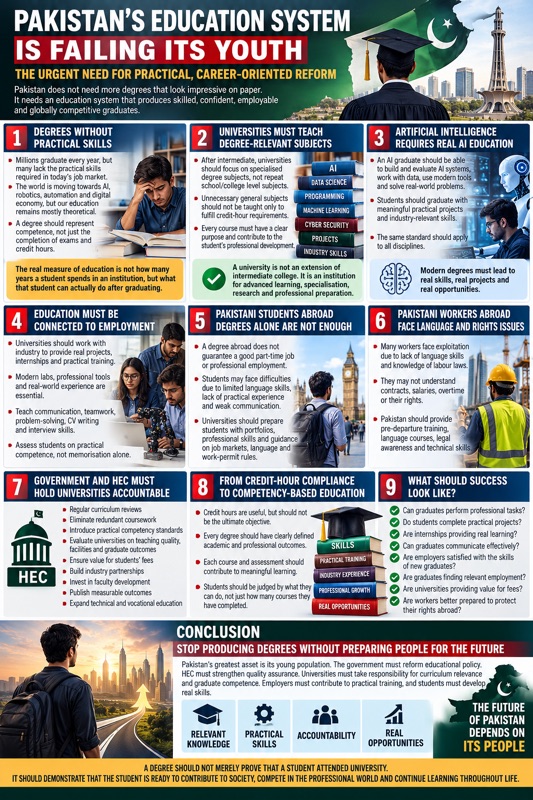
Pakistan’s Education System Is Failing Its Youth: The Urgent Need for Practical, Career-Oriented Reform
Pakistan does not need more degrees that look impressive on paper. It needs an education system that produces skilled, confident, employable, and globally competitive graduates.
1. The Fundamental Problem: Degrees Without Practical Skills
Pakistan’s education system is facing a serious structural challenge. Schools, colleges, and universities continue to educate millions of students, yet a critical question remains: are we preparing young people for the realities of modern life, the demands of the job market, and the rapidly changing global economy?
The world is moving towards artificial intelligence, robotics, automation, cybersecurity, advanced engineering, biotechnology, and digital business. Employers increasingly seek people who can solve problems, develop products, use modern technologies, communicate effectively, and deliver measurable results.
Unfortunately, many students graduate with theoretical knowledge but insufficient practical experience. They may possess a degree in a modern discipline without having developed the professional skills required to work confidently in that field.
A degree should represent competence, not merely the successful completion of examinations and credit hours.
The real measure of education is not how many years a student spends in an institution, but what that student can actually do after graduating.
2. Universities Must Teach Degree-Relevant Subjects, Not Repeat Intermediate Education
One of the most important reforms Pakistan needs is a fundamental restructuring of university curricula.
After completing intermediate education, students enter universities to pursue specialised degrees. At this stage, their education should progressively shift towards their chosen profession, advanced knowledge, practical training, research, and industry-specific skills.
However, students in many programmes continue to study general subjects that they have already encountered at school or college, sometimes because institutions need to fulfil prescribed credit-hour requirements.
General education has value, but universities must ensure that it serves a clear educational purpose rather than becoming a mechanism for filling credit hours.
For example, a student pursuing a Bachelor’s degree in Artificial Intelligence should receive rigorous training in programming, mathematics for AI, statistics, machine learning, data science, neural networks, AI ethics, and practical AI development.
The student should not have to spend unnecessary university-level time repeating material that is substantially similar to previously completed school or intermediate courses simply because it appears in a standardised curriculum.
The same principle should apply to computer science, software engineering, business, engineering, biotechnology, and other specialised disciplines.
What should change?
- Degree-relevant subjects must take priority. The majority of academic time should be devoted to the student’s chosen field, its foundations, and its professional applications.
- Unnecessary repetition must be eliminated. Universities should assess what students have already learned and avoid duplicating substantially equivalent content.
- Credit hours must reflect learning outcomes. Students should earn credits by developing knowledge and competence, not by attending classes that add little educational value.
- General education must have a clear purpose. Communication, ethics, civic awareness, and other foundational subjects should be retained where appropriate, but taught efficiently and meaningfully.
- Universities must have the freedom and responsibility to modernise curricula. Programmes should be updated in consultation with industry experts, researchers, employers, and professional bodies.
The objective is not to eliminate every general subject. It is to end unnecessary repetition and ensure that each course contributes meaningfully to a student’s academic and professional development.
A university is not an extension of intermediate college. It is an institution for advanced learning, specialisation, research, and professional preparation.
3. Artificial Intelligence Requires Real Artificial Intelligence Education
Consider a student enrolled in a four-year Artificial Intelligence degree.
After completing the programme, that student should be capable of building and evaluating practical AI systems, understanding machine-learning models, working with datasets, writing code, using modern development tools, and solving real-world problems.
The student should graduate with a portfolio of meaningful projects and a clear understanding of how AI is applied in business, healthcare, manufacturing, agriculture, education, and other industries.
The same standard should apply to every specialised degree.
A software engineering graduate should know how to develop, test, document, and maintain software. An engineering graduate should have practical laboratory and design experience. A business graduate should understand financial analysis, business operations, digital tools, and decision-making.
Universities must move beyond teaching students how to pass examinations. They must teach them how to perform professional work.
4. Education Must Be Connected to Employment
A major weakness in the education-to-employment pipeline is the distance between what students learn and what employers require.
Many employers seek candidates with practical experience, communication skills, technical competence, and the ability to work in teams. Yet students may complete their degrees without adequate exposure to real professional environments.
Universities should therefore establish meaningful partnerships with companies, software houses, factories, hospitals, research centres, and other relevant organisations.
Every suitable degree programme should incorporate:
- Industry-linked projects and practical assignments.
- Internships or supervised workplace experience.
- Modern laboratories and professional software tools.
- Communication, teamwork, and problem-solving training.
- Career counselling, CV preparation, and interview practice.
- Assessments based on demonstrated competence, not memorisation alone.
Graduation should indicate that a student has met clearly defined professional learning outcomes, not merely accumulated a required number of credits.
5. Pakistani Students Abroad: Degrees Alone Do Not Guarantee Employment
Thousands of Pakistani students pursue higher education abroad in the hope of securing better career opportunities and a more stable future.
However, studying in a foreign country does not automatically guarantee a suitable part-time job or professional employment.
Students may face difficulties because of limited language proficiency, a lack of workplace experience, weak communication skills, unfamiliarity with local employment practices, or insufficient practical competence.
When a student cannot demonstrate useful skills to an employer, even a legitimate and respected degree may not be enough to secure a preferred position.
Pakistan must prepare its students for international opportunities before they leave the country.
Universities should help students develop practical portfolios, professional communication skills, interview confidence, and experience with tools used in their chosen industries.
Students intending to study abroad should also receive guidance about the language, employment rules, work-permit conditions, and labour-market expectations of their destination country.
The goal should be to ensure that Pakistani students arrive abroad prepared to compete, learn, and contribute—not merely to hold a qualification.
6. The Struggles of Pakistani Workers Abroad
The problem extends beyond university graduates.
Many Pakistani workers travel abroad for employment in construction, manufacturing, transport, hospitality, and other sectors. Their contribution is significant, but some face exploitation or workplace difficulties because they lack language proficiency, knowledge of local labour laws, or the confidence to communicate their concerns.
A worker who cannot understand an employment contract, question an incorrect salary, explain a workplace safety concern, or report unfair treatment may be placed at a disadvantage.
In some workplaces, workers also struggle to ensure that their contributions are properly recognised.
Pakistan should introduce comprehensive pre-departure training for overseas workers, including:
- Basic language training relevant to the destination country.
- Understanding employment contracts, salaries, overtime, and working hours.
- Awareness of workplace safety and legal rights.
- Guidance on reporting exploitation and accessing legal assistance.
- Technical certification and practical skills relevant to the intended occupation.
These measures would help workers protect themselves, communicate confidently, and pursue better employment opportunities.
7. The Government and HEC Must Hold Universities Accountable
The Higher Education Commission (HEC), the federal government, provincial authorities, and university administrations must recognise that educational quality cannot be measured solely by the number of institutions, degree programmes, enrolled students, or credits completed.
A modern accountability framework should evaluate what universities actually deliver.
Essential policy reforms
1. Regular curriculum reviews
Degree programmes should be reviewed at defined intervals to ensure that they reflect technological progress, industry requirements, and international professional standards.
2. Eliminate redundant coursework
Universities should identify repetitive or low-value courses, particularly where equivalent learning has already been completed at the intermediate level. Any required general education should have explicit learning objectives and appropriate academic depth.
3. Introduce practical competency standards
Each degree should specify the skills students must demonstrate before graduation. These standards should be tested through projects, practical examinations, laboratory work, research, and other appropriate assessments.
4. Strengthen university accountability
Institutions should be evaluated on teaching quality, laboratory facilities, faculty expertise, curriculum relevance, graduate competencies, student support, and employment outcomes—while recognising that employment also depends on wider economic conditions.
5. Ensure value for students’ fees
Universities charge students substantial fees, making transparency and educational quality essential. Institutions should demonstrate that their programmes provide appropriate teaching, facilities, practical learning opportunities, and meaningful academic support.
6. Build partnerships with industry
Employers and professional experts should contribute to curriculum design, internship opportunities, applied research, and the assessment of relevant professional competencies.
7. Invest in faculty development
Teachers must receive ongoing training in modern technologies, teaching methods, assessment practices, and developments within their fields.
8. Publish measurable outcomes
Universities should publish reliable information about programme costs, graduation rates, practical training opportunities, graduate employment, and the relevance of their degrees to the labour market.
9. Expand technical and vocational education
Not every student must pursue a traditional university degree. High-quality technical and vocational pathways should be available to prepare skilled workers for domestic and international employment.
8. A National Shift from Credit-Hour Compliance to Competency-Based Education
Pakistan needs to reconsider the purpose of its higher education framework.
Credit hours are a useful administrative tool, but they should not become the ultimate objective of university education.
A student should not be considered professionally prepared simply because the student has completed a prescribed number of courses. Equally, a university should not be regarded as successful simply because it has fulfilled formal curriculum requirements.
The education system should move towards a competency-based model in which every degree has clearly defined academic and professional outcomes.
For instance, an Artificial Intelligence graduate should be able to demonstrate practical AI development skills. A civil engineering graduate should demonstrate the appropriate engineering knowledge and practical competence. A business graduate should be able to apply analytical and managerial skills to realistic business problems.
The precise requirements will differ by discipline, but the principle must remain the same: every course, credit, assessment, and practical activity should contribute to meaningful learning.
Universities should be encouraged to innovate, provided they meet rigorous academic standards, professional requirements, and transparent quality-assurance criteria.
9. What Should Success Look Like?
Pakistan should judge the success of its education reforms through measurable evidence.
The government should ask:
- Can graduates perform the tasks expected in their chosen professions?
- Do students complete meaningful practical projects before graduation?
- Are internships and industry partnerships providing real learning?
- Can graduates communicate effectively in professional environments?
- Are employers satisfied with the skills of new graduates?
- Are graduates finding relevant employment or successfully creating businesses?
- Are universities providing genuine value for the fees they charge?
- Are Pakistani workers better prepared to understand their contracts and protect their rights abroad?
Reliable data should be collected and published regularly. These findings should guide curriculum reform, institutional evaluation, funding decisions, and future education policy.
Conclusion: Stop Producing Degrees Without Preparing People for the Future
Pakistan’s greatest asset is its young population. But a young population becomes an economic advantage only when people receive relevant education, practical skills, professional opportunities, and the confidence to participate in the modern economy.
The government must reform educational policy. HEC must strengthen quality assurance. Universities must take responsibility for curriculum relevance and graduate competence. Employers must contribute to practical training, and students must be encouraged to develop real skills alongside academic knowledge.
Most importantly, universities must stop treating the completion of credit hours as a substitute for meaningful education.
After intermediate education, students should enter higher education to deepen their knowledge, specialise in their chosen disciplines, conduct research, and develop professional competence. General education should remain where it provides genuine value, but unnecessary repetition must not consume time and resources that should be devoted to advanced learning.
Pakistan does not need to abandon its educational foundations. It needs to modernise them.
The country needs universities that teach relevant knowledge, develop practical skills, demand accountability, and prepare graduates for real opportunities.
A degree should not merely prove that a student attended university. It should demonstrate that the student is ready to contribute to society, compete in the professional world, and continue learning throughout life.
The future of Pakistan depends not on how many degrees it awards, but on how capable, productive, and empowered its people become.


Comments
Post a Comment