Pakistan VS India A Comprehensive Comparative Analysis of Air Power, Naval Strength, Military Exercises and Future Defence Capabilities. What
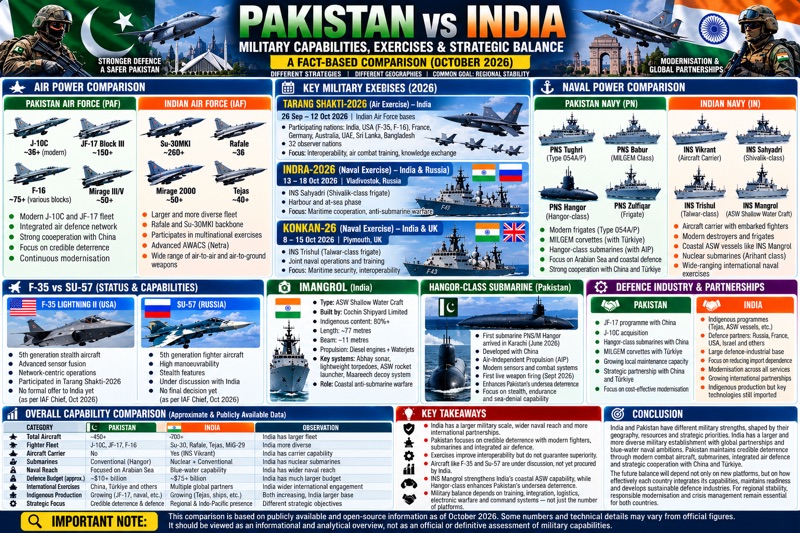
Pakistan VS India A Comprehensive Comparative Analysis of Air Power, Naval Strength, Military Exercises and Future Defence Capabilities
An assessment of regional military balance, technological modernisation, international partnerships and strategic preparedness in South Asia
Introduction
The military balance between India and Pakistan remains one of the most consequential security issues in South Asia. Both countries maintain large armed forces, modern combat aircraft, sophisticated missile systems and nuclear deterrence capabilities. However, their military strategies differ because of disparities in economic resources, geography, force structure, international partnerships and strategic priorities.
India possesses a larger overall military establishment, a broader range of defence platforms and a more extensive blue-water naval presence in the Indian Ocean. Pakistan, meanwhile, focuses on maintaining credible deterrence through a combination of modern multirole fighters, integrated air defence, missile capabilities, submarines and strategic defence cooperation, particularly with China.
Recent Indian military activities—including Exercise Tarang Shakti-2026, the India–Russia naval exercise INDRA-2026, and the India–United Kingdom exercise KONKAN-26—offer an opportunity to examine these differences. India’s INS Mangrol also highlights its investment in coastal anti-submarine warfare, while discussions surrounding the F-35 and Su-57 illustrate the importance of future combat-aircraft procurement.
The central question is not simply which country has more aircraft, ships or weapons. It is which country can most effectively integrate technology, intelligence, personnel, logistics, electronic warfare and command systems into a reliable defence architecture.
1. Exercise Tarang Shakti-2026: India’s International Air-Power Engagement
Exercise Tarang Shakti-2026, conducted by the Indian Air Force from 26 September to 12 October 2026, brought together air forces from Australia, the United States, the United Arab Emirates, France, Germany, Sri Lanka and Bangladesh. India’s Ministry of Defence also reported the participation of 32 observer nations.
Aircraft identified in the official announcement included the American F-35 Lightning II and F-16, French Rafale, Airbus A400M, aerial-refuelling aircraft and C-130 variants. The exercise provided opportunities for joint training, professional exchanges, mission planning and improved interoperability between participating forces.
For India, such exercises serve several purposes. They expose Indian personnel to different operational procedures, support professional relationships, provide experience in coordinating aircraft and support elements, and reinforce defence partnerships.
However, participation in a multinational exercise should not be confused with a formal defence alliance, the transfer of classified technology or a procurement agreement.
Comparison with Pakistan
Pakistan also conducts multinational and bilateral air exercises, maintains defence relationships with China and Türkiye, and operates combat aircraft from different origins. Its modernisation includes the J-10C and JF-17 Thunder, alongside F-16 aircraft and other legacy platforms.
The principal difference is scale and partnership structure. India has increasingly engaged with a broad range of Western, European, Middle Eastern and Indo-Pacific partners, while Pakistan’s combat-aircraft development and modernisation are particularly closely linked to Chinese cooperation.
Neither approach automatically guarantees superior combat performance. The practical value of an exercise depends on the quality of training, the realism of scenarios, the integration of sensors and command systems, and whether lessons learned are incorporated into operational procedures.
For Pakistan, the relevant objective is to ensure that its own exercises develop measurable improvements in interoperability, electronic-warfare resilience, airborne surveillance, joint mission planning and coordination between combat aircraft and ground-based systems.
2. F-35, Su-57, Rafale, J-10C and JF-17: The Future of Air Combat
Advanced combat aircraft are often compared by speed, range, weapons and manoeuvrability. Yet modern air combat depends increasingly on the quality of sensors, software, electronic warfare, secure communications, targeting information and support systems.
The F-35 and Su-57
The American F-35 is a low-observable multirole combat aircraft designed around sensor fusion and network-enabled operations. Its ability to combine information from different sensors is a major part of its intended operational value.
Russia’s Su-57 is also designed as a low-observable multirole fighter, with an emphasis on combining sensors, weapons, manoeuvrability and reduced observability. However, a reliable comparison between the two requires information about specific configurations, software, weapons, training and operational support that is not fully available publicly.
In October 2026, reporting on comments by India’s air chief indicated that no formal offer for the F-35 had been made by the US government at that time and that India had not reached a final decision on the Su-57 offer. These procurement discussions should not be interpreted as proof that either aircraft has been selected for India’s operational fleet.
India’s existing combat-aircraft structure
India operates a diverse fleet that includes Su-30MKI, Rafale, Mirage 2000, MiG-29 and Tejas aircraft. This diversity provides different capabilities but also creates demanding requirements for maintenance, spare parts, training, software support and weapons integration.
India’s future combat-aircraft choices will depend on the balance between immediate squadron requirements, domestic manufacturing ambitions, cost, technology transfer and the development of indigenous programmes.
Pakistan’s combat-aircraft modernisation
Pakistan’s air-power structure includes the J-10C, JF-17 Thunder and F-16, alongside older aircraft. The JF-17 programme is particularly significant because it gives Pakistan a platform that can be progressively developed through cooperation between Pakistan Aeronautical Complex and China’s Chengdu Aircraft Corporation.
The J-10C and JF-17 Block III are relevant to Pakistan’s modernisation because they can contribute to a broader system involving modern radars, beyond-visual-range weapons, airborne surveillance and ground-based command networks. Actual capability depends on the configuration available, training standards, weapon integration, maintenance and operational readiness.
Which side has the advantage?
India’s larger and more varied combat-aircraft inventory gives it a significant structural advantage in scale. Pakistan’s objective is not necessarily to match every Indian platform individually, but to maintain credible deterrence through a well-integrated force.
In a modern engagement, an aircraft’s effectiveness depends on the complete sequence of detection, identification, decision-making, targeting and weapon employment. Electronic warfare, airborne early warning, secure data links and pilot training can substantially influence this sequence.
Consequently, it is not responsible to declare a guaranteed winner simply by comparing the F-35, Rafale, Su-30MKI, J-10C or JF-17 in isolation.
3. Naval Power: India’s Blue-Water Reach and Pakistan’s Maritime Deterrence
India’s geographical position and wider Indian Ocean interests support a blue-water naval strategy. Its navy operates aircraft carriers, destroyers, frigates, submarines and maritime aviation assets designed to support operations beyond its immediate coastline.
Pakistan’s naval priorities are more closely linked to the Arabian Sea, protection of maritime trade, coastal security, safeguarding ports and maintaining a credible deterrent against a larger naval force.
These different missions mean that the two navies should not be assessed solely by counting ships. Their requirements, deployment patterns, operating areas and strategic objectives are not identical.
INS Sahyadri and Exercise INDRA-2026
India’s INS Sahyadri is a Shivalik-class guided-missile frigate. The ship arrived in Vladivostok, Russia, on 10 October 2026 for the bilateral naval exercise INDRA-2026, which was announced for 13–18 October.
The exercise programme included harbour and at-sea phases. Such activities can help participating crews practise communications, seamanship, coordination and operational procedures.
The exercise demonstrates continued naval engagement between India and Russia. It does not, by itself, prove the existence of a new alliance or disclose the precise readiness and performance of either navy.
INS Trishul and Exercise KONKAN-26
INS Trishul is a Talwar-class guided-missile frigate, commonly identified by pennant number F43. It should not be confused with a Shivalik-class vessel or assigned an incorrect pennant number.
The ship arrived in Plymouth, United Kingdom, for the India–UK naval exercise KONKAN-26, announced for 8–15 October 2026. The exercise provides a setting for professional engagement and coordinated naval activity between the Indian Navy and Royal Navy.
For Pakistan, the significance of these exercises lies in the broader pattern: India is using international naval relationships to develop familiarity with partner forces and reinforce its ability to operate in different maritime environments.
Pakistan also conducts international maritime exercises and has developed close defence cooperation with China and Türkiye. The meaningful comparison is the quality of training, the maturity of operational systems and the ability to sustain deployments—not merely the number of foreign ports visited.
4. INS Mangrol and Pakistan’s Undersea Challenge
INS Mangrol represents India’s investment in anti-submarine warfare in shallow and coastal waters. India’s official public announcement identifies Cochin Shipyard Limited, Kochi, as the builder and reports more than 80 per cent indigenous content.
The release lists an Abhay hull-mounted sonar, lightweight torpedoes, an indigenous anti-submarine rocket launcher and the Maareech countermeasure system. It also describes three diesel engines and waterjet propulsion.
A vessel of this type is designed for a different role from a large guided-missile frigate. It can contribute to coastal underwater surveillance, local maritime security and anti-submarine operations in littoral environments.
The vessel should be understood as part of a wider system involving ships, helicopters, maritime patrol aircraft, sensors and command networks. No single platform independently provides complete control of the underwater environment.
Pakistan’s submarine modernisation
Pakistan’s undersea capability is an important part of its maritime deterrence strategy. The Hangor-class submarine programme, developed through Pakistan–China defence cooperation, is intended to modernise Pakistan’s submarine fleet.
Pakistan’s first Hangor-class submarine, PNS/M Hangor, arrived in Karachi in June 2026. Pakistani authorities have described the platform as incorporating modern sensors, combat systems, air-independent propulsion and enhanced stealth features. In September 2026, reporting based on an ISPR announcement described the submarine’s first live weapon firing in the Arabian Sea.
These developments are significant, but the distinction between a platform’s arrival, formal induction, training, and sustained operational readiness remains important. The same standard should be applied to Indian and Pakistani equipment.
Comparative assessment
India’s coastal anti-submarine craft and larger surface combatants contribute to a layered maritime approach. Pakistan’s submarine modernisation strengthens its focus on undersea deterrence.
The two capabilities are not direct equivalents: one concerns a surface vessel designed for shallow-water anti-submarine missions, while the other concerns submarines intended for undersea operations. Their strategic relevance lies in how each contributes to its country’s broader maritime system.
For Pakistan, sustained investment in submarine maintenance, crew training, maritime surveillance and reliable command systems will be important to obtaining long-term value from its submarine programme.
5. Indigenous Defence Production and Foreign Partnerships
India’s defence industry combines domestic programmes with foreign-origin platforms and technologies. Cooperation with Russia, France, the United States, Israel and other partners has helped shape India’s current inventory, while indigenous shipbuilding and aerospace projects aim to increase domestic production.
Pakistan’s modernisation relies significantly on cooperation with China and Türkiye, alongside selected Western-origin systems. The JF-17 programme demonstrates the importance of a long-term industrial partnership that supports production, maintenance and incremental upgrades.
Both countries face similar challenges: dependence on imported engines or components, the cost of advanced electronics, access to specialist materials, software support, ammunition production and the need to keep equipment available over many years.
Domestic assembly does not automatically mean complete technological independence. A defence industry becomes strategically valuable when it can maintain equipment, manufacture essential components, train specialists, upgrade systems and support platforms during a prolonged crisis.
India has an advantage in the overall scale of its economy and defence-industrial base. Pakistan’s challenge is to direct limited resources towards programmes that deliver sustainable operational capability rather than pursuing prestige acquisitions without adequate support.
6. Command, Control, Intelligence and Electronic Warfare
Modern military power depends on more than aircraft and ships. The ability to combine intelligence, surveillance, communications, electronic warfare and command decisions can be as important as the performance of individual platforms.
For air forces, this includes airborne early-warning aircraft, ground-based radars, secure communications, data links, electronic countermeasures and coordination between combat aircraft and command centres.
For navies, it includes maritime surveillance, sonar and other underwater sensors, communications between ships and aircraft, and the ability to coordinate different platforms.
India’s larger force structure gives it greater overall resources to develop such systems, although integration across a diverse inventory remains a demanding technical and organisational task.
Pakistan’s priority is to ensure that its modern aircraft, radars, missiles, surveillance assets and command systems operate as a coherent network. The objective should be dependable information sharing, resilience under electronic attack and effective decision-making—not simply acquiring additional individual platforms.
These are broad strategic considerations. Public information does not reveal the complete performance of either country’s classified networks or wartime procedures.
7. Defence Exercises: Publicity Versus Measurable Readiness
Military exercises serve legitimate purposes, including training, deterrence, international engagement and professional development. However, the number of participating countries or the presence of a famous aircraft does not independently measure combat effectiveness.
Tarang Shakti demonstrates India’s interest in multinational air-force engagement. INDRA and KONKAN demonstrate bilateral naval cooperation. Pakistan’s own exercises, including the Pakistan Navy’s SEASPARK-2026, have emphasised readiness and coordination across maritime and other military elements.
A fair assessment should ask whether exercises improve mission planning, communications, logistics, safety, sensor integration and the ability to operate under difficult conditions. Public announcements can establish that an exercise took place, but they cannot provide a complete assessment of its classified outcomes.
Pakistan should therefore evaluate its exercises through practical lessons, professional standards and improvements in coordination. India should be assessed by the same criteria.
8. Strategic Advantages and Structural Limitations
India has important structural advantages in total military scale, economic resources, naval reach and the diversity of its international defence relationships. Its aircraft carriers, larger surface fleet and broad combat-aircraft inventory support a wider range of missions.
Pakistan has a different strategic problem: it must maintain credible deterrence while managing a substantial capability asymmetry. Its modernisation of combat aircraft, submarines, missiles and command systems is therefore closely connected to the need to preserve a reliable defensive posture.
Neither country’s advantages should be exaggerated. Large inventories require maintenance, trained personnel, logistics and sustainable budgets. Modern equipment can be constrained by limited availability, integration difficulties, supply-chain disruption or insufficient training.
Likewise, the existence of a modern aircraft or submarine does not prove that a country would prevail in a conflict. Outcomes depend on the mission, intelligence, readiness, geography, decision-making, political objectives and escalation risks.
9. Priorities for Pakistan’s Future Defence Planning
A responsible Pakistani defence-modernisation strategy should concentrate on a number of long-term priorities.
Integrated air defence: Improve the coordination of combat aircraft, airborne surveillance, ground-based radar, command systems and electronic warfare.
Sustainable combat-aircraft capability: Prioritise availability, training, maintenance, weapons integration and upgrades alongside the acquisition of new aircraft.
Maritime surveillance and undersea capability: Maintain investment in submarine readiness, maritime patrol, coastal monitoring, anti-submarine warfare and protection of sea lines of communication.
Domestic maintenance and production: Strengthen technical skills, repair facilities, supply chains and the ability to maintain essential equipment during disruptions.
Realistic training and interoperability: Measure exercises by operational learning and improved coordination rather than publicity or symbolic participation.
Financial sustainability: Consider lifetime costs, infrastructure, spare parts, training and weapons stocks before committing to expensive platforms.
These priorities are intended as high-level policy considerations, not operational instructions or predictions about the outcome of a particular military confrontation.
Conclusion: The Balance Is Determined by Systems, Not Headlines
India’s recent military exercises and naval programmes illustrate its pursuit of wider international cooperation, maritime reach and continued modernisation. Tarang Shakti-2026 demonstrates multinational air-force engagement; INDRA-2026 and KONKAN-26 highlight naval cooperation; INS Mangrol represents a dedicated coastal anti-submarine capability; and the discussion of the F-35 and Su-57 reflects India’s continuing debate about future combat-aircraft choices.
Pakistan’s modernisation, including the J-10C, JF-17 and Hangor-class submarine programme, reflects a different approach shaped by strategic geography, resource constraints and close defence cooperation with China.
India possesses clear structural advantages in overall scale and naval reach. Pakistan’s challenge is to sustain credible deterrence by integrating its available capabilities efficiently, maintaining readiness and investing in technologies that strengthen the wider defence system.
Ultimately, the military balance cannot be determined by counting aircraft, ships or missiles alone. It depends on how reliably each country connects sensors, intelligence, command and control, trained personnel, weapons and logistics.
For two nuclear-armed neighbours, the most responsible measure of defence preparedness is the ability to deter aggression, preserve national security and prevent a crisis from escalating into a catastrophic conflict. Credible defence, professional military preparedness and strategic restraint remain essential to lasting regional stability.
Selected Sources
- Indian Ministry of Defence / Press Information Bureau — Exercise Tarang Shakti-2026
https://www.pib.gov.in/PressReleasePage.aspx?PRID=2315563&lang=2®=48 - Indian Ministry of Defence — INDRA-2026 and KONKAN-26 announcements
https://www.pib.gov.in/AllRelease.aspx?lang=1®=1 - Indian Ministry of Defence — INS Mangrol
https://www.pib.gov.in/PressReleaseIframePage.aspx?PRID=2321516&lang=2®=48 - Radio Pakistan — First Hangor-class submarine arrives in Karachi, 11 June 2026
https://www.radio.gov.pk/11-06-2026/first-hangor-class-submarine-pnsm-hangor-arrives-in-karachi - Dawn — Reporting on PNS/M Hangor’s first live weapon firing, 27 September 2026
https://www.dawn.com/news/2033036/newly-inducted-hangor-class-submarine-conducts-maiden-live-weapon-firing-in-arabian-sea-ispr - The New Indian Express — Reporting on the Indian Air Force chief’s F-35 and Su-57 comments, October 2026
https://www.newindianexpress.com/india/2026/Oct/10/no-formal-f-35-offer-from-us-government-yet-to-decide-on-su-57-offer-iaf-chief
Editorial note: This article uses public information available as of 12 October 2026. Procurement discussions, announced exercise dates and induction status can change. Publicly announced specifications and claims should not be treated as a complete picture of classified capability or operational readiness.


Comments
Post a Comment