Pakistan at a Political Crossroads: A Possible Path from PTI–Government Confrontation to Reconciliation.
A/I Generated Pic
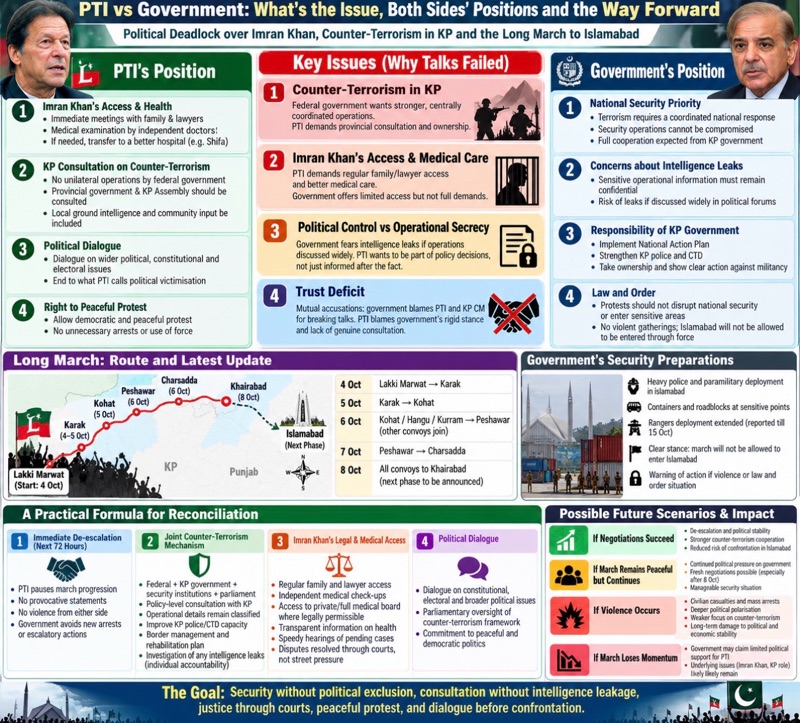 Pakistan at a Political Crossroads: A Possible Path from PTI–Government Confrontation to Reconciliation
Pakistan has entered another sensitive political phase. The Pakistan Tehreek-e-Insaf (PTI), led in this protest by Khyber Pakhtunkhwa Chief Minister Sohail Afridi, has launched a long march towards Islamabad after negotiations with the federal government failed. The immediate dispute concerns the treatment of Imran Khan, access to him and his doctors, and—most importantly—the framework for counter-terrorism operations in Khyber Pakhtunkhwa.
The confrontation is taking place at a particularly difficult time because KP is simultaneously facing a serious militancy challenge. Consequently, the political dispute should not be allowed to become a dispute over Pakistan’s national security itself.
The central disagreement
The government’s position is that terrorism requires a coordinated national response and that security operations cannot be compromised by political disagreements. Government ministers have also accused the KP government and PTI of failing to provide adequate cooperation against militancy. These are government allegations, not established facts.
PTI presents a different argument. Its position is that the federal government should not unilaterally impose or conduct security measures in KP while expecting the provincial government to accept political responsibility for them. PTI has called for meaningful consultation with the KP government.
There is actually a potentially important middle ground between these positions.
Consultation does not have to mean disclosure of operational intelligence.
A provincial government can be involved in:
- counter-terrorism policy;
- policing and CTD capacity;
- rehabilitation of affected populations;
- intelligence-sharing mechanisms;
- border-management policy;
- protection of civilians;
- post-operation governance;
while the identities of targets, timing of raids and sensitive intelligence remain restricted to authorised security personnel.
That distinction could become the foundation of a political settlement.
A proposed formula for PTI–Government reconciliation
I would suggest a “National Security + Political Reconciliation Framework” rather than either side demanding complete victory.
1. Immediate 72-hour political ceasefire
Both sides should publicly agree:
No provocative statements, no threats, no violence and no escalation while negotiations continue.
The PTI should temporarily suspend movement towards Islamabad.
The government should simultaneously suspend any new political or administrative escalation against the KP government while negotiations are taking place.
2. A five-member National Security Coordination Committee
A small committee could include:
Federal Government + KP Government + Parliament + Security institutions + Opposition
Its mandate should be specifically limited to counter-terrorism coordination.
Most importantly:
Policy information should be shared; operational intelligence should remain classified.
For example:
Assembly/Political level:
“We have decided to intensify CT operations in these districts.”
Operational level:
“Which house will be raided at 2 a.m. tomorrow” should remain restricted.
This would address the government’s legitimate concern about intelligence leaks while also addressing PTI’s demand that KP should not be treated as a passive recipient of federal decisions.
3. Independent intelligence-leak mechanism
One of the biggest concerns surrounding counter-terrorism operations is whether sensitive information can reach militants before an operation.
Therefore, instead of accusing an entire political party or ethnic community, Pakistan should establish:
A confidential joint intelligence cell
with representatives from the relevant federal and provincial security institutions.
If information is leaked, the investigation should identify the individual or network responsible, rather than blaming a political party, province or ethnic group collectively.
4. عمران خان کا معاملہ — legal route
The government should not be asked to simply release a prisoner outside the legal process.
But PTI should receive:
- reasonable access for lawyers;
- access for immediate family;
- appropriate medical examination;
- access to independent/private physicians where legally permissible;
- transparent information regarding his health;
- speedy hearings of pending legal cases.
The PTI, in return, should agree that questions concerning Khan’s conviction, bail or release will be resolved through courts and constitutional procedures, rather than through street pressure.
This is particularly relevant because access to Imran Khan was one of the major sticking points in the failed talks.
What is happening with the long march?
The march began from Gandi Chowk, Lakki Marwat, on October 4, led by KP Chief Minister Sohail Afridi. Reports say thousands of supporters joined the initial convoy.
The announced first-phase route is approximately:
Lakki Marwat → Karak → Kohat → Peshawar → Charsadda → Khairabad/Nowshera
The PTI has deliberately not disclosed the final details of the Islamabad leg. According to the announced programme, the participants are expected to consolidate at Khairabad on October 8, where the next phase will be announced.
The government, meanwhile, has increased security around Islamabad, including restrictions and Rangers deployment, and has stated that violent gatherings will not be permitted.
Therefore, October 8 could become an important political turning point, because by then the size and momentum of the march should be clearer and both sides will have another opportunity to negotiate.
What happens if negotiations resume?
The most practical formula would be:
PTI gives:
- suspension of the march;
- guarantee of peaceful protest;
- no attacks on state installations;
- cooperation with counter-terrorism institutions;
- acceptance that Imran Khan’s legal cases proceed through courts;
- no demand for political control over operational intelligence.
Government gives:
- meaningful KP participation in counter-terrorism policy;
- no unilateral political takeover of the province through the security dispute;
- guaranteed legal/family/medical access to Imran Khan;
- agreement on an independent medical mechanism;
- commitment to political dialogue;
- no unnecessary arrests or violence against peaceful protesters;
- parliamentary oversight of the broader counter-terrorism framework.
Security institutions give:
- classified operational information remains protected;
- institutional coordination with KP is strengthened;
- civilian casualties are investigated transparently;
- allegations of intelligence leaks are investigated individually and professionally.
This creates a “You don’t control our operations, and we don’t bypass your province” arrangement.
The ethnic dimension must be handled very carefully
There is an important security reality in the region: communities on both sides of the Pakistan-Afghanistan border have historical, tribal, linguistic and family connections.
But this should not become an argument that Pakistani Pashtuns or Afghan Pashtuns collectively support terrorism.
That would be both politically dangerous and analytically inaccurate.
The correct security question is:
Which individuals, networks and organisations are facilitating militants, and what evidence exists against them?
Not:
“Which ethnicity do they belong to?”
KP’s civilian population and its police personnel have themselves suffered heavily from militancy. Therefore, the province’s population should be treated as a partner in counter-terrorism rather than collectively suspected.
Possible long-term effects of the confrontation
1. If the confrontation remains peaceful
The political system could eventually be pushed toward a new dialogue mechanism between Islamabad and Peshawar.
The current crisis could therefore lead to a clearer division between:
political authority → provincial authority → operational security authority.
That could actually strengthen Pakistan’s counter-terrorism architecture.
2. If violence occurs
This would be much more serious.
A violent confrontation could produce:
PTI–government conflict → civilian casualties → arrests → further political polarisation → institutional confrontation → weaker cooperation against militancy.
At that point, the original dispute over political and constitutional issues could become secondary to a much broader security crisis.
3. If the march loses momentum
The government could argue that PTI’s street mobilisation has limited capacity.
However, that would not necessarily eliminate PTI’s political influence or resolve the underlying issues surrounding Imran Khan.
4. If the march becomes very large
The government would face a difficult choice between allowing a major demonstration near Islamabad and taking enforcement measures that could produce casualties or further political polarisation.
That is precisely why negotiations remain preferable to a physical confrontation.
The biggest lesson
Pakistan does not need a winner and loser in this dispute.
It needs a formula in which:
The government does not surrender national security.
PTI does not surrender its constitutional political rights.
KP does not lose its legitimate role in matters directly affecting its population.
The security institutions retain operational secrecy.
And Imran Khan’s legal and medical rights are protected through transparent procedures.
The failed negotiations should therefore be viewed not necessarily as the end of dialogue, but as an indication that the two sides were unable to resolve a narrow but extremely important institutional question: who decides counter-terrorism policy in KP, and who controls the operational details?
Interestingly, even a Dawn editorial published today argues that the talks came close enough to a solution that negotiations should not necessarily be abandoned.
My proposed formula in one sentence:
“Consultation without operational leakage, security without political exclusion, justice through courts, peaceful protest without violence, and dialogue before confrontation.”
That would give both sides a way to step back without either side having to publicly admit defeat—which may be the most realistic route toward de-escalation in the present situation.


Comments
Post a Comment