Pakistan and India Armed Forces.
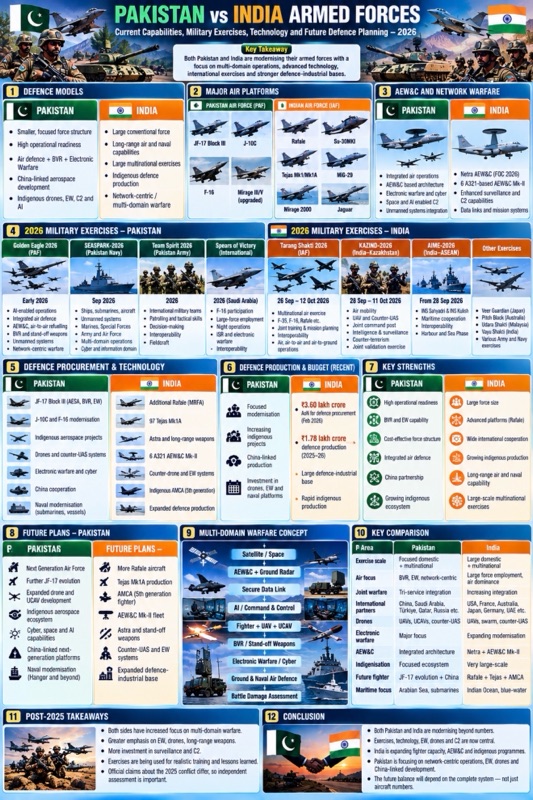
Picture A/I generated Just For Reference
Pakistan and India Armed Forces
Current Capabilities, Military Exercises, Technology and Future Defence Planning — 2026
Introduction
Pakistan and India are the two major military powers in South Asia. Because of their geographic proximity and history of conflict, both countries continuously develop their readiness, training, technology, command-and-control, and deterrence capabilities.
The 2026 situation cannot be understood simply by comparing the number of aircraft, missiles, or soldiers. Modern warfare increasingly depends on an integrated system:
Fighter aircraft + radar + AEW&C + electronic warfare + data links + missiles + air defence + drones + command-and-control + trained personnel.
1. The Basic Difference in Defence Models
🇮🇳 India
India’s defence-modernisation model is broad and large-scale:
Large conventional force
↓
Long-range air and naval capabilities
↓
Large multinational exercises
↓
Indigenous defence production
↓
Network-centric / multi-domain warfare
In February 2026, India’s Defence Acquisition Council granted Acceptance of Necessity for proposals worth approximately ₹3.60 lakh crore, including additional MRFA/Rafale capability, combat missiles and high-altitude pseudo-satellite capability for the Indian Air Force.
India is also rapidly expanding domestic defence production. India’s Ministry of Defence reported defence production of approximately ₹1.78 lakh crore during 2025–26.
🇵🇰 Pakistan
Pakistan’s model is comparatively more focused, network-centric and cost-conscious:
Smaller force structure
↓
High readiness
↓
Air defence + BVR + EW
↓
China-linked aerospace development
↓
Indigenous drones / EW / C2 / AI
The Pakistan Air Force has described its modernization direction as a transition toward a “Next Generation Air Force”, emphasizing unmanned systems, electronic warfare, space, cyber and AI-enabled capabilities.
2. Air Power — The Main Difference
India’s major fighter platforms
- Su-30MKI
- Rafale
- Tejas Mk1/Mk1A
- Mirage 2000
- MiG-29
- Jaguar
India’s major advantage is the scale and diversity of its fighter fleet.
However, operating aircraft from different origins also creates an integration challenge: different aircraft, weapons, sensors and logistics systems must increasingly operate through a common network.
This is why India is investing heavily in AEW&C, data links, electronic warfare and indigenous mission systems.
Pakistan’s major fighter platforms
- JF-17 Thunder
- J-10C
- F-16
- Upgraded Mirage III/V elements
For the PAF, modernization has focused strongly on JF-17 Block III, AESA radar, electronic warfare and BVR capability.
Pakistan’s public defence statements also increasingly emphasize indigenous kill chains, EW, cyber, space, AI and unmanned systems.
3. AEW&C and the Real Modern Air-Warfare System
This is one of the most important areas.
A modern air operation is not simply:
Fighter radar → missile
Instead, it increasingly works as:
Ground Radar
↓
AEW&C
↓
Data Link
↓
Fighter Radar / Sensors
↓
Electronic Warfare
↓
BVR Missile
↓
Battle Damage Assessment
The entire network matters.
India
India granted Final Operational Clearance to its indigenous Netra AEW&C system in June 2026.
India also contracted for six A321-based AEW&C Mk-II aircraft in 2026. These are intended to provide enhanced airborne surveillance, secure communications, situational awareness and command-and-control.
Pakistan
Pakistan is pursuing a similar direction through integrated air operations, ISR, EW, cyber, space and AI-enabled command-and-control.
PAF’s 2026 Golden Eagle exercise publicly emphasized the integration of AEW&C, air-to-air refuelling, electronic warfare, BVR weapons and unmanned systems within a network-centric framework.
4. India’s 2026 Exercise Environment
India’s exercise calendar places considerable emphasis on international interoperability.
✈️ Tarang Shakti 2026
26 September – 12 October 2026, Jodhpur
Foreign participants include:
🇦🇺 Australia
🇺🇸 United States
🇦🇪 UAE
🇫🇷 France
🇩🇪 Germany
🇱🇰 Sri Lanka
🇧🇩 Bangladesh
Publicly reported participating aircraft include:
- F-35
- F-16
- Rafale
- A400M
- MRTT
- C-130/C-130J
- KC-30A
The exercise focuses on joint training, interoperability, mission planning and operational procedures.
🇰🇿 KAZIND-2026
28 September – 11 October 2026
India and Kazakhstan are conducting this exercise with emphasis on:
- Air mobility
- UAV operations
- Counter-UAS
- Joint command posts
- Intelligence and surveillance
- Joint validation exercises
🇵🇭 AIME-2026
The ASEAN–India Maritime Exercise involves Indian Navy ships INS Sahyadri and INS Kulish.
The exercise focuses on maritime cooperation and interoperability between India and ASEAN maritime forces.
Other Indian exercises
India also participates in programmes such as:
- Veer Guardian — Japan
- Pitch Black — Australia
- Udara Shakti — Malaysia
- Vayu Shakti — India
- Various Army and Navy exercises
Pitch Black provides a multinational air-combat environment, while Udara Shakti provides tactical interaction between Indian and Malaysian combat aircraft.
5. Pakistan’s 2026 Exercise Environment
Pakistan also uses exercises as a means of validating operational readiness rather than simply conducting routine training.
🇵🇰 PAF Golden Eagle 2026
Publicly described elements include:
- AI-enabled operations
- Network-centric warfare
- Integrated Air Defence
- Cyber
- Space
- Electromagnetic-spectrum operations
- AEW&C
- Air-to-air refuelling
- BVR weapons
- Stand-off weapons
- Unmanned systems
- Manned-unmanned teaming
This reflects the PAF’s emphasis on an integrated kill chain.
⚓ SEASPARK-2026
Pakistan Navy’s major maritime exercise brings together:
- Ships
- Submarines
- Aircraft
- Unmanned systems
- Marines
- Special Forces
- Army
- Air Force
The exercise focuses on maritime + air + land + cyber + information-domain integration within a multi-domain operational framework.
🪖 Pakistan Army Team Spirit 2026
This international military competition focuses on:
- Patrolling
- Tactical skills
- Decision-making
- Interoperability
- Fieldcraft
International teams participate alongside Pakistani military personnel.
🌍 International air exercises
Pakistan also participates in international exercises such as Spears of Victory, including F-16 Block-52 participation and training involving large-force employment, night operations, ISR and electronic-warfare environments.
6. The Most Important Change After 2025: Multi-Domain Warfare
The public statements and exercises of both countries indicate a major shift.
The older concept:
Fighter vs Fighter
is increasingly becoming:
Sensor → Data → EW → Command → Missile → Drone → Air Defence → Assessment
A fighter aircraft will increasingly operate as part of a larger network rather than independently.
7. India’s Future Planning
India’s publicly announced programmes indicate several major future directions.
① Additional Rafale capability
India’s 2026 procurement process for MRFA/Rafale represents an effort to expand advanced multirole fighter capability and strengthen long-range air operations.
② Tejas Mk1A
India has moved forward with procurement of 97 Tejas Mk1A aircraft, strengthening its indigenous fighter fleet.
③ Astra and long-range weapons
India continues development and procurement of the Astra family and other stand-off/precision weapons.
④ AEW&C Mk-II
The six-aircraft A321-based AEW&C Mk-II programme is particularly important for India’s future airborne surveillance and battle-management architecture.
⑤ Counter-drone and EW
India is also expanding counter-UAS and electronic-warfare capabilities, including systems intended to detect, disrupt and counter unmanned threats.
⑥ AMCA
India’s long-term objective includes the indigenous Advanced Medium Combat Aircraft (AMCA), intended as a next-generation fighter programme.
8. Pakistan’s Future Planning
Pakistan’s public defence statements indicate several major directions.
① Next Generation Air Force
The PAF has publicly linked its modernization to its transition toward a Next Generation Air Force.
② JF-17 Block III
Key areas include:
- AESA radar
- Improved avionics
- Electronic warfare
- BVR capability
- Improved mission systems
③ Indigenous Aerospace Development
Pakistan’s National Aerospace Science & Technology Park and related initiatives are intended to expand indigenous aerospace research, development and production.
④ Drones
Pakistan is increasingly developing a domestic unmanned-systems ecosystem, including UAVs and counter-UAS technologies.
⑤ China Cooperation
Pakistan continues defence-industrial and aerospace cooperation with China, particularly around fighter development, production and related technologies.
⑥ Naval Modernisation
Pakistan Navy’s long-term modernisation includes submarine development, surface vessels, maritime aviation and unmanned maritime capabilities.
9. Exercise Comparison
|
Area |
🇮🇳 India |
🇵🇰 Pakistan |
|
Exercise scale |
Large domestic + multinational exercises |
Focused domestic + multinational exercises |
|
Air focus |
Large Force Employment, air dominance, interoperability |
BVR, EW, network-centric operations, integrated air defence |
|
Joint warfare |
Increasing Army-Navy-Air Force integration |
Strong emphasis on tri-service integration |
|
International partners |
USA, France, Australia, Japan, Germany, UAE and others |
China, Saudi Arabia, Türkiye, Qatar, Russia, Oman, USA and others |
|
Drones |
UAVs, swarm systems, counter-UAS |
UAVs, UCAVs, loitering systems, counter-UAS |
|
Electronic warfare |
Fighter and ground-based EW modernisation |
Major component of PAF’s multi-domain kill chain |
|
AEW&C |
Netra + AEW&C Mk-II |
Integrated air-operations/AEW&C architecture |
|
Indigenisation |
Very large-scale defence-industrial programme |
Focused aerospace, EW and UAS ecosystem |
|
Future fighter |
Rafale + Tejas + AMCA |
JF-17 evolution + China-linked next-generation development |
|
Maritime focus |
Indian Ocean / blue-water capability |
Arabian Sea / regional and submarine-centric capability |
10. How Should the 2025 Conflict Be Interpreted?
This requires caution.
India and Pakistan presented significantly different official narratives about the 2025 conflict. Pakistan made claims regarding Indian aircraft and air-defence losses, while India emphasized its own operational achievements and defence preparedness.
Therefore, claims from either side should not automatically be treated as an independent assessment of the battlefield outcome.
However, one broader trend is visible in the 2026 programmes of both countries:
Multi-domain warfare, electronic warfare, drones, long-range weapons, surveillance and command-and-control have all received increased attention.
11. Where Is the Real Competition?
The future competition is unlikely to be simply:
Rafale vs J-10C
or
Su-30MKI vs JF-17
The more important competition will be:
Sensor vs Sensor
Who detects the other side first?
Network vs Network
Who can distribute information faster and more reliably?
EW vs EW
Who can protect their own systems while disrupting the opponent’s electromagnetic operations?
BVR vs BVR
Which side has the stronger combination of missile, targeting, guidance and sensor integration?
Air Defence vs Stand-off Weapons
Which side has the more resilient layered system?
Human + AI + Drone
Which side can integrate manned and unmanned systems more effectively?
Training vs Training
Which side can conduct more realistic exercises and convert lessons learned into improvements?
12. The Future Battlefield
Based on publicly announced programmes, the future architecture is increasingly moving toward:
Satellite / Space
↓
AEW&C + Ground Radar
↓
Secure Data Link
↓
AI / Command & Control
↓
Fighter + UAV + UCAV
↓
BVR / Stand-off Weapons
↓
Electronic Warfare / Cyber
↓
Ground & Naval Air Defence
↓
Battle Damage Assessment
This represents a transition from platform-centric warfare toward “system-of-systems” warfare.
Conclusion
In 2026, both Pakistan and India are modernising their armed forces beyond simply increasing the number of aircraft, missiles or ships.
India’s major direction
Large defence-industrial base + expanded fighter capacity + Rafale + Tejas + AEW&C Mk-II + long-range weapons + multinational exercises + indigenous AMCA/technology.
Pakistan’s major direction
Focused air power + JF-17/J-10C + BVR/EW + indigenous kill-chain + drones/AI/cyber/space + China-linked aerospace cooperation + high-tempo exercises.
Their exercise programmes reflect this broader transformation.
India is using exercises such as Tarang Shakti, Pitch Black, Veer Guardian, KAZIND and AIME to strengthen interoperability across different partners and domains.
Pakistan is using exercises such as Golden Eagle, SEASPARK and international air exercises to develop multi-domain integration, network-centric operations and operational readiness.
Therefore, the future Pakistan–India military balance cannot be understood from aircraft numbers alone.
The more meaningful comparison is:
Aircraft + Sensors + AEW&C + EW + Data Links + Missiles + Drones + Air Defence + Training + Logistics + Command-and-Control.


Comments
Post a Comment