NO MORE WASEEM ABBAS
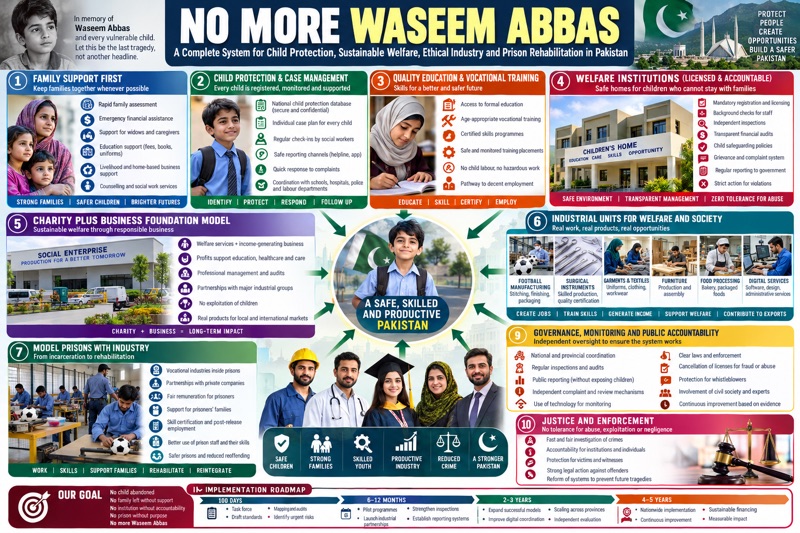
NO MORE WASEEM ABBAS
A National Blueprint for Child Protection, Self-Sustaining Welfare, Ethical Industry and Prison Rehabilitation in Pakistan
A Policy and Systems Reform Proposal
Every child deserves protection. Every vulnerable family deserves dignity. Every institution entrusted with public trust must be accountable.
1. Introduction: When a Child Entrusted to Our Care Dies
The death of 15-year-old Muhammad Waseem Abbas in Multan is a painful reminder of the failures that can occur when vulnerable children are placed in institutions that are expected to protect them.
According to news reports published on October 20, 2026, Waseem was living in an orphanage when he was sent to learn electrical work under a contractor. Police said the teenager attempted to leave the workplace before he was allegedly chased and struck by a car in Multan’s Royal Orchard housing society. CCTV footage reportedly showed the boy running before the vehicle struck him. Authorities subsequently investigated the circumstances surrounding his placement, alleged mistreatment and death. Geo News and The Express Tribune.
This case must be treated as more than an individual criminal investigation. It should prompt a comprehensive examination of how Pakistan protects children who have lost their parents, how charitable institutions are regulated, how children enter vocational training and who remains accountable when a child is exposed to danger.
The criminal allegations must be established through lawful investigation and due process. Nevertheless, the broader policy lesson is clear: a child who enters a welfare institution must never lose the protection, dignity and rights that every other child deserves.
No child should have to depend on luck to remain safe.
Pakistan needs a system in which child protection, family support, education, vocational development, responsible business and institutional accountability work together.
This proposal presents a practical framework for building that system.
2. The Root Problem: Poverty, Institutional Dependence and Weak Accountability
When a family’s principal earner dies, the consequences can extend far beyond the immediate loss.
A widow may be unable to support several children. Relatives may lack the resources to provide adequate care. Children may leave school, enter unsafe employment or be placed in residential institutions because their families have no realistic alternatives.
Orphanages and charitable organisations can provide essential services. Many are established and managed by people who genuinely want to help. However, charitable intentions alone cannot guarantee professional standards, financial integrity or child safety.
Risks arise when institutions lack adequate funding, trained personnel, independent oversight, transparent accounts or enforceable safeguarding procedures.
The same problem can occur when children are sent to private employers for training without a documented placement agreement, verified working conditions, effective supervision or a reliable way to report abuse.
The solution is not to abolish charitable institutions or assume that every institution is abusive. It is to build a regulatory and economic system in which responsible organisations can thrive and negligent or exploitative organisations cannot hide behind charitable status.
3. The First Principle: Support Families Before Institutionalising Children
The first priority should be to prevent unnecessary family separation.
Losing a father or mother should not automatically mean losing a home, a school or a normal childhood.
Pakistan should establish a structured Family Preservation and Support Programme for vulnerable households.
Key measures
A. Rapid family assessment
When a child’s parent dies or a family enters severe financial hardship, trained social workers should assess the household’s income, housing, education, safety and care arrangements.
B. Emergency financial assistance
Eligible families should receive time-limited emergency assistance followed, where necessary, by a longer-term support plan.
C. Education protection
School fees where applicable, uniforms, books, transport and essential educational expenses should be covered through targeted support.
D. Livelihood support for surviving parents
Widows and other caregivers should have access to employment services, vocational training, home-based enterprises, childcare support and suitable microenterprise opportunities.
E. Family-based alternative care
When a child cannot safely remain with a parent, authorities should assess suitable relatives, foster care or other family-based arrangements before considering residential care, subject to the child’s best interests and applicable law.
F. Individual case management
Every child receiving public or charitable protection should have a confidential case file, an identified social worker, a care plan and periodic reviews.
The objective is straightforward: help families remain together whenever this is safe and appropriate.
4. A National Licensing and Accountability System for Welfare Institutions
Every organisation caring for children must meet clear, enforceable standards.
Pakistan should strengthen a risk-based licensing framework covering public, private, charitable and religious residential care providers, with requirements adapted to the relevant provincial and territorial laws.
Mandatory registration and operating standards
Every licensed institution should have:
- Verified ownership, governance and management information.
- Background checks and suitability assessments for staff and relevant volunteers.
- Adequate sleeping arrangements, food, sanitation, healthcare and educational access.
- A written child safeguarding policy and a designated safeguarding officer.
- Rules governing contact with employers, outside visitors and other third parties.
- Confidential complaint mechanisms accessible to children.
- Documented procedures for missing children, suspected abuse and emergencies.
- Independent financial audits and transparent reporting of donations and expenditure.
- Unannounced inspections by authorised independent oversight personnel.
- A child-specific care plan and an appropriate process for family contact and reunification.
A transparent licensing system
The public should be able to verify whether an institution is registered, when it was last inspected, whether its licence is current and whether formal enforcement action has been taken.
Sensitive information about children must never be published.
Institutions that fail to meet standards should receive corrective orders where appropriate. Serious or repeated violations should lead to suspension, cancellation or other lawful sanctions.
Where an institution must close, children must be transferred through a professionally managed safeguarding process. They must not simply be abandoned or moved without assessment.
Who should be allowed to establish a welfare institution?
Your proposed model rightly emphasises institutional capacity and accountability. Large industrial groups, established foundations, universities, hospitals and professionally managed charitable organisations could be encouraged to establish or support licensed institutions.
However, size alone must not determine eligibility. A small, competent charity should not be excluded merely because it lacks a corporate sponsor.
The proper test should be whether an organisation can demonstrate financial sustainability, competent governance, safe care and compliance with the law.
5. The Charity Plus Business Foundation Model
Traditional charitable organisations frequently depend on donations, grants and individual benefactors. These remain important sources of support, but excessive dependence on irregular donations can make essential services financially fragile.
Pakistan should encourage a new model: the Charity Plus Business Foundation.
Under this model, a charitable organisation operates a professionally managed, income-generating enterprise whose legally permitted surplus supports its social mission.
The foundation is not a business that uses charity to improve its reputation. It is a social-purpose organisation that uses responsible business activity to finance lasting public benefit.
How the model would work
A foundation would maintain two clearly separated functions:
The welfare function
Responsible for child protection, education, housing, healthcare, family support and safeguarding.
The commercial function
Responsible for production, sales, procurement, employment, customer service, business planning and financial performance.
Separate accounts, independent audits, conflict-of-interest controls and transparent financial reporting would prevent commercial activities from obscuring the use of charitable resources.
The enterprise should not be permitted to use children as a source of cheap labour or make their basic needs dependent on business profitability.
Potential industries
|
Industry |
Potential activities |
Social benefit |
|
Football manufacturing |
Cutting, stitching, finishing and packaging |
Employment and vocational pathways |
|
Surgical instruments |
Suitable manufacturing, finishing, inspection and packaging processes |
Skilled employment and export opportunities |
|
Garments and textiles |
Uniforms, clothing and workwear |
Employment and commercial contracts |
|
Furniture |
Assembly, repair and production |
Technical training and local employment |
|
Digital services |
Software, graphic design and administrative services |
Skilled careers for young adults |
|
Food processing |
Bakery products, catering and packaged foods |
Local employment and enterprise development |
|
Agriculture |
Nurseries, horticulture and suitable agricultural activities |
Food production and rural livelihoods |
|
Technical services |
Electrical, solar and equipment maintenance |
Practical skills and self-employment |
Pakistan’s established football and surgical-instrument industries, particularly around Sialkot, provide potential partners for carefully designed vocational and social-enterprise programmes.
However, each proposed enterprise must be assessed for market demand, investment requirements, production costs, safety, quality certification and the availability of genuine buyers.
How profits should be used
After operating expenses, taxes, contractual obligations and necessary reinvestment, distributable surplus could be allocated to:
- Child welfare and family support.
- Education and vocational scholarships.
- Business expansion and additional employment.
- Emergency reserves and long-term financial sustainability.
The precise allocation should be determined by the institution’s financial position, governing documents and applicable law.
A charity should never promise that a business will finance all welfare expenses before its commercial viability has been demonstrated.
6. Ethical Industrial Partnerships with Major Business Groups
Large industrial groups can contribute more than donations.
They possess production expertise, supply chains, technology, managerial experience and access to domestic and international markets.
The government should create a framework through which qualified businesses can partner with licensed foundations.
Responsibilities of participating companies
A participating company could:
- Finance machinery and workplace improvements.
- Provide technical instructors and recognised vocational qualifications.
- Guarantee minimum purchase volumes through transparent contracts where commercially feasible.
- Provide apprenticeships and employment pathways for eligible adults and graduates.
- Support independent audits and occupational safety assessments.
- Publish the social outcomes of its investment.
Responsibilities of the foundation
The foundation would provide appropriately equipped facilities, trained staff, accountable governance and a legally compliant workforce.
Commercial decisions should remain separate from decisions about a child’s care.
Corporate participation must not provide an industrial group with control over children’s personal information, unrestricted access to residents or permission to use a welfare institution as an unregulated production site.
7. Modern Model Prisons: From Incarceration to Rehabilitation
Pakistan should also examine whether selected prisons can be transformed into modern correctional and vocational centres.
Prisons already incur substantial costs for security, administration, accommodation and basic services. Where legally permitted and operationally appropriate, organised vocational production could create skills, structured activities and opportunities for eligible prisoners to contribute financially to their families.
The purpose must be rehabilitation, not the exploitation of people who are unable to leave the institution freely.
The proposed prison-industry partnership
A qualified private company would provide suitable machinery, raw materials, instructors, production specifications and confirmed commercial orders.
The prison administration would retain responsibility for lawful custody, security and institutional management.
Independent oversight would examine working conditions, remuneration, safety, complaints and the treatment of prisoners.
Possible industries include:
- Football stitching and related finishing work.
- Garment production and uniforms.
- Furniture assembly and woodworking.
- Packaging and suitable light manufacturing.
- Maintenance, repair and technical trades.
- Other safe production activities supported by genuine market demand.
Surgical-instrument work should be introduced only where the facility, training, supervision and quality requirements justify it. Hazardous processes must not be assigned to unqualified prisoners.
A fair remuneration framework
Prison work must not be treated as a source of unrestricted cheap labour.
A transparent system should establish remuneration, hours, safety standards, deductions where legally permitted, grievance procedures and the distribution of earnings in accordance with applicable law.
Subject to the law and the prisoner’s informed agreement where required, earnings could be divided among:
- Personal spending within authorised rules.
- Voluntary support for dependants.
- Savings for release and reintegration.
- Other lawful obligations.
No family contribution should be imposed arbitrarily, and no prisoner should lose access to essential food, healthcare or legal rights because of an inability to work.
Supporting prison staff and their families
Correctional officers and other prison employees also have families and financial responsibilities.
Industrial programmes may create additional professional roles in training, maintenance, quality assurance, inventory management and production supervision.
Such duties should be formally authorised, appropriately compensated and separated from ordinary salary entitlements. Commercial revenue must not become an informal source of payments or personal benefits for prison officials.
Rehabilitation after release
A prison factory is only one part of rehabilitation.
Every participating prisoner should, where appropriate, receive a release plan that may include recognised skills certification, identity documentation, employment referrals, counselling, family reintegration and assistance accessing lawful employment.
The success of a prison-industry programme should be measured by safety, skills acquired, financial transparency, employment after release and reduced reoffending—not simply by the quantity of goods produced.
8. Preventing Exploitation in Child Vocational Training
The circumstances reported in Waseem Abbas’s case make this issue particularly urgent.
Vocational training can improve a young person’s future, but sending a vulnerable child to a private employer without adequate safeguards can expose that child to abuse, exploitation and unsafe work.
Pakistan needs a formal Child Vocational Placement Protocol.
Before any placement, the responsible authority should establish:
- The child’s age and eligibility under applicable labour and education laws.
- The identity and suitability of the employer.
- The precise nature of the training and the permitted tasks.
- A written agreement identifying responsibilities and supervision.
- The child’s safe accommodation and transport arrangements, where relevant.
- A named caseworker who maintains contact with the child.
- A confidential means for the child to report mistreatment.
- Immediate withdrawal procedures if the placement becomes unsafe.
Residential-care institutions must not hand children over informally to contractors, employers or private individuals.
Children must never be required to remain in a workplace where they feel threatened, abused or unsafe.
A child reporting mistreatment must receive protection and an independent assessment, not punishment for attempting to leave.
Education must come first
Vocational training for children must be age-appropriate, lawful, safe and compatible with education.
Commercial production targets must never determine a child’s access to food, shelter, schooling or protection.
Hazardous machinery and dangerous industrial processes must remain inaccessible to children.
The aim is to prepare young people for decent employment when they are legally eligible—not to create a captive workforce.
9. A National Child Protection Information and Referral System
Pakistan should develop a coordinated child protection system that connects institutions, schools, hospitals, police, labour departments, social workers and authorised welfare organisations.
The system should not become a public database of vulnerable children. Personal information must be protected and access restricted to authorised professionals.
Core functions
A. Verified case management
Every child at risk should have a responsible caseworker and an up-to-date protection plan.
B. Safe reporting
Children, teachers, relatives, staff and members of the public should be able to report suspected abuse through confidential, accessible channels.
C. Rapid response
Credible allegations of serious harm should trigger prompt risk assessment, appropriate protective action and referral to the relevant authorities.
D. Inter-agency coordination
Child protection agencies, police, labour inspectors and healthcare professionals should have clear responsibilities and secure procedures for sharing necessary information.
E. Independent investigation
Complaints involving an institution’s management must not be investigated solely by that same management.
F. Public accountability
Authorities should publish anonymised information on inspections, complaints, enforcement actions and outcomes, without compromising children’s privacy or ongoing investigations.
Punjab’s Child Protection Policy, approved in June 2025, provides an existing policy foundation for coordinated action across departments. UNICEF’s reporting on the policy also identified gaps in the availability of district-level child protection services. Implementation, staffing, resources and measurable enforcement should therefore be central priorities. UNICEF Pakistan.
10. Financial Transparency: Ending the Misuse of Charity
Charitable giving must remain a source of public trust.
The government should strengthen oversight to distinguish legitimate fundraising from fraud, financial abuse and the personal enrichment of people entrusted with charitable resources.
Every registered foundation should maintain:
- A dedicated institutional bank account.
- Properly documented donations and expenditure.
- Annual financial statements and independent audits appropriate to its size and risk.
- Disclosure of related-party transactions.
- A written policy governing executive remuneration and administrative costs.
- Procurement procedures and controls against conflicts of interest.
- Accessible complaint and whistleblower channels.
- A published annual impact report.
Administrative expenditure should be assessed in context. Paying qualified staff, maintaining secure facilities and employing professional accountants are legitimate costs; the objective is to prevent waste, fraud and undisclosed personal benefit, not to penalise necessary professional management.
Serious financial misconduct should result in proportionate legal action, restitution where appropriate, and the suspension or cancellation of licences in accordance with due process.
Where a foundation’s licence is cancelled, authorities must protect the children and other vulnerable people who depend on it.
11. Governance: Who Should Run the System?
A successful model requires cooperation between government, industry and civil society, with clear separation of responsibilities.
Federal government
The federal government should support national coordination, relevant legislation, labour protections, human-rights standards, skills recognition and industrial development within its constitutional and legal responsibilities.
Provincial governments
Provincial authorities should lead implementation of relevant child protection, social welfare, labour inspection and prison programmes under their jurisdiction.
Independent regulators
Authorised regulators should license institutions, conduct inspections, investigate compliance failures and publish enforcement information.
Industrial partners
Businesses should supply expertise, equipment, training, employment pathways and commercial opportunities under transparent agreements.
Civil society
Independent charities, child rights organisations, universities, professional associations and community organisations should help improve service quality, provide oversight and represent the interests of vulnerable people.
Independent complaints and review mechanisms
Children, families, workers and prisoners should have safe channels to raise concerns. Complaints must be capable of reaching authorities independent of the institution concerned.
No industrial group, government official or charitable organisation should be allowed to regulate its own performance without independent scrutiny.
12. Implementation Roadmap: From Proposal to National Reform
The system should be introduced through evidence-based pilot programmes rather than a single nationwide restructuring without adequate preparation.
Phase One: First 100 Days
- Establish a multidisciplinary policy task force.
- Map registered residential child-care institutions and identify regulatory gaps.
- Review existing complaints, inspection arrangements and referral pathways.
- Audit current prison industries, facilities, contracts and training capacity.
- Consult affected children, families, former residents, prisoners, correctional staff, charities and industrial partners.
- Draft minimum safeguarding standards and transparent licensing requirements.
- Identify immediate safety risks requiring urgent intervention.
Phase Two: Months 4–12
- Pilot a family support programme in selected districts.
- Strengthen inspections and case management in selected child-care institutions.
- Establish a carefully supervised industrial partnership with a licensed foundation.
- Pilot one prison-industry programme with a qualified manufacturer.
- Create independent reporting and complaints procedures.
- Introduce financial monitoring and clear remuneration rules.
- Commission independent evaluations before expanding the programmes.
Phase Three: Years 2–3
- Expand successful programmes to additional districts and prisons.
- Establish regional vocational and social-enterprise partnerships.
- Develop recognised training and employment pathways.
- Improve digital coordination among authorised child protection agencies.
- Introduce periodic independent performance reviews.
- Revise the model according to evidence, costs, outcomes and lessons learned.
Phase Four: Years 4–5
Subject to independent evaluation, extend effective models across Pakistan through agreements with provincial governments and other relevant authorities.
Expansion should depend on demonstrable improvements in safety, service quality, financial sustainability and rehabilitation.
13. How Success Should Be Measured
The government must not judge this initiative by the number of factories opened, the amount of money collected or the number of institutions registered.
The central question is whether vulnerable people are safer and better able to build independent lives.
|
Area |
Proposed performance indicators |
|
Child protection |
Safeguarding compliance, response times and independently reviewed complaint outcomes |
|
Family support |
Families stabilised and children safely maintained or reunited with family where appropriate |
|
Education |
Attendance, retention and completion |
|
Vocational training |
Qualifications gained and transitions into lawful, suitable employment |
|
Welfare enterprises |
Operating sustainability, audited accounts and surplus reinvested in the social mission |
|
Prison industries |
Safe working conditions, fair remuneration, skills gained and post-release employment |
|
Staff welfare |
Training, workplace safety and authorised compensation for additional responsibilities |
|
Public accountability |
Timely audits, inspection coverage and resolution of substantiated violations |
|
Long-term outcomes |
Improved wellbeing, stable livelihoods and reduced repeat offending where reliably measurable |
All indicators should be defined consistently, independently verified and published in aggregate form. Institutions must never be encouraged to conceal abuse merely to protect their performance ratings.
14. Financing the National Programme
A realistic financing strategy should combine several sources rather than relying on one funding stream.
Potential sources include:
- Federal and provincial budget allocations.
- Regulated charitable donations.
- Corporate social responsibility funding.
- Philanthropic endowments.
- Competitive grants and development partnerships.
- Commercial income from viable social enterprises.
- Lawful industrial contracts for prison vocational programmes.
Each funding source should have clearly defined terms, transparent reporting and independent oversight.
Public money should be allocated according to demonstrated need and performance. Charitable donations should remain traceable, and commercial income should not be treated as guaranteed revenue before actual costs and market demand are established.
A dedicated feasibility study should estimate the capital investment, staffing requirements, operating expenses and expected social outcomes of each pilot project.
15. A Special Justice Review of the Waseem Abbas Case
The immediate case must remain subject to lawful investigation, independent scrutiny and due process.
News reports published on October 21, 2026, stated that the principal suspect had reportedly died in an alleged police encounter after an apparent escape from custody, while authorities also investigated the orphanage’s handling of the boy’s placement. The reported circumstances of the suspect’s death, custody and escape raise separate questions that should be examined independently of the original allegations. Geo News and HUM News English.
The case therefore requires several distinct lines of accountability:
The death itself: Establish the facts, preserve evidence, identify all relevant participants and pursue the case according to law.
The placement decision: Determine who authorised the placement, what safeguards existed and whether applicable child protection and labour requirements were followed.
The institution’s conduct: Independently assess supervision, complaints, staff actions and compliance with its legal obligations.
The police process: Examine the reported escape from custody and the subsequent encounter through a credible, independent and legally appropriate process.
The family’s rights: Keep the family informed through lawful channels, protect its dignity and provide access to available legal and support services.
The death of an accused person must not automatically close every question surrounding the case. Equally, allegations against other people must not be treated as proven without evidence and due process.
Waseem’s case should inform systemic reform without compromising the integrity of any ongoing investigation.
16. The Moral Foundation: Protecting People Without Exploiting Them
The proposed system rests on a fundamental principle: vulnerable people must never become instruments for somebody else’s profit.
Children need safety, education and a secure path to adulthood.
Widows and struggling families need opportunities to earn a living without being forced to surrender their children’s care.
Charitable organisations need a realistic path to financial sustainability, but they must remain accountable.
Businesses should be encouraged to invest in social development, but commercial objectives must never override human rights.
Prisoners should have opportunities to learn, work and support their families under lawful and fair conditions, without being treated as disposable labour.
Government departments must be judged not only by the policies they announce but by the protection they actually deliver.
A responsible welfare system does not ask a child to repay society for receiving food and shelter. It invests in that child’s future.
A responsible prison system does not measure rehabilitation by production alone. It prepares people to return to society with skills, stability and a better chance of living lawfully.
A responsible charity does not depend indefinitely on public sympathy. It builds transparent, sustainable institutions that use resources effectively and protect those in their care.
Conclusion: No More Waseem Abbas
Waseem Abbas’s death should not be reduced to a headline that disappears when public attention moves elsewhere.
It should become a catalyst for a lasting reform agenda.
Pakistan has the people, industrial capabilities, charitable traditions and professional expertise to build a more effective system. What is needed is coordinated implementation, sustainable financing, independent oversight and the political will to enforce clear standards.
The country must move beyond a model in which vulnerable families are left to survive through informal charity and residential institutions operate with inconsistent oversight.
It must build a model that combines family support, safe alternative care, professional welfare management, ethical business, meaningful vocational training and rehabilitative prison industries.
The measure of success will not be how many institutions claim to serve the poor. It will be whether a child can safely report abuse, whether a widow can support her family, whether a charitable donation reaches its intended purpose and whether a prisoner can leave custody better prepared to live independently.
No child should be sent into an unsafe situation because an institution lacks a proper system. No family should be abandoned because poverty has removed its choices. No charitable organisation should be allowed to operate beyond accountability. And no prison should waste the opportunity to help people rebuild their lives.
Let Waseem Abbas’s name stand for a national commitment to prevention, protection, accountability and human dignity.
The objective is not simply to respond after a child dies. It is to build a system that identifies danger, intervenes early and makes such tragedies far less likely to happen again.
Selected References
- Geo News — Multan employer arrested over the alleged killing of a 15-year-old orphan, October 20, 2026.
- Geo News — Case registered against orphanage administration after Waseem Abbas’s death, October 21, 2026.
- HUM News English — Waseem Abbas case and questions surrounding the reported death of the principal suspect, October 22, 2026.
- UNICEF Pakistan — Punjab’s Child Protection Policy.
- Pakistan Ministry of Human Rights — Human Rights Legislation of Pakistan.
Note: This is a proposed policy framework, not a statement of existing law. Specific implementation measures would require legal review, consultation with relevant authorities and assessment of financial and operational feasibility. Allegations concerning the Waseem Abbas case should be distinguished from findings established through lawful proceedings.


Comments
Post a Comment