EUROPE AT A CROSSROADS: THE VOICE OF YOUTH, THE COST OF LIVING, AND THE URGENT NEED FOR REFORM
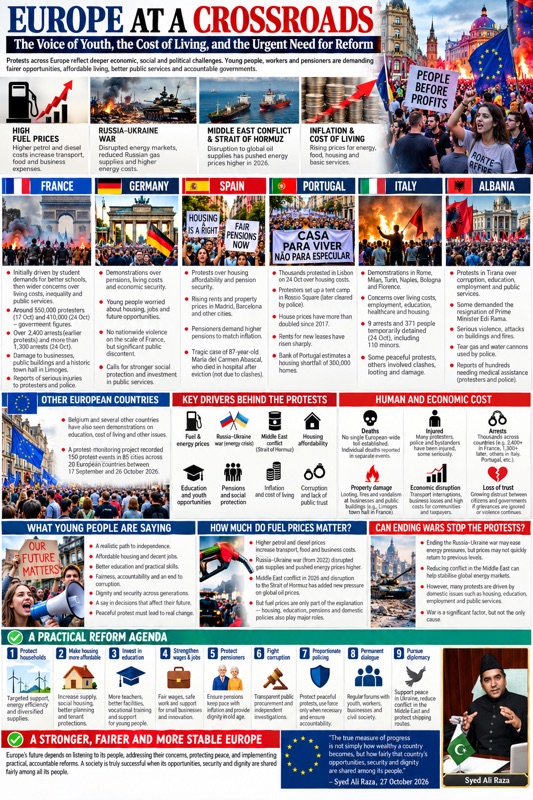
EUROPE AT A CROSSROADS: THE VOICE OF YOUTH, THE COST OF LIVING, AND THE URGENT NEED FOR REFORM
By Syed Ali Raza
An International Perspective on Social Justice, Economic Security, Peace and Responsible Governance
27 October 2026
Introduction: A Warning That Europe Must Not Ignore
Across Europe, from the streets of Paris and Barcelona to Berlin, Rome, Lisbon and Tirana, a growing wave of public demonstrations is drawing attention to a difficult question: Can economic progress truly be called success if ordinary people, particularly young people, increasingly struggle to afford a home, obtain quality education, find secure employment and build a hopeful future?
In October 2026, demonstrations across several European countries brought together students, workers, pensioners, housing activists and citizens frustrated by rising living costs and concerns about public services. Although the protests differ in their immediate causes, they reveal a shared demand for greater economic security, accountable government and a fairer distribution of opportunity.
According to recent reporting by the Associated Press, Euronews and other international media, the demonstrations have included both peaceful marches and serious episodes of violence, property damage and clashes with police. The challenge facing Europe is therefore twofold: governments must address legitimate public grievances, while protesters and political movements must protect public safety and reject violence as a substitute for democratic dialogue. [1][2]
1. France: Education, Inequality and the Cost of Living
France has emerged as one of the principal centres of the current protest movement.
The demonstrations initially gained momentum through high-school students demanding better educational facilities, sufficient teachers, smaller classes and greater investment in under-resourced schools. The movement subsequently expanded, attracting trade unions, workers and other citizens concerned about inflation, energy costs, poverty and the quality of public services.
On 17 October, the French Interior Ministry estimated that approximately 550,000 people participated in demonstrations nationwide, while organisers put the figure at around 800,000. During the following weekend, on 24 October, the government estimated participation at approximately 410,000, while organisers reported a substantially higher figure. These are separate demonstrations and should not be added together as if they represented different individuals.
The scale of the mobilisation illustrates the depth of public dissatisfaction, but it does not mean that every participant supported every demand or that every demonstration was violent.
The human and economic cost
The unrest has nevertheless carried a serious price.
French authorities reported approximately 2,400 arrests following the earlier wave of disturbances around 17 October. Subsequent reporting described more than 1,300 arrests during the demonstrations of 24 October, although figures varied as reports were updated.
The reported damage included looted businesses, damaged shops, fires at public buildings and injuries to demonstrators and security personnel. A historic town hall in Limoges suffered severe fire damage. Reports also documented serious injuries to young people during the unrest, including injuries associated with crowd-control weapons.
These incidents raise important questions about the proportionality of police force, the protection of peaceful demonstrators and the responsibility of individuals who engage in arson, assault or looting.
The French government has condemned the violence, while demonstrators and labour organisations have continued to press for improvements in education, living standards and public services. [1][2][3]
The lesson is clear: restoring public order is necessary, but order alone cannot resolve the grievances that brought people into the streets.
2. Germany: Economic Security and the Future of Young People
Germany’s experience has not been identical to France’s, and the available reporting does not establish a comparable nationwide wave of violence there.
Nevertheless, Germany has also experienced demonstrations relating to pensions, living costs and other social concerns. Young people across Europe are increasingly questioning whether their education, qualifications and future employment will provide the stability previous generations expected.
The principal concerns include the affordability of housing, the cost of living, access to secure work and confidence in public institutions.
Germany’s situation demonstrates why the European protests should not be treated as one uniform movement. Some demonstrations are driven by immediate economic pressures, while others reflect specific concerns about pensions, education, foreign policy or social protection.
The appropriate response is to identify each country’s actual problems rather than apply a single political explanation to the entire continent. [3][4]
3. Spain: Housing Affordability and the Security of Retirement
Spain’s protests have highlighted two fundamental questions: Can young people afford to live independently, and can older citizens depend on their pensions?
In Madrid, pensioners and their supporters have demanded that pensions keep pace with actual inflation, that minimum pensions provide greater security and that the public pension system be protected.
Meanwhile, housing affordability has become a major concern in Madrid, Barcelona and other urban areas. Rising property prices and rents have made it increasingly difficult for many young workers to live close to their jobs or save enough to purchase a home.
For a young person, employment is not a complete measure of economic independence if most of their salary disappears into rent and essential bills.
The housing debate also raises difficult questions about property speculation, short-term tourist accommodation, construction, housing supply and the protection of tenants. Effective reform must address the interaction of these factors rather than assume that a single measure can solve the crisis.
A tragic housing-related case has further intensified public concern. An 87-year-old woman, María del Carmen Abascal, died in hospital about two weeks after being evicted from her home. Her death became a focus of housing-rights protests. However, it should not be misrepresented as a death directly caused by the October street clashes. [3][4]
The broader lesson is that housing policy must recognise both the rights of property owners and the fundamental need for people to have secure, affordable accommodation.
4. Portugal: When Housing Becomes an Unaffordable Necessity
Portugal offers one of the clearest examples of how a social problem can become a public movement.
In Lisbon and Porto, rising housing costs have become a major source of frustration, especially for younger residents and people on ordinary salaries.
On 24 October, thousands marched in Lisbon to demand more affordable housing. Following the demonstration, protesters established a tent camp in Rossio Square to draw attention to the difficulty of finding suitable accommodation. Police subsequently cleared the camp, and reports described arrests and minor injuries.
The scale of the problem is illustrated by figures cited in recent reporting: Portuguese house prices have more than doubled since 2017, while rents for new leases have also risen dramatically. The Bank of Portugal has estimated a housing shortfall of approximately 300,000 homes. [3]
A young person interviewed during the protests expressed frustration about housing speculation, concentrated wealth and inequality. Such concerns reflect a wider fear that hard work may no longer be enough to secure an independent life.
The solution, however, must extend beyond slogans. Portugal needs a combination of increased housing construction, affordable public and social housing, better use of vacant properties, transparent planning, improved transport links and carefully designed tenant protections.
The objective should be to make housing accessible without creating policies that unnecessarily discourage the construction and maintenance of homes.
5. Italy: Wages, Public Services and Social Discontent
In Italy, demonstrations in cities including Rome, Milan, Turin, Naples, Bologna and Florence have addressed a range of concerns, including living costs, employment opportunities, education, healthcare, housing and opposition to war.
Recent reporting described arrests and temporary detentions during demonstrations on 24 October. Italian police reported nine arrests and 371 people briefly detained across eight cities, including 110 minors among those taken to police stations. These figures refer to different legal and procedural categories and should not be treated as equivalent convictions.
Some demonstrations remained peaceful, while other gatherings involved the throwing of objects, clashes with police, looting or damage to property.
The presence of young people among those involved makes it particularly important to distinguish between students expressing legitimate grievances and individuals participating in violence.
Italy’s policy challenge is to improve access to opportunity while maintaining the sustainability of its public finances. Better employment prospects, stronger vocational training, more effective public services and greater housing availability can help reduce frustration. At the same time, law enforcement must respond proportionately and consistently to violence. [1][2]
6. Albania: Corruption, Education and Public Trust
Albania’s protests have included a more explicitly political dimension.
Demonstrators in Tirana have demanded action against alleged corruption, better employment prospects, improved educational standards and greater protection for public services. Some have also called for the resignation of Prime Minister Edi Rama.
Students have raised concerns about tuition costs, educational investment and corruption within the education system. These demands have joined a broader anti-government movement.
The unrest has included serious violence, attacks on buildings, fires and confrontations involving police. Authorities have used crowd-control measures, including tear gas and water cannons, while reports have described hundreds of people requiring medical assistance across incidents involving both protesters and police.
The allegations of corruption must be investigated through credible evidence and due process rather than treated as established findings simply because they have been raised at demonstrations.
Albania’s experience demonstrates the importance of transparent public procurement, independent oversight, fair access to education and credible mechanisms for investigating allegations against officials. Where public trust is weak, even a local grievance can become part of a much wider political crisis. [1][3]
7. Belgium and Other European Countries
Belgium has also witnessed demonstrations, including student mobilisation connected with educational concerns and wider European grievances.
Beyond France, Spain, Germany, Italy, Portugal, Albania and Belgium, protests have been recorded in other European countries, although the causes and scale differ.
A protest-monitoring project, austerity.watch, reported that it had recorded 150 protest events in 85 cities across 20 European countries between 17 September and 26 October 2026. This is a record of events covered by that project, not a complete count of every protest in Europe.
The figures should therefore be interpreted as evidence of a geographically broad protest wave rather than a definitive measure of its total size or intensity. [4]
8. Are Fuel Prices and International Wars Contributing to the Crisis?
Fuel prices and international conflicts form an important part of the economic background, but their role must be understood accurately.
The Russia–Ukraine war
Russia’s full-scale invasion of Ukraine in February 2022 disrupted European energy markets. Reduced Russian gas supplies, sanctions, uncertainty about future supply and the need to find alternative sources contributed to a severe energy shock.
Higher energy costs affected electricity, heating, industrial production and household budgets. Businesses facing higher operating costs also came under pressure to raise prices, reduce expenditure or accept lower margins.
Although energy markets subsequently changed, the economic consequences did not disappear overnight. Inflation, accumulated household expenses and pressure on wages continued to affect many people.
The war is therefore an important part of the explanation for Europe’s energy insecurity, but it is not the sole explanation for the protests taking place in 2026.
The Middle East and the Strait of Hormuz
A further energy shock in 2026 has been associated with conflict in the Middle East and disruption affecting shipping through the Strait of Hormuz.
The European Central Bank has explained that disruption to this strategic route affected global oil and refined-fuel supply, contributing to higher refining margins and retail fuel prices.
When crude oil, petrol and diesel become more expensive, the consequences extend beyond motorists. Transport, agriculture, logistics and the distribution of food and other essential goods can all become more costly.
The resulting pressure can be particularly severe for households whose wages are not rising at the same rate as essential expenses. [5]
Why fuel is only part of the answer
Fuel prices can intensify public frustration, but they do not explain every protest.
France’s demonstrations have included demands for better schools and public services. Spain and Portugal have experienced strong housing-related mobilisation. Italy’s protests have included employment, healthcare and education. Albania’s demonstrations have focused heavily on alleged corruption and political accountability.
A credible analysis must recognise the interaction of international economic shocks with domestic policy decisions and long-standing social problems.
It would be misleading to blame every protest on Russia, Ukraine, the Middle East, immigration or any single political actor.
9. What Are Young People Really Saying?
Behind the crowds, arrests and television images lies a generation asking difficult questions about its future.
Young Europeans are not necessarily demanding identical policies, nor do all young people share the same political views. Nevertheless, the recent protests reveal several recurring concerns.
First, they want a realistic path to independence. Education and employment should provide a reasonable opportunity to afford housing, pay essential bills and build savings.
Second, they want education that prepares them for real life. This includes adequately staffed schools, practical skills, accessible higher education and pathways into secure employment.
Third, they want fairness and accountability. Public money should be used transparently, allegations of corruption should be investigated impartially, and political decisions should be explained openly.
Fourth, they want dignity and security across generations. Young people need opportunities to build their lives, while pensioners need protection from poverty and excessive increases in essential costs.
Fifth, they want their concerns to be heard before frustration becomes a crisis. Peaceful protest is an important democratic mechanism, but it should lead to meaningful engagement rather than endless confrontation.
The message is not that every demand made in the streets is automatically correct. It is that democratic governments should investigate the underlying problems instead of dismissing public dissatisfaction as merely a security issue.
10. The Damage: Who Ultimately Pays the Price?
When demonstrations turn violent, the consequences extend well beyond the immediate confrontation.
Human costs
Injuries to protesters, police officers, journalists and bystanders can have lasting physical, psychological and financial consequences. Serious injuries to young people are especially troubling because they can affect education, employment and future independence.
Deaths must be documented separately and accurately. The reports reviewed for this article do not establish a single, comprehensive death toll attributable to the entire European protest wave. Individual deaths connected to separate events should not be combined or attributed to the street clashes without reliable evidence.
Damage to businesses and public property
Looting, fires, vandalism and the destruction of public buildings can impose substantial costs on communities. Small businesses may lose stock, suffer interruptions to trading or face expensive repairs. Public authorities must then divert resources towards restoration, policing and emergency response.
The damage reported in France, including the severe fire damage to the historic Limoges town hall, illustrates the potential scale of these consequences.
Economic disruption
Road closures, transport interruptions, reduced business activity and heightened security measures can affect workers, customers and local economies.
The costs may ultimately be borne by taxpayers, businesses, insurance providers and ordinary residents, including people who did not participate in the protests.
Damage to trust
Perhaps the most serious long-term cost is the deterioration of trust between citizens and institutions.
If governments ignore legitimate grievances, frustration may deepen. If authorities use excessive force, confidence in law enforcement may decline. If protesters attack innocent people or destroy public property, public support for their demands may weaken.
A sustainable solution must therefore protect both the right to peaceful protest and the right of the wider public to live safely.
11. A Practical Reform Agenda: What Should Governments Do?
The answer to Europe’s challenges is neither indiscriminate repression nor acceptance of violence. It is a programme of practical, accountable and measurable reform.
1. Protect households from energy shocks
Governments should consider targeted support for low-income households, essential transport and energy-intensive small businesses when prices rise sharply.
Any temporary assistance should be transparent, affordable and directed towards those most in need. Broad subsidies that disproportionately benefit wealthier households can become expensive and difficult to sustain.
Europe should also strengthen energy efficiency, diversify reliable energy supplies, improve electricity-grid connections and accelerate economically viable clean-energy projects.
Reducing dependence on volatile fossil-fuel markets would improve resilience, although the transition must be managed in a way that protects workers and vulnerable consumers.
2. Make housing more affordable
Governments should increase the supply of homes in places where people need them, improve planning and construction processes, and expand social and affordable housing.
Policies should also address vacant properties, speculative practices and the effects of short-term rentals where these demonstrably reduce long-term housing availability.
Tenant protections can provide greater security, but they should be designed carefully alongside measures that encourage the construction and maintenance of rental housing.
The objective must be a functioning housing market in which ordinary workers, students, families and older people have realistic options.
3. Invest in education and young people
Schools need sufficient teachers, safe buildings, effective learning resources and support for students from disadvantaged backgrounds.
Governments should expand apprenticeships, technical education, vocational training and partnerships between educational institutions and employers.
Young people also need access to affordable mental-health and career guidance services, alongside opportunities to participate in decisions that affect their futures.
Education funding should be measured against outcomes, including student achievement, employment opportunities and reductions in inequality.
4. Strengthen wages and employment opportunities
Governments, employers and trade unions should work towards fair wages, safe working conditions and credible career pathways.
Policies should encourage productive investment, innovation and small-business development rather than relying exclusively on temporary assistance.
Where wage increases are necessary, their design should take account of workers’ purchasing power, business viability and the wider economic environment.
The goal should be an economy in which work provides a reasonable standard of living.
5. Protect pensioners and essential public services
Pension systems should be financially sustainable while protecting older citizens against severe losses in purchasing power.
Governments should regularly assess whether minimum pensions and targeted benefits are sufficient to cover essential needs.
Healthcare, education and other essential public services should be evaluated against measurable standards of access, quality and efficiency.
Reforms should be transparent about their costs and long-term consequences.
6. Improve accountability and fight corruption
Public procurement, infrastructure contracts and the allocation of public funds should be subject to transparent procedures and independent scrutiny.
Investigations into alleged corruption must be impartial, evidence-based and free from political interference.
Where wrongdoing is established, the law should be applied fairly, regardless of the position or political affiliation of those involved.
Citizens must have accessible channels for reporting misconduct and obtaining information about public decisions.
7. Make policing proportionate and accountable
Police must protect public safety, peaceful demonstrators, journalists, businesses and bystanders.
At the same time, individuals who commit assault, arson, looting or other offences should be investigated through lawful procedures.
The use of force should be necessary, proportionate and subject to independent review. Serious injuries associated with crowd-control weapons should receive prompt investigation, and victims should have access to appropriate medical care and legal remedies.
Governments should establish clear communication channels with protest organisers, use trained liaison officers where appropriate and avoid treating peaceful participation as evidence of criminal conduct.
8. Create permanent channels for dialogue
Rather than waiting for streets to fill with angry crowds, governments should establish regular forums involving young people, workers, students, pensioners, local businesses and civil-society organisations.
These forums should produce published commitments, clear deadlines and measurable progress reports.
For example, a government responding to student protests could publish a timetable for teacher recruitment and school repairs. A city facing a housing crisis could publish annual targets for affordable homes, completed construction and waiting-list reductions.
Dialogue becomes meaningful when citizens can see whether promises have been fulfilled.
9. Pursue diplomacy and reduce the costs of conflict
Europe should continue supporting diplomatic efforts to achieve a just and sustainable peace in Ukraine, consistent with international law and the sovereignty of states.
It should also work with international partners to reduce conflict in the Middle East, protect maritime shipping and prevent further disruptions to global energy supplies.
Diplomacy cannot eliminate every economic shock, but reducing conflict and improving energy security can help protect households and businesses from avoidable costs.
10. Measure reform by results
Governments should publish regular indicators covering housing affordability, energy poverty, youth unemployment, school staffing, purchasing power, public-service quality and progress in addressing corruption.
These measures would allow citizens to assess whether policy changes are improving everyday life.
A reform programme should be judged not by the number of announcements it produces, but by whether people can actually afford their homes, access good education, find meaningful employment and live with dignity.
12. A Shared Responsibility: Governments, Protesters and Society
Governments have a responsibility to listen, explain their decisions, protect civil liberties and address legitimate grievances.
Protest organisers have a responsibility to communicate their demands clearly, protect peaceful participants and reject attacks on innocent people.
Young people should be given meaningful opportunities to shape policy, rather than being treated only as a security concern.
Businesses should contribute to fair employment practices and responsible investment, while civil society and the media should provide accurate information and encourage constructive debate.
These responsibilities are not identical, but they are interconnected. A society cannot maintain lasting stability through force alone, and social reform cannot succeed if violence destroys the institutions and public resources needed to deliver it.
Conclusion: A Europe That Listens Can Become Stronger
The demonstrations across Europe in October 2026 should be understood as a serious warning about economic security, social expectations and public trust.
Rising fuel prices, the legacy of the Russia–Ukraine energy crisis, renewed pressure from conflict in the Middle East, housing shortages, educational concerns, pension security and allegations of corruption all contribute to the wider picture. Their importance varies from country to country, and no single explanation accounts for every protest.
The damage caused by violence is real. Injured people, damaged businesses, burned buildings and disrupted communities deserve attention and justice. Equally, the concerns that brought peaceful demonstrators into the streets deserve a serious response.
Europe’s long-term strength will depend not only on economic output, security spending or political competition, but also on whether ordinary people can build stable lives and trust that public institutions work in the public interest.
The way forward is practical reform, responsible leadership, peaceful dialogue, proportionate law enforcement and a sustained commitment to fairness.
A young person should not have to choose between education and basic living expenses. A worker should not have to work full-time and remain unable to afford secure housing. An older citizen should not have to fear poverty after a lifetime of work. And no peaceful citizen should have to fear violence for expressing a legitimate concern.
The answer to Europe’s challenges is not to silence its young people, nor to romanticise street violence. It is to build institutions that listen before frustration becomes unrest, deliver reform before trust collapses and uphold justice without abandoning compassion.
A stable society is not one in which nobody protests. It is one in which people can raise their voices peacefully, governments respond honestly, and disagreements lead to constructive change.
The true measure of progress is not simply how wealthy a country becomes, but how fairly that country’s opportunities, security and dignity are shared among its people.
— Syed Ali Raza
Selected Sources
[1] Associated Press, reporting on protests across Europe, France, Italy, Albania, Spain and Portugal, 24 October 2026.
[2] Euronews, “Protests sweep across Europe from France to Albania, Italy, Spain and Portugal,” 24 October 2026, and subsequent reporting on arrests in France.
[3] Associated Press and international reporting on the European cost-of-living, education and housing protests, October 2026.
[4] Austerity Watch, European protest-monitoring records through 26 October 2026.
[5] European Central Bank, “From well to pump: how fuel prices are formed,” 31 July 2026, discussing the effects of disruption to the Strait of Hormuz on refined-fuel prices.
Editorial note: Arrests, temporary detentions, injuries and deaths are distinct categories. Reported figures may change as investigations continue. National estimates and organisers’ estimates of protest attendance also differ. The figures in this article are attributed to their reporting periods and should not be interpreted as a complete European-wide casualty or financial-loss total.


Comments
Post a Comment