Do Pakistan’s Military-Linked Businesses Pay Taxes?
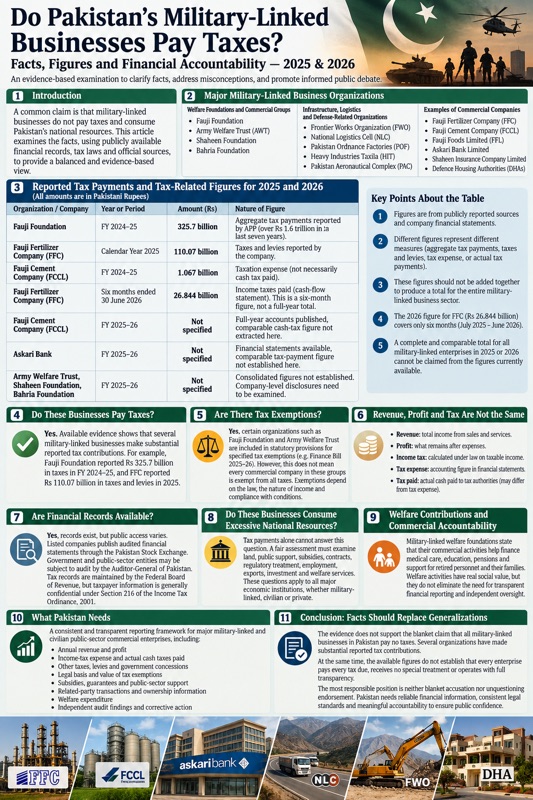
Do Pakistan’s Military-Linked Businesses Pay Taxes?
Facts, Figures and Financial Accountability — 2025 and 2026
An evidence-based examination of military-linked business enterprises, tax payments, exemptions and their contribution to Pakistan’s economy
Introduction
In Pakistan, a frequently repeated claim is that military-linked businesses do not pay taxes and that the armed forces consume the country’s national resources without making a corresponding economic contribution.
Such claims deserve examination through reliable financial records, tax legislation and independent scrutiny. Neither blanket accusations nor unquestioning acceptance of institutional claims can replace documented evidence.
Pakistan has several commercial enterprises, welfare foundations and public-sector organizations associated with the armed forces. Their activities include fertilizer production, cement, banking, insurance, energy, agriculture, logistics, construction and defense manufacturing.
The important questions are straightforward:
- Do these businesses pay taxes?
- How much tax have they reportedly paid in 2025 and 2026?
- Do any of them benefit from tax exemptions?
- Are their financial records available to the public?
- Do their contributions justify the public resources they use, and are their activities adequately scrutinized?
The available evidence shows that some military-linked businesses make substantial reported tax contributions. It also shows that tax treatment and financial disclosure differ across organizations. Both facts must be acknowledged.
1. Major Military-Linked Business Organizations in Pakistan
Pakistan has several organizations associated with the armed forces that operate in commercial, welfare or public-sector capacities.
Welfare foundations and commercial groups
- Fauji Foundation
- Army Welfare Trust (AWT)
- Shaheen Foundation
- Bahria Foundation
Infrastructure, logistics and defense-related organizations
- Frontier Works Organization (FWO)
- National Logistics Cell (NLC)
- Pakistan Ordnance Factories (POF)
- Heavy Industries Taxila (HIT)
- Pakistan Aeronautical Complex (PAC)
Examples of commercial companies associated with these business groups
- Fauji Fertilizer Company Limited (FFC)
- Fauji Cement Company Limited (FCCL)
- Fauji Foods Limited (FFL)
- Askari Bank Limited
- Shaheen Insurance Company Limited
Defence Housing Authorities also operate under their respective legal frameworks and should be examined separately from ordinary commercial companies.
These organizations are not legally identical. Some are foundations, some are incorporated companies, and others are public-sector or defense-related entities. Their ownership structures, accounting obligations and tax treatment can therefore differ.
2. Reported Tax Payments and Tax-Related Figures for 2025 and 2026
The following table brings together publicly reported figures and company financial information. It deliberately distinguishes aggregate tax contributions, taxes and levies, accounting tax expenses, and actual tax payments.
All amounts are in Pakistani rupees. One billion rupees equals 100 crore rupees.
|
Organization / company |
Year or period |
Reported amount |
Nature of figure |
|
Fauji Foundation |
FY 2024–25 |
Rs 325.7 billion |
Aggregate tax payments reported by Associated Press of Pakistan (APP). |
|
Fauji Fertilizer Company (FFC) |
Calendar year 2025 |
Rs 110.07 billion |
Taxes and levies reported by the company. |
|
Fauji Cement (FCCL) |
FY 2024–25 |
Rs 1.067 billion |
Taxation expense reported in its financial performance summary; not necessarily cash tax paid in that year. |
|
Fauji Fertilizer Company (FFC) |
Six months ended June 30, 2026 |
Rs 26.844 billion |
Income taxes paid, as reported in the half-year cash-flow statement previously identified. This is a six-month figure, not a full-year total. |
|
Fauji Cement (FCCL) |
FY 2025–26 |
Full-year accounts published |
A comparable actual cash-tax figure has not been independently extracted for this article. |
|
Askari Bank |
2025–26 |
Not independently verified here |
Company financial statements are available, but a comparable actual tax-payment figure has not been established here. |
|
Army Welfare Trust, Shaheen Foundation and Bahria Foundation |
2025–26 |
Consolidated figures not established |
Separate accounts and available company-level disclosures need to be examined. |
Sources for the reported figures:
- Fauji Foundation: Associated Press of Pakistan, January 4, 2026 — Fauji Foundation paid over Rs 1.6 trillion tax in last seven years.
https://www.app.com.pk/national/fauji-foundation-paid-over-rs-1-6-trillion-tax-in-last-seven-years/ - Fauji Fertilizer Company: Associated Press of Pakistan — FFC announces Rs 73.6 billion profit, final dividend for 2025.
https://www.app.com.pk/domestic/ffc-announces-rs-73-6-bln-profit-final-dividend-for-2025/ - Fauji Cement: Annual Report 2025.
https://fccl.com.pk/eng/wp-content/uploads/2025/05/FCCL-Annual-Report-2025.pdf - Pakistan Stock Exchange company records:
https://dps.psx.com.pk/company/FFC
https://dps.psx.com.pk/company/FCCL
How should these figures be interpreted?
The figures provide evidence that substantial tax contributions have been reported by at least some military-linked business organizations. However, they must not be added together to produce a supposed total for the entire military-linked business sector.
The Rs 325.7 billion attributed to Fauji Foundation is an aggregate reported figure. Its precise scope must be established before adding it to the taxes and levies reported by individual companies that may be associated with the same group.
Similarly, the Rs 1.067 billion reported by Fauji Cement represents a tax expense, while FFC’s Rs 26.844 billion figure concerns income taxes paid during a six-month period. These are different accounting measures.
The 2026 figure for FFC covers only the six months ended June 30, 2026. It must not be presented as the company’s full-year 2026 tax payment. The financial year 2026–27 is also still in progress as of October 18, 2026.
A complete and comparable total for all military-linked enterprises in 2025 or 2026 cannot responsibly be claimed from the figures currently established.
3. Does Every Military-Linked Business Receive a Tax Exemption?
No conclusion about every organization can be reached from the legal status of one foundation or company.
Pakistan’s Income Tax Ordinance, 2001, and its schedules establish the rules for taxation, exemptions and other concessions. Eligibility depends on the relevant law, the organization’s legal status, the nature of its income and compliance with applicable conditions.
The Finance Bill 2025–26 included Fauji Foundation and Army Welfare Trust in a statutory list relating to specified tax exemptions. That provision is relevant to the public debate, but it should not be interpreted as proof that every commercial company associated with these organizations is exempt from every tax.
The correct questions are:
- Which legal provision applies to each organization?
- Which categories of income qualify for an exemption?
- Does the exemption apply to a foundation, a subsidiary or a particular activity?
- Are the relevant legal conditions satisfied?
- What is the financial value of the exemption?
- How does the treatment compare with that of similarly situated civilian businesses?
A charitable foundation and a separately incorporated commercial company may have different tax obligations, even when they are associated with the same business group.
Official reference: Federal Board of Revenue, Finance Bill 2025–26 and Finance Act materials.
https://www.fbr.gov.pk/Budget2025-26/FinanceAct.html
4. Revenue, Profit and Tax Are Not the Same
Public debate often confuses three different financial concepts.
Revenue is the money a business generates from selling goods and services.
Profit is what remains after the relevant expenses have been deducted.
Tax is determined under the applicable law, based on taxable income, adjustments, exemptions and other relevant provisions.
A company that reports Rs 400 billion in annual revenue does not necessarily earn Rs 400 billion in profit. Nor can its tax liability be calculated simply by applying the corporate income-tax rate to its revenue.
Furthermore, an income-tax expense recorded in an annual report is not necessarily the amount of cash paid to tax authorities during that same period. Payments may relate to different assessment periods, advance taxes or adjustments.
A meaningful comparison therefore requires consistent figures for:
- Revenue and operating profit.
- Profit before tax and profit after tax.
- Income-tax expense.
- Actual tax payments during the specified period.
- Other taxes and levies.
- Legally available exemptions, credits and concessions.
Without these distinctions, financial comparisons can mislead the public.
5. Are Their Financial Records Available?
Yes, records exist in different forms, but the level of public access varies.
Listed companies generally publish audited annual financial statements and other disclosures through the Pakistan Stock Exchange. Government departments and public-sector entities may also be subject to applicable audit arrangements and reporting requirements.
The Auditor-General of Pakistan publishes audit reports for entities within its jurisdiction. The Federal Board of Revenue maintains tax records under the applicable legal framework.
However, the existence of a record does not automatically make it publicly accessible. Section 216 of the Income Tax Ordinance, 2001, generally protects taxpayer information, subject to specified legal exceptions.
Consequently, the public cannot automatically obtain every organization’s complete tax return or confidential assessment simply because the organization is commercially significant.
Useful public sources include:
- Federal Board of Revenue: https://www.fbr.gov.pk/
- Pakistan Stock Exchange: https://dps.psx.com.pk/
- Auditor-General of Pakistan: https://agp.gov.pk/
These sources can help establish a company’s reported financial performance, available tax information and published audit findings.
6. Do These Businesses Consume an Excessive Share of National Resources?
Tax payments alone cannot answer this question.
An organization may pay substantial taxes while also benefiting from government land, public infrastructure, preferential financing, subsidies, guarantees or other arrangements. Conversely, an organization may contribute to employment, exports, domestic production, investment and welfare services.
A fair assessment must examine both sides of the balance sheet.
For each major enterprise, investigators should establish, where the information is available:
- The value and terms of land and other assets acquired.
- The amount of government financial support, subsidies and guarantees.
- Whether public contracts were awarded competitively.
- Whether the business faces the same applicable regulatory and tax rules as comparable companies.
- The profits generated and how they are distributed or reinvested.
- The amount spent on welfare activities.
- The findings of independent audits and the action taken on material objections.
These questions are legitimate regardless of whether an enterprise is associated with the armed forces, a civilian government or a private business group.
The objective should be to identify facts, not to assume wrongdoing or complete institutional immunity.
7. Welfare Contributions and Commercial Accountability
Military-linked welfare foundations state that their commercial activities help finance medical care, education, pensions, scholarships and assistance for retired personnel and their families.
Such services can have real social value and should be assessed on their merits.
At the same time, welfare activities do not eliminate the need for transparent financial reporting. The public should be able to distinguish a foundation’s charitable expenditure from the commercial performance of its subsidiaries.
A useful reporting framework would identify the revenue generated by commercial businesses, their tax obligations, the value of exemptions, the amounts transferred to welfare programmes and the results of independent audits.
Transparent reporting can demonstrate the value of legitimate welfare activities while also identifying any weaknesses in governance or financial accountability.
8. What Pakistan Needs: A Consistent Standard of Accountability
A constructive reform would be to establish consistent, legally appropriate public reporting requirements for major military-linked and civilian public-sector commercial enterprises.
Where applicable, disclosures should include:
- Annual revenue and profit.
- Income-tax expense and actual cash taxes paid.
- Other taxes, levies and material government concessions.
- The legal basis and estimated value of tax exemptions.
- Subsidies, guarantees and significant public-sector support.
- Related-party transactions and ownership information where required by law.
- Welfare expenditure and transfers to charitable activities.
- Independent audit findings and corrective action.
Legitimate national-security information may require protection. But ordinary commercial financial information should not automatically be treated as secret merely because an enterprise is associated with a defense institution.
The objective is not to impose identical accounting rules on legally different organizations. It is to ensure that each organization is accountable under the rules that actually apply to it.
Conclusion: Facts Should Replace Generalizations
The available evidence does not support the blanket assertion that every military-linked business in Pakistan pays no taxes. Publicly reported tax contributions by Fauji Foundation and Fauji Fertilizer Company, together with published financial statements from companies such as Fauji Cement, demonstrate that substantial tax payments and tax-related reporting exist in parts of this business sector.
Equally, these examples do not establish that every military-linked enterprise pays every tax due, receives no special treatment or operates with sufficient transparency.
The reported figures for 2025 and the available six-month figure for 2026 are useful evidence, but they do not amount to a complete consolidated account of the entire sector. Tax exemptions, actual payments, public support and the use of national resources must be assessed organization by organization.
The most responsible conclusion is therefore neither blanket accusation nor unquestioning endorsement.
If military-linked enterprises make substantial contributions to Pakistan’s economy, independently verifiable financial records should demonstrate those contributions. If any enterprise receives preferential treatment or fails to meet its legal obligations, the same records should make that visible.
Pakistan needs a system in which military-linked, civilian public-sector and private enterprises are evaluated through reliable financial information, consistent legal standards and meaningful accountability.
Public confidence is built not by demanding that people accept claims, but by making those claims verifiable.


Comments
Post a Comment