Beyond New Provinces: A Low-Cost Governance Roadmap for Pakistan.
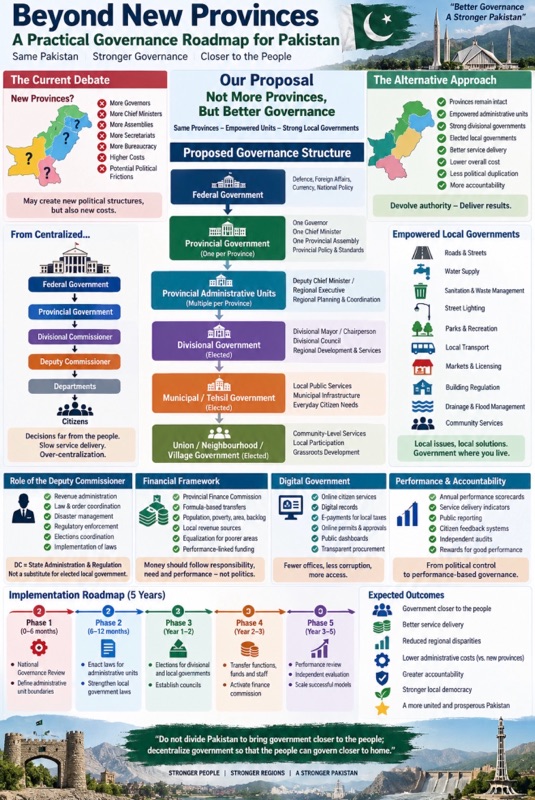 Beyond New Provinces: A Low-Cost Governance Roadmap for Pakistan
Rethinking the Debate on New Provinces
Pakistan is once again engaged in a serious debate over the creation of new provinces. The argument is understandable. Large provinces face problems of administrative distance, uneven development, concentration of power, and limited access to government services for citizens living far from provincial capitals.
However, the question we should ask is not simply:
“How many provinces should Pakistan have?”
The more important question is:
“How can government be brought closer to the people without creating unnecessary political and administrative costs?”
Creating a new province may address geographical and administrative concerns, but it also requires additional political and institutional structures—such as a separate provincial assembly, chief minister, governor, secretariat, departments and senior administrative machinery.
Pakistan should therefore consider an alternative approach:
Instead of creating more provinces, create empowered administrative units within existing provinces and build a strong, elected local-government system below them.
This can provide greater administrative access and regional autonomy without unnecessarily duplicating the entire provincial structure.
The Core Principle: Decentralize Government, Not Necessarily Provinces
The fundamental problem is not simply the size of Pakistan’s provinces. The deeper problem is the excessive concentration of decision-making authority.
If a province is divided into two or three provinces but the same concentration of power continues in the new provincial capitals, the ordinary citizen may see little real improvement.
The objective should therefore be:
Smaller administrative jurisdictions, greater delegated authority, stronger local governments and clearer accountability.
In simple terms:
Do not merely redraw boundaries. Redistribute authority.
1. One Province, Multiple Empowered Administrative Units
Existing provinces can be reorganized into several large administrative units according to:
- Population
- Geography
- Economic activity
- Infrastructure
- Service-delivery requirements
- Regional development needs
For example, Punjab could be organized into three or four major administrative units without turning them into separate provinces.
The province would continue to have:
- One Governor
- One Chief Minister
- One Provincial Assembly
- One provincial constitutional structure
At the same time, each major administrative unit could have a:
Deputy Chief Minister / Regional Executive
with clearly defined administrative and development responsibilities.
This would bring the provincial government closer to different regions without creating an entirely new provincial government for each region.
2. Deputy Chief Minister Should Have Real Institutional Authority
A Deputy Chief Minister should not become merely another political title.
The office should have clearly defined responsibilities for:
- Regional development planning
- Health coordination
- Education coordination
- Agriculture
- Irrigation
- Infrastructure
- Investment facilitation
- Regional economic development
- Coordination with local governments
These powers should be defined through legislation and Rules of Business.
The principle should be:
Authority must belong to an institution, not merely to an individual office-holder.
3. The Real Reform: From District Administration to Divisional Government
The most important part of this proposed model is the transformation of the division from a purely bureaucratic administrative boundary into an empowered level of elected government.
Pakistan should consider developing a system of:
Divisional Government
instead of relying primarily on the traditional Deputy Commissioner-centred administrative structure for local development and public service delivery.
A possible governance structure would be:
Federal Government
↓
Provincial Government
↓
Provincial Administrative Units
↓
Elected Divisional Government
↓
Municipal / Tehsil Government
↓
Union / Neighbourhood / Village Government
The division can become the strategic regional level between the province and municipalities.
4. What Should a Divisional Government Look Like?
Each division could have:
An Elected Divisional Mayor / Chairperson
and
An Elected Divisional Council
The Divisional Government could be responsible for regional functions such as:
- Regional development planning
- Major local infrastructure
- Inter-municipal transport coordination
- Regional water and drainage planning
- Waste-management coordination
- Economic development
- Public infrastructure
- Regional environmental planning
- Coordination between municipalities and local governments
The purpose would not be to create another layer of bureaucracy.
The purpose would be to create an elected regional authority that is accountable to the people of that division.
5. Redefining the Role of the Deputy Commissioner
This proposal does not require the abolition of the civil administration.
Instead, it requires a clearer separation between:
State Administration
and
Elected Local Government
The Deputy Commissioner and other civil-administration officers should continue to perform important state and regulatory functions, including:
- Revenue administration
- Disaster management
- Regulatory enforcement
- Coordination of law-and-order matters
- Elections-related responsibilities
- Implementation of federal and provincial laws
- Other statutory and regulatory functions
However, the DC should not become a substitute for elected local government.
The principle should be:
The DC represents the administrative state; elected local government represents the people.
This distinction is essential for democratic decentralization.
6. Make Local Government the Government of Everyday Life
For the ordinary citizen, government is not primarily about foreign policy, national defence or provincial legislation.
Government is about:
- Roads
- Water
- Sanitation
- Waste collection
- Street lighting
- Parks
- Local transport
- Markets
- Building regulation
- Drainage
- Local infrastructure
These matters should be handled as close to the citizen as practically possible.
A citizen should not need access to a provincial capital to solve a neighbourhood or municipal problem.
Therefore:
Local government should not be treated as an optional administrative department. It should become the principal institution for everyday public service delivery.
7. Power Must Follow Responsibility
One of the biggest weaknesses of decentralization in Pakistan has historically been the transfer of responsibilities without adequate financial and administrative authority.
Giving local governments responsibility without resources simply creates frustration.
Therefore:
Responsibility + Authority + Budget + Accountability
must move together.
If a local government is responsible for sanitation, it must have:
- A defined budget
- Staff
- Procurement authority
- Planning authority
- Revenue sources
- Performance targets
Only then can citizens hold it accountable.
8. A Strong Provincial Finance Commission
Financial decentralization should become a central part of this reform.
Provincial governments should establish effective Provincial Finance Commissions through which resources are transferred to divisional and local governments according to transparent formulas.
The formula could consider:
- Population
- Area
- Poverty
- Backwardness
- Infrastructure deficit
- Revenue effort
- Service-delivery needs
- Performance
Transfers should not depend primarily on political influence or personal relationships.
The principle should be:
Money should follow population, need, responsibility and performance—not political connections.
9. Give Local Governments Their Own Revenue Sources
Local governments cannot become genuinely effective if they depend entirely on discretionary grants.
They should therefore have clearly defined local revenue sources, such as:
- Property-related taxes
- Commercial licensing
- Parking fees
- Building approval fees
- Market fees
- Municipal service charges
- Local permits
- Other legally assigned local revenues
At the same time, poorer areas must receive equalization transfers from the provincial government.
This would create a balance between:
Local fiscal responsibility
and
National/provincial solidarity.
10. One Function, One Accountable Authority
Pakistan’s governance system often suffers because several institutions share responsibility for the same function.
When something goes wrong, each institution can blame another.
The new system should therefore adopt a simple principle:
One Function — One Clearly Accountable Authority.
For example:
|
Level of Government |
Primary Responsibility |
|
Federal |
Defence, foreign affairs, currency, national policy |
|
Province |
Legislation, provincial policy, standards and major strategic functions |
|
Administrative Unit |
Regional planning and coordination |
|
Division |
Regional development and integrated services |
|
Municipality/Tehsil |
Local public services |
|
Union/Neighbourhood/Village |
Community-level services |
The citizen should always know:
Who is responsible?
And equally importantly:
Who should be held accountable?
11. Digital Government Must Support Decentralization
Administrative decentralization should not mean creating hundreds of new offices.
It should be combined with digital government.
Services such as:
- Birth and death registration
- Property services
- Building approvals
- Local taxation
- Licences
- Complaints
- Permits
- Development tracking
- Procurement
- Budget information
should increasingly be available online.
The objective should be:
Fewer unnecessary offices, fewer intermediaries and more direct access to government.
Technology can allow Pakistan to decentralize authority without proportionally increasing administrative overhead.
12. Performance-Based Local Government
Every Divisional and Local Government should have measurable annual performance indicators.
These could include:
- School attendance
- Basic health-service availability
- Clean-water coverage
- Waste collection
- Road maintenance
- Revenue collection
- Development-project completion
- Complaint-resolution time
- Citizen satisfaction
Performance should be publicly reported.
This would gradually shift political competition from:
“Which party controls this area?”
to:
“What has this government delivered?”
That would be a major improvement in Pakistan’s democratic culture.
13. Why This Could Cost Less Than Creating New Provinces
The strongest argument for this model is not that it will cost nothing.
It will still require investment in:
- Local government institutions
- Digital systems
- Staff
- Regional planning
- Elected councils
- Service-delivery capacity
However, the objective is to avoid duplicating the complete political and constitutional structure of another province.
Instead of creating another:
- Governor
- Chief Minister
- Provincial Assembly
- Provincial Secretariat
- Full provincial departments
- Complete senior bureaucracy
the existing provincial structure can remain intact while administrative and financial authority is distributed downward.
Therefore:
The objective should be to decentralize existing resources rather than continuously create new layers of government.
14. Constitutional and Legal Reform
Pakistan already has an important constitutional foundation for local government.
Article 140-A of the Constitution provides for local-government systems and the devolution of political, administrative and financial responsibility and authority to elected local representatives.
The challenge is therefore not simply to introduce the idea of local government.
The challenge is to make it meaningful, permanent, financially viable and institutionally protected.
Any major reform should carefully examine:
- Constitutional requirements
- Provincial local-government laws
- Rules of Business
- Fiscal-transfer mechanisms
- Civil-service structures
- Local taxation
- Election arrangements
- Intergovernmental coordination
The goal should be to create a system that survives changes in political governments.
15. A Five-Year Governance Roadmap
Phase I — National Governance Review
Establish an independent national/provincial governance commission to study:
- Population
- Geography
- Administrative workload
- Economic potential
- Infrastructure gaps
- Public-service access
- Fiscal capacity
The objective should be to determine the most appropriate administrative-unit boundaries based on evidence rather than political pressure.
Phase II — Establish Administrative Units
Existing provinces should establish major administrative units through appropriate legal mechanisms.
Each unit should have:
- A defined administrative secretariat
- A Deputy Chief Minister/Regional Executive
- Regional planning authority
- Defined development responsibilities
- Coordination mechanisms with Divisional Governments
No unnecessary duplication of provincial institutions should be allowed.
Phase III — Establish Elected Divisional Governments
Divisions should become meaningful regional governments.
Introduce:
- Directly or appropriately elected Divisional leadership
- Divisional Councils
- Defined functions
- Dedicated budgets
- Transparent financial transfers
- Public performance reporting
Phase IV — Empower Municipal and Local Governments
Municipalities, Tehsils, Union Councils, Neighbourhood Councils and Village Councils should receive clearly defined responsibilities.
Their powers should include the functions that directly affect citizens’ daily lives.
Phase V — Fiscal and Administrative Devolution
Transfer:
Functions + Funds + Staff + Authority
together.
A decentralization programme without financial decentralization should not be considered complete.
Phase VI — Performance Review
After three to five years, an independent review should measure:
- Administrative cost
- Service delivery
- Development outcomes
- Revenue collection
- Citizen satisfaction
- Regional inequality
- Corruption risks
- Efficiency of government
Successful models should be expanded; ineffective structures should be redesigned.
16. This Should Be a National Model, Not a Provincial Political Project
The proposed system should not be presented as an argument against any particular province or region.
It should apply, with appropriate adjustments, across:
Punjab, Sindh, Khyber Pakhtunkhwa and Balochistan.
Different provinces have different geography, populations and administrative needs. Therefore, the exact number and boundaries of administrative units should not be politically predetermined.
The principle should be uniform:
Administrative boundaries should serve citizens, not political interests.
17. The Choice Before Pakistan
Pakistan should not reduce the national debate to a choice between:
More Provinces
and
No Reform.
There is a third option:
Deep Administrative and Political Devolution
Under this model:
The Province remains politically intact.
Administrative units bring the provincial government closer to regions.
Divisional Governments provide elected regional governance.
Municipal and local governments deliver everyday services.
Civil administration performs its statutory and regulatory functions.
Money follows responsibility.
Performance determines accountability.
Conclusion: Bring Government Closer, Not Government Houses
Pakistan does not necessarily need more governors, more chief ministers, more assemblies and more secretariats to bring government closer to its people.
Pakistan needs:
More authority at the regional level.
More power for elected local governments.
More financial autonomy.
Clearer responsibilities.
Stronger accountability.
Less administrative duplication.
The central idea can therefore be summarized in one sentence:
“Do not divide Pakistan simply to bring government closer to the people; decentralize government so that the people can govern closer to home.”
The proposed roadmap offers a middle path between the demand for new provinces and the continuation of an overly centralized system.
One Province — Multiple Empowered Administrative Units
One Governor — One Chief Minister — One Provincial Assembly
Strong Divisional Governments
Empowered Municipal and Local Governments
A Professional Civil Administration
Fiscal Devolution with Accountability
Digital, Transparent and Performance-Based Governance
Pakistan’s real challenge is not merely the size of its provinces.
It is the distance between decision-making and the citizen.
The solution should therefore be simple:
Reduce the distance between government and the people—without unnecessarily multiplying governments.


Comments
Post a Comment