The Makkah Joint Defence Agreement
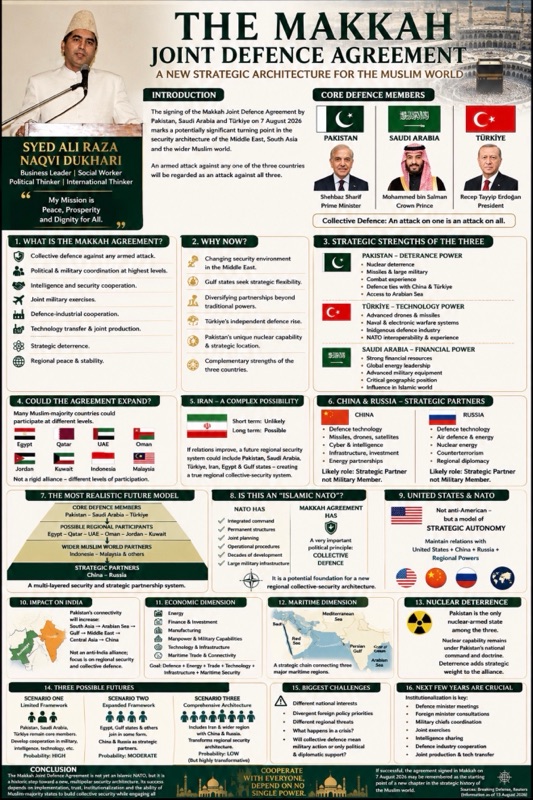 The Makkah Joint Defence Agreement
A New Strategic Architecture for the Muslim World
Introduction
The signing of the Makkah Joint Defence Agreement by Pakistan, Saudi Arabia and Türkiye on 7 August 2026 marks a potentially significant turning point in the security architecture of the Middle East, South Asia and the wider Muslim world.
The agreement was signed in Makkah by Saudi Crown Prince Mohammed bin Salman, Turkish President Recep Tayyip Erdoğan and Pakistani Prime Minister Shehbaz Sharif. Its central principle is that an armed attack against any one of the three countries will be regarded as an attack against all three. (Breaking Defense)
The agreement should not yet be described as an “Islamic NATO.” NATO has decades of institutional development, integrated military structures, permanent command arrangements and established procedures that this new agreement does not yet possess.
However, the Makkah agreement could become the foundation of something strategically important: a new regional collective-security framework based on cooperation among Muslim-majority states while maintaining relations with both Western and Eastern powers.
Its long-term significance may therefore be much greater than the three original signatories.
1. What Is the Makkah Joint Defence Agreement?
At its core, the Makkah agreement establishes a principle of collective defence.
Pakistan, Saudi Arabia and Türkiye have committed themselves to treating an armed attack against one member as an attack against all three.
This creates a powerful deterrence mechanism.
The three countries also intend to establish political and military coordination mechanisms involving their foreign and defence ministers and military chiefs. The agreement provides for greater defence cooperation, joint military exercises and cooperation in defence-industry development, including technology transfer and potentially joint production. (Reuters)
The agreement therefore has several dimensions:
- Collective defence
- Military coordination
- Intelligence and security cooperation
- Joint military exercises
- Defence-industrial cooperation
- Technology transfer
- Strategic deterrence
- Regional stability
Its practical strength, however, will depend on how these commitments are implemented.
2. Why Was the Agreement Signed Now?
The timing is extremely important.
The Middle East is experiencing a major transformation in its security environment. Traditional assumptions about regional security are changing, while Gulf states increasingly seek greater strategic flexibility.
Saudi Arabia in particular has strong relationships with the United States, but it is simultaneously expanding its relationships with China, Russia, Türkiye, Pakistan and other powers.
Türkiye has also pursued a more independent foreign and defence policy while remaining a NATO member.
Pakistan, meanwhile, has deep strategic relationships with both Saudi Arabia and China and possesses a unique military capability among Muslim-majority states because it is a nuclear-armed country.
The Makkah agreement therefore brings together three states with complementary strategic capabilities.
Saudi Arabia contributes financial strength, energy resources and geographic importance.
Türkiye contributes a rapidly expanding indigenous defence industry, advanced drones, missiles, naval capabilities and NATO-level military experience.
Pakistan contributes a large and experienced military, nuclear deterrence, missile capabilities and extensive defence cooperation with China.
Together, these capabilities create a considerably more diversified strategic partnership than any of the three countries could create alone.
3. The Strategic Logic Behind the Three Countries
Pakistan: The Strategic Deterrence Power
Pakistan occupies a unique position in this emerging framework.
It is geographically positioned between South Asia, Central Asia, China and the Middle East. It also possesses nuclear weapons and a large conventional military.
Pakistan’s strategic value includes:
- Nuclear deterrence
- Ballistic and cruise missile capabilities
- A large armed force
- Combat experience
- Air-force capabilities
- Defence-industrial cooperation with China and Türkiye
- Access to the Arabian Sea
- Strategic links with the Gulf
Pakistan therefore gives the Makkah framework a strategic dimension that would be difficult for most regional alliances to replicate.
Türkiye: The Defence-Technology Power
Türkiye brings another critical component: a rapidly developing indigenous defence industry.
Its strengths include:
- Unmanned aerial systems
- Missiles
- Naval systems
- Electronic warfare
- Defence electronics
- Indigenous military platforms
- NATO interoperability
- A substantial conventional military
Türkiye’s defence industry could potentially become one of the technological engines of the Makkah framework.
The agreement’s emphasis on defence-industry cooperation and technology transfer could therefore be particularly important in the long term. (Reuters)
Saudi Arabia: The Financial and Geographic Power
Saudi Arabia contributes a different but equally important form of strategic power.
It possesses:
- Major financial resources
- Global energy importance
- A strategically critical geographic position
- Advanced Western military equipment
- Significant air-defence capabilities
- Influence in the Arab and Islamic worlds
Saudi Arabia can provide the financial foundation for large-scale defence modernization and regional infrastructure.
Thus, the three countries are not simply combining armies.
They are combining military capability, technology, finance, geography and strategic influence.
4. Why the Agreement Could Become Bigger
The most important question is not necessarily why Pakistan, Saudi Arabia and Türkiye signed the agreement.
The more important question is:
Who could join or cooperate with the framework in the future?
If the agreement develops successfully, other Muslim-majority countries could potentially participate at different levels.
Possible countries include:
- Egypt
- Qatar
- United Arab Emirates
- Oman
- Jordan
- Kuwait
- Indonesia
- Malaysia
However, it would be premature to describe these countries as future members.
Their foreign-policy priorities differ considerably, and some maintain defence relationships with the United States or other external powers.
The future architecture could therefore be based not on one rigid alliance but on different levels of participation.
5. Egypt: The Most Important Potential Arab Addition
Egypt would be particularly significant because of its large military, strategic location and political weight in the Arab world.
Its geography connects the Mediterranean, Red Sea and Suez Canal.
Egypt also possesses one of the largest armed forces in the Arab world.
However, reports have indicated disagreements over whether Egypt should have been included in the original Makkah framework. Therefore, Egypt’s participation should currently be considered a possibility rather than an established development.
If Egypt eventually joined, the strategic weight of the framework would increase considerably.
6. Qatar, UAE and Oman
The Gulf states could play an important role in a future regional security architecture.
Qatar
Qatar possesses enormous energy resources and has historically maintained relationships with multiple competing powers.
Its role could be particularly important in diplomacy, energy security and strategic finance.
United Arab Emirates
The UAE possesses substantial financial resources, advanced military capabilities and an increasingly diversified foreign policy.
It maintains relationships with the United States, China, Russia, India, Pakistan and other powers.
Its participation would therefore give the framework additional economic and technological weight.
Oman
Oman could play a unique diplomatic role.
Because of its history of maintaining dialogue with competing regional powers, Oman could potentially contribute to conflict prevention and diplomatic communication rather than simply military power.
7. What About Iran?
Iran is perhaps the most complicated question.
At first sight, Iranian participation may appear unlikely because the Makkah agreement is emerging during a period of serious regional tensions.
However, Iran also has strategic relationships with China and Russia, and its inclusion in a genuinely comprehensive regional security system could theoretically transform the framework.
If relations between Iran and the Gulf states eventually improve substantially, a future regional security system could theoretically include:
Pakistan + Saudi Arabia + Türkiye + Iran + Egypt + Gulf states
Such an arrangement would be far more significant than a traditional military alliance.
It could become a genuine regional collective-security system.
But this remains a long-term possibility, not an immediate expectation.
8. Could China Join?
China is likely to be one of the most important external powers in the future of the Makkah framework.
However, China’s participation would probably not take the form of immediately becoming a formal military member.
A more realistic model would be:
Makkah Defence Framework + China as Strategic Partner
China could contribute through:
- Defence technology
- Missiles
- Drones
- Satellites
- Air-defence systems
- Naval technology
- Cyber capabilities
- Intelligence cooperation
- Infrastructure
- Investment
- Energy partnerships
China already has strong strategic relationships with Pakistan and Saudi Arabia.
Most importantly, China has demonstrated that it can play a diplomatic role in the Gulf, including its role in facilitating the Saudi-Iran rapprochement.
Therefore, China’s greatest contribution may not necessarily be sending troops.
It may be helping build a broader strategic and economic architecture.
9. Could Russia Join?
Russia presents a similar possibility.
A full Russian military membership in the Makkah agreement is not necessarily the most likely scenario.
A strategic partnership, however, is much more realistic.
Russia could cooperate in:
- Defence technology
- Air defence
- Energy
- Nuclear energy
- Intelligence
- Counterterrorism
- Regional diplomacy
- Military education
Russia also maintains relationships with Türkiye, Iran, Saudi Arabia and other Middle Eastern countries.
Its involvement could therefore strengthen the framework’s multipolar character.
10. The Most Realistic Future Model
Instead of imagining one giant military alliance, the more realistic future model could look like this:
Core Defence Members
Pakistan – Saudi Arabia – Türkiye
↓
Possible Regional Participants
Egypt – Qatar – UAE – Oman – Jordan – Kuwait
↓
Wider Muslim World Partners
Indonesia – Malaysia and others
↓
Strategic Partners
China – Russia
This would create something different from NATO.
It would be a multi-layered security and strategic partnership system.
11. Is This an “Islamic NATO”?
Not yet.
Calling it an “Islamic NATO” may be politically attractive, but it is analytically premature.
NATO has:
- Integrated military command
- Permanent command structures
- Joint planning
- Established operational procedures
- Decades of institutional development
- Large integrated military infrastructure
The Makkah agreement currently does not have an equivalent institutional structure.
What it does have is a very important political principle: collective defence.
Therefore, the more accurate description would be:
The Makkah Joint Defence Agreement is a potential foundation for a new regional collective-security architecture.
That distinction is important.
12. The United States and NATO
The emergence of the Makkah framework does not necessarily mean that Pakistan, Saudi Arabia or Türkiye are becoming anti-American.
This is particularly important.
Saudi Arabia maintains deep relations with Washington.
Türkiye remains a NATO member.
Pakistan has a long history of security and diplomatic relations with the United States.
The emerging pattern may therefore be better described as:
Strategic Autonomy
The countries want the ability to maintain relationships with:
United States + China + Russia + regional powers
rather than becoming completely dependent on one great power.
This is part of the broader movement toward a more multipolar international system.
13. The Impact on India
India will naturally watch this development closely.
Pakistan’s strategic position could change significantly if its security relationships with Saudi Arabia and Türkiye become institutionalized and expand toward other Arab states.
Pakistan would then have stronger links across:
South Asia → Arabian Sea → Gulf → Middle East → Central Asia → China
This would give Pakistan greater strategic connectivity.
For India, the important issue would not simply be the military strength of the three original members.
It would be the possibility of Pakistan becoming part of a much broader Middle East–South Asia strategic network.
At the same time, the Makkah agreement should not automatically be interpreted as an anti-India alliance. Its stated purpose is collective defence and regional security, not a military campaign against a specific country. (Reuters)
14. The Economic Dimension
The future power of the framework may ultimately depend as much on economics as on military forces.
Consider the combination:
Saudi Arabia
Energy + capital
UAE/Qatar
Finance + investment + energy
Türkiye
Manufacturing + defence industry
Pakistan
Manpower + military capability + geographic connectivity
China
Industrial capacity + technology + capital
Russia
Energy + military technology + strategic resources
This could produce a highly diversified economic-security network.
The real strategic opportunity would therefore be to connect:
Defence + Energy + Trade + Technology + Infrastructure + Maritime Security
rather than focusing only on military cooperation.
15. The Maritime Dimension
The geography is particularly important.
The potential framework would connect areas around:
- Arabian Sea
- Persian Gulf
- Red Sea
- Gulf of Oman
- Eastern Mediterranean
This means maritime security could become one of the most important areas of cooperation.
Pakistan’s Arabian Sea position, Saudi Arabia’s Red Sea and Gulf geography, and Türkiye’s access to the Mediterranean create a strategic chain connecting three major maritime regions.
If additional Gulf and Red Sea states participate, the geographic importance would increase dramatically.
16. Nuclear Deterrence and Strategic Balance
One of the most sensitive aspects of the framework is Pakistan’s nuclear capability.
Pakistan is currently the only nuclear-armed state among the three founding members.
This does not mean that Pakistan’s nuclear weapons automatically become the collective nuclear arsenal of the agreement.
The distinction is critical.
The Makkah agreement should therefore be understood as a collective-defence arrangement, while Pakistan’s nuclear capability remains under Pakistan’s national command and doctrine.
Nevertheless, the existence of nuclear deterrence inevitably adds strategic weight to the alliance.
17. Three Possible Futures
Scenario One: Limited Makkah Framework
Pakistan, Saudi Arabia and Türkiye remain the core members.
They develop:
- Joint exercises
- Military coordination
- Defence production
- Intelligence cooperation
- Technology transfer
This would already represent a significant regional defence partnership.
Probability: High
Scenario Two: Expanded Regional Framework
Additional countries such as Egypt, Qatar, UAE, Oman or Jordan participate in some form.
China and Russia remain strategic partners rather than formal members.
The result would be a powerful regional security network.
Probability: Moderate
Scenario Three: Comprehensive Regional Security Architecture
A much larger framework eventually includes:
Pakistan
Saudi Arabia
Türkiye
Egypt
Qatar
UAE
Oman
Jordan
Iran
with:
China and Russia as major strategic partners.
This would fundamentally change the security architecture of the Middle East and South Asia.
It could create one of the world’s most important strategic blocs.
Probability: Currently Low, but strategically transformative if it occurs
18. The Biggest Challenges
The agreement also faces serious challenges.
The member states have different national interests.
Saudi Arabia and Türkiye do not always share identical foreign-policy priorities.
Pakistan’s primary security concerns include India and its own regional environment.
Saudi Arabia is heavily concerned with Gulf security and regional missile threats.
Türkiye has interests extending into Europe, the Caucasus, Syria, Iraq, the Mediterranean and beyond.
Therefore, the real test will come when a member faces a crisis that does not equally affect the other two.
The question will be:
Will the collective-defence principle translate into actual military action, or primarily into political and diplomatic support?
That question cannot yet be answered.
19. Why the Next Few Years Matter
The first major test will be institutionalization.
If the three countries create permanent mechanisms for:
- Defence-minister meetings
- Foreign-minister consultations
- Military-chief coordination
- Joint exercises
- Intelligence sharing
- Defence-industrial cooperation
- Joint production
- Technology transfer
then the agreement could gradually evolve into a durable institution.
Türkiye has already indicated that political and military mechanisms are being established and that joint exercises and defence-industry cooperation are part of the implementation process. (Reuters)
This implementation phase may ultimately prove more important than the signing ceremony itself.
20. A New Model of Strategic Autonomy
The deeper meaning of the Makkah agreement may not be the creation of an anti-Western or anti-Eastern bloc.
Its greater significance could be the emergence of a new model:
Cooperate with everyone, depend on no single power, and develop regional capacity for collective security.
This model would allow Saudi Arabia to maintain its American relationship while deepening ties with China and Türkiye.
It would allow Türkiye to remain in NATO while developing deeper relationships with Pakistan and the Gulf.
It would allow Pakistan to maintain relationships with the United States while strengthening its strategic partnerships with China, Saudi Arabia and Türkiye.
Such flexibility is increasingly characteristic of a multipolar international system.
21. Pakistan’s Potential Strategic Role
Pakistan could emerge as one of the central bridges of this architecture.
Its geography connects:
China → Pakistan → Arabian Sea → Gulf → Middle East
while its military relationships connect it with:
Türkiye + Saudi Arabia + China
This gives Pakistan an unusual strategic position.
If Islamabad can combine defence cooperation with trade, logistics, energy, technology and infrastructure, the country could potentially become a major strategic connector between South Asia, the Gulf and Eurasia.
The opportunity, however, depends heavily on Pakistan’s economic stability and diplomatic consistency.
Conclusion
The Makkah Joint Defence Agreement is still at an early stage.
It is not yet an Islamic NATO.
It is not yet a military bloc comparable to NATO.
China and Russia are not currently formal members.
Egypt, Qatar, UAE, Oman and other countries should not be described as members unless they officially join.
Nevertheless, the agreement has created something strategically significant.
For the first time, Pakistan’s nuclear deterrence, Türkiye’s defence-industrial capabilities and Saudi Arabia’s financial, energy and geographic power are being placed within a formal collective-defence framework.
If the agreement remains limited to the three founding countries, it will still represent a significant regional defence partnership.
But if it evolves into a broader framework involving other Arab and Muslim-majority countries, while China and Russia become strategic partners, its importance could be far greater.
The ultimate possibility is not simply a military alliance.
It is the emergence of a new, multipolar security architecture linking South Asia, the Gulf, the Middle East and Eurasia.
The central question of the coming years will therefore not be:
“Will the Makkah Agreement become an Islamic NATO?”
The more important question is:
“Can the Makkah Agreement evolve into an independent regional security architecture capable of balancing relationships with the United States, China, Russia and other major powers while promoting collective security among Muslim-majority states?”
If the answer is yes, the agreement signed in Makkah on 7 August 2026 may eventually be remembered not merely as a defence pact between three countries, but as the starting point of a new chapter in the strategic history of the Muslim world.
Sources and Current Verification
This article reflects information available as of 13 August 2026. The core facts concerning the signing, collective-defence principle and planned political/military coordination are supported by current reporting from Reuters and other regional and international sources. (Reuters)


Comments
Post a Comment