The Cockroach Party Movement: How Unity Became Its Greatest Strength.
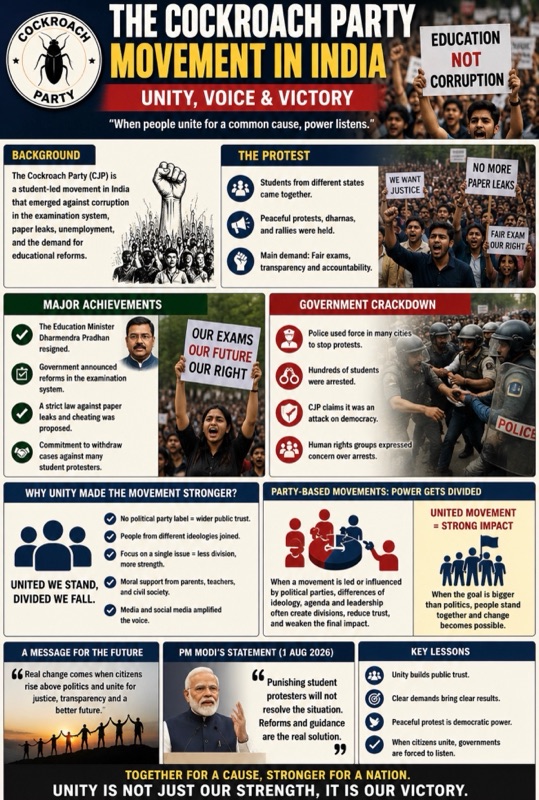 The Cockroach Party Movement: How Unity Became Its Greatest Strength
Introduction
The recent rise of the Cockroach Party (CJP) movement in India has attracted national and international attention. What began as a student-led campaign against examination irregularities and demands for educational reforms evolved into a broader public movement. Regardless of differing political opinions, the movement demonstrated an important principle: when citizens unite around a common cause, their collective voice can become significantly stronger.
A Movement Beyond Party Politics
One of the most discussed features of the Cockroach Party movement was its image as a people-centered campaign focused on educational reforms rather than traditional party politics. This perception encouraged students, parents, teachers, and members of civil society from different backgrounds to support the same cause. As a result, the movement expanded beyond the support base of any single political group.
Why Unity Increased Public Support
When people identify themselves first as citizens rather than supporters of competing political parties, they often find it easier to work toward a common objective. In the case of the Cockroach Party movement, the emphasis on transparency, fairness, and accountability appealed to many individuals who may otherwise have remained divided by political affiliations.
The Power of a Common Cause
History has shown that movements with clear and focused demands often gain greater public attention. The Cockroach Party movement concentrated on issues that directly affected millions of students and families, making it easier for the public to understand and support its objectives. A shared purpose created a stronger sense of solidarity.
Political Developments
The movement was followed by significant political developments, including the resignation of India’s Education Minister and government commitments to introduce reforms aimed at improving the examination system and addressing concerns about paper leaks and accountability. These developments became an important part of the national debate surrounding education and governance.
Does Every Non-Political Movement Succeed?
The answer is no. No movement—whether political or non-political—is guaranteed to succeed. Success depends on many factors, including public participation, effective leadership, peaceful organization, clear objectives, media attention, legal processes, and the willingness of governments to respond. However, broad public unity can strengthen a movement’s influence and legitimacy.
Lessons from the Cockroach Party Movement
The Cockroach Party movement highlights an important lesson for democratic societies. When citizens unite around a common national issue instead of allowing political divisions to dominate the discussion, they may be better positioned to influence public policy. Unity does not eliminate differences of opinion, but it can help transform those differences into constructive dialogue focused on solving shared problems.
Conclusion
The Cockroach Party movement illustrates how unity around a common cause can increase public participation and strengthen civic engagement. While no movement can claim guaranteed success, broad public support, peaceful participation, and clearly defined goals often improve the chances of achieving meaningful reforms. In every democracy, lasting progress is more likely when citizens place the public interest above political rivalry and work together for the benefit of society.


Comments
Post a Comment