Prophet Muhammad ﷺ — His Noble Personality, Mission, Love, and the Message of 12 Rabi al-Awwal.
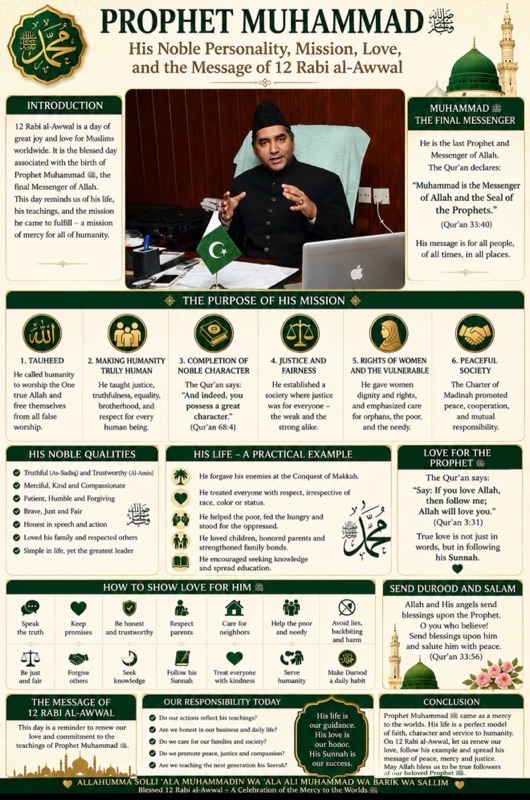
Prophet Muhammad ﷺ — His Noble Personality, Mission, Love, and the Message of 12 Rabi al-Awwal
Introduction
Throughout human history, countless great personalities have emerged who influenced their societies and left their mark on civilization. Yet, among all of them, Prophet Muhammad ﷺ stands as a unique and unparalleled figure whose message transformed not merely one nation or region, but humanity itself.
His life brought humanity from darkness toward the light of faith, justice, mercy, knowledge, dignity, morality, and compassion.
For millions of Muslims around the world, 12 Rabi al-Awwal is a day associated with the blessed birth of Prophet Muhammad ﷺ. The exact historical date of his birth has been discussed differently by scholars and historians, but in many Muslim communities, particularly across South Asia, 12 Rabi al-Awwal is observed with deep love and reverence as a day of remembrance of the Prophet ﷺ.
This day is not merely an occasion for celebration. It is an opportunity to ask ourselves:
Why did Prophet Muhammad ﷺ come? What did he give to humanity? What does loving him truly mean? And how can we demonstrate that love through our lives?
Muhammad ﷺ — The Final Messenger of Allah
Prophet Muhammad ﷺ is the final Prophet and Messenger of Allah. With him, the chain of Prophethood was completed.
The Qur’an declares:
“Muhammad is the Messenger of Allah and the Seal of the Prophets.”
(Qur’an 33:40)
His mission was not restricted to a particular race, tribe, nation, or geographical region. His message was universal.
Allah says:
“And We have not sent you except as a mercy to the worlds.”
(Qur’an 21:107)
This is why the life of Muhammad ﷺ is not simply a chapter in Muslim history. It is a profound part of the history of humanity itself.
The Messenger of Mercy ﷺ
One of the most beautiful qualities of Prophet Muhammad ﷺ was his extraordinary mercy.
He taught humanity to respect every human being. He emphasized the rights of orphans, the poor, widows, travelers, neighbors, workers, and the vulnerable.
He taught that strength is not a license to oppress others. Rather, true strength carries responsibility.
His mercy extended beyond his followers. His teachings emphasized justice and compassion even toward those who disagreed with him or opposed him.
His life demonstrated that leadership is not about domination—it is about service, responsibility, compassion, and justice.
The Purpose of His Mission
The mission of Prophet Muhammad ﷺ was not limited to teaching rituals. His mission transformed the spiritual, moral, intellectual, social, and ethical foundations of human life.
1. The Message of Tawheed
The first and greatest message brought by the Prophet ﷺ was the Oneness of Allah.
He called humanity to worship the One true Creator and to free itself from every form of false worship and unjust human domination.
The message of Tawheed gives human beings a profound sense of dignity: a person who submits to Allah does not need to become a slave to injustice, wealth, status, or another human being.
2. Making Humanity Truly Human
Before the rise of Islam, many societies were deeply affected by tribal conflict, injustice, exploitation, social inequality, violence, and moral corruption.
The Prophet ﷺ transformed the social order by establishing principles of:
- Truthfulness
- Justice
- Brotherhood
- Compassion
- Accountability
- Equality
- Responsibility
He demonstrated that the transformation of a society begins with the transformation of the individual.
The Completion of Noble Character
The character of Prophet Muhammad ﷺ was at the heart of his mission.
The Qur’an describes him:
“And indeed, you possess an عظیم character.”
(Qur’an 68:4)
Truthfulness, honesty, patience, forgiveness, mercy, humility, justice, modesty, fulfilling promises, and respecting the rights of others were all central elements of his character.
He did not merely preach good character.
He lived it.
His life became a practical example of what moral excellence looks like.
Muhammad ﷺ — The Truthful and Trustworthy
Even before receiving Prophethood, Muhammad ﷺ was known among the people of Makkah as As-Sadiq — the truthful — and Al-Amin — the trustworthy.
This carries a powerful lesson for us.
If we truly love the Prophet ﷺ, then our businesses should reflect honesty, our words should reflect truth, our promises should reflect reliability, and our dealings should reflect integrity.
The goal of love for the Prophet ﷺ should be that people recognize his teachings through our character.
Justice as a Foundation of Society
Prophet Muhammad ﷺ established a society in which justice was not supposed to depend upon wealth, tribe, family, or social status.
The powerful were accountable, and the weak were entitled to protection.
Justice was not merely a slogan; it was a principle that had to be applied even when it was difficult.
This was one of the great achievements of the Prophetic model: a fragmented society was transformed into a community based upon law, responsibility, brotherhood, and justice.
The Dignity and Rights of Women
The Prophet ﷺ elevated the dignity and status of women and established important rights and responsibilities within family and society.
He emphasized kindness toward wives, respect for mothers, care for daughters, and protection of family relationships.
His own relationship with his daughter, Fatimah رضي الله عنها, demonstrated profound love, respect, and dignity.
His teachings challenged practices that denied women their basic dignity and established principles that continue to shape Islamic family ethics.
Caring for Orphans, the Poor, and the Vulnerable
The protection of vulnerable people was central to the Prophetic message.
Islam placed great emphasis on caring for orphans, feeding the poor, supporting widows, helping travelers, and assisting those in need.
The Prophet ﷺ taught his followers that a healthy society cannot ignore those who are struggling.
A society is truly strong when its weakest members are treated with dignity.
Human Equality and the Rights of the Oppressed
Prophet Muhammad ﷺ challenged arrogance based on race, wealth, tribe, and lineage.
The Qur’an declares:
“Indeed, the most noble of you in the sight of Allah is the one who is most righteous.”
(Qur’an 49:13)
This principle placed moral character and righteousness above worldly status.
The Prophetic message established a profound concept of human dignity: no person is inherently superior to another because of race, wealth, nationality, or family background.
The Charter of Madinah — A Model of Social Cooperation
After migrating to Madinah, Prophet Muhammad ﷺ helped establish an organized society involving different tribes and religious communities.
The Charter of Madinah provided a framework for mutual responsibilities, security, cooperation, and social order among different groups.
This demonstrates that the Prophetic model was not limited to personal spirituality. It also addressed the organization of society, governance, justice, communal responsibility, and peaceful coexistence.
The Conquest of Makkah — Forgiveness in the Face of Power
One of the most remarkable chapters of the Prophet’s ﷺ life was the Conquest of Makkah.
Those who had persecuted him and his companions, forced them from their homes, and fought against them eventually found themselves powerless before him.
Yet when the Prophet ﷺ gained victory, he did not make revenge the foundation of his triumph.
Instead, forgiveness and mercy became the defining features of that moment.
This is one of the greatest lessons of his life:
True power is not merely the ability to defeat an enemy; true power is having the strength to forgive when revenge is possible.
Love for Muhammad ﷺ — The Heart of Faith
For Muslims, love for Prophet Muhammad ﷺ is not merely an emotional attachment. It is deeply connected with faith.
We love him because he is the final Messenger of Allah, because he delivered the Qur’anic message, because he taught humanity how to worship Allah, and because his life provides guidance for every dimension of human existence.
But genuine love cannot remain only in words.
The Qur’an gives us the standard:
“Say: If you love Allah, then follow me; Allah will love you.”
(Qur’an 3:31)
This verse establishes a profound principle:
The greatest evidence of love is obedience and following the beloved.
What Does Love for the Prophet ﷺ Really Mean?
If we truly love Muhammad ﷺ, then that love should appear in our daily lives.
It should make us:
- Speak the truth.
- Keep our promises.
- Honor our parents.
- Protect the rights of our neighbors.
- Care for orphans and the poor.
- Avoid injustice.
- Conduct business honestly.
- Avoid lies, backbiting, and false accusations.
- Forgive others.
- Treat people with dignity.
- Stand for justice even when it is difficult.
- Seek knowledge.
- Serve humanity.
- Follow the Sunnah of the Prophet ﷺ.
If 12 Rabi al-Awwal inspires us toward these actions, then remembrance becomes more than an event.
It becomes a renewal of our covenant with the life and teachings of Muhammad ﷺ.
12 Rabi al-Awwal — A Day of Love, Remembrance, and Renewal
For many Muslims, 12 Rabi al-Awwal is a day of joy, remembrance, devotion, and love for the Prophet ﷺ.
People gather in mosques and communities, recite Durood and Salam, listen to Seerah, share Naat, and remember the life and mission of the Messenger of Allah ﷺ.
The most meaningful way to honor this occasion is to understand the Seerah and bring its values into our own lives.
Lighting lamps is beautiful, but more important is allowing the light of the Prophetic character to illuminate our hearts.
Speaking about truth is beautiful, but more important is making our own speech truthful.
Claiming love is easy, but living according to the character of the beloved is the real test of love.
Sending Durood and Salam
The Qur’an itself commands believers to send blessings and peace upon the Prophet ﷺ:
“Indeed, Allah and His angels send blessings upon the Prophet. O believers, send blessings upon him and greet him with peace.”
(Qur’an 33:56)
Therefore, whenever the name of Muhammad ﷺ is mentioned, the believer’s heart should respond with love and the tongue with Durood and Salam:
Allahumma salli ‘ala Muhammadin wa ‘ala ali Muhammad wa sallim.
Durood is not merely a phrase. It is an expression of our love, respect, gratitude, and connection with the Messenger of Allah ﷺ.
The Prophetic Message for the Modern World
Today, humanity has achieved extraordinary scientific and technological progress. Yet the modern world continues to face war, injustice, poverty, hatred, social division, family breakdown, and moral crises.
This reminds us that material progress alone is not enough.
Humanity needs progress with morality.
Power with justice.
Freedom with responsibility.
Economic development with compassion.
Technology with wisdom.
And societies where the weak are protected rather than exploited.
The life of Muhammad ﷺ offers a powerful model of this balance.
Our Responsibility Today
12 Rabi al-Awwal should encourage every believer to look beyond history and examine the present.
We should ask ourselves:
Do our dealings reflect the teachings of Muhammad ﷺ?
Is there love and respect within our families?
Are we honest in our businesses?
Do we care for our neighbors and the poor?
Do we remain just even with people who disagree with us?
Are we teaching the next generation the Seerah of the Prophet ﷺ?
These questions transform 12 Rabi al-Awwal from a date on the calendar into a moment of personal and social renewal.
Love of the Prophet ﷺ and Unity of the Ummah
The love of Muhammad ﷺ is one of the greatest bonds connecting Muslims throughout the world.
Muslims may speak different languages, live in different countries, belong to different cultures, and come from different backgrounds, but they share love for the same Messenger ﷺ.
Therefore, love for the Prophet ﷺ should also inspire unity, brotherhood, mutual respect, compassion, and reconciliation within the Muslim Ummah.
We should avoid hatred, arrogance, unnecessary division, and hostility toward one another.
The Prophetic model teaches us that believers should care for each other and stand together in times of difficulty.
Conclusion — Muhammad ﷺ: Our Love, Our Guidance, Our Way
The life of Prophet Muhammad ﷺ is a divine gift and a mercy to humanity.
He did not merely teach us how to worship.
He taught us how to live.
He taught us how to honor our parents, love our families, raise our children, protect our neighbors, support the poor, conduct honest business, uphold justice, forgive our enemies, and live with dignity and compassion.
For many Muslims, 12 Rabi al-Awwal is a beautiful occasion to remember the birth and life of the Prophet ﷺ, express love and gratitude, send Durood and Salam, study his Seerah, and renew our commitment to his teachings.
But the greatest tribute to Muhammad ﷺ is not merely to speak about him.
It is to live according to what he taught.
Because true love means making the path of the beloved our own path.
O Allah, bless Muhammad ﷺ and the family of Muhammad ﷺ.
We thank You for the blessing of being among the Ummah of Muhammad ﷺ.
We consider love for Your Messenger ﷺ one of the greatest treasures of our faith.
Make us people whose lives reflect his mercy, whose words reflect his truthfulness, whose dealings reflect his honesty, and whose character reflects his noble example.
May Allah grant us sincere love for Prophet Muhammad ﷺ, the ability to follow his Sunnah, and the strength to carry his message of mercy, justice, dignity, compassion, and peace to humanity.
ﷺ Blessed 12 Rabi al-Awwal — A Celebration of the Mercy to the Worlds ﷺ
The arrival of Muhammad ﷺ was a mercy.
His Seerah is guidance.
His love is a blessing.
And following his path is the road to success.
Allahumma salli ‘ala Muhammadin wa ‘ala ali Muhammad wa barik wa sallim.


Comments
Post a Comment