Political Reforms: The Only Sustainable Path to Pakistan’s Stability.
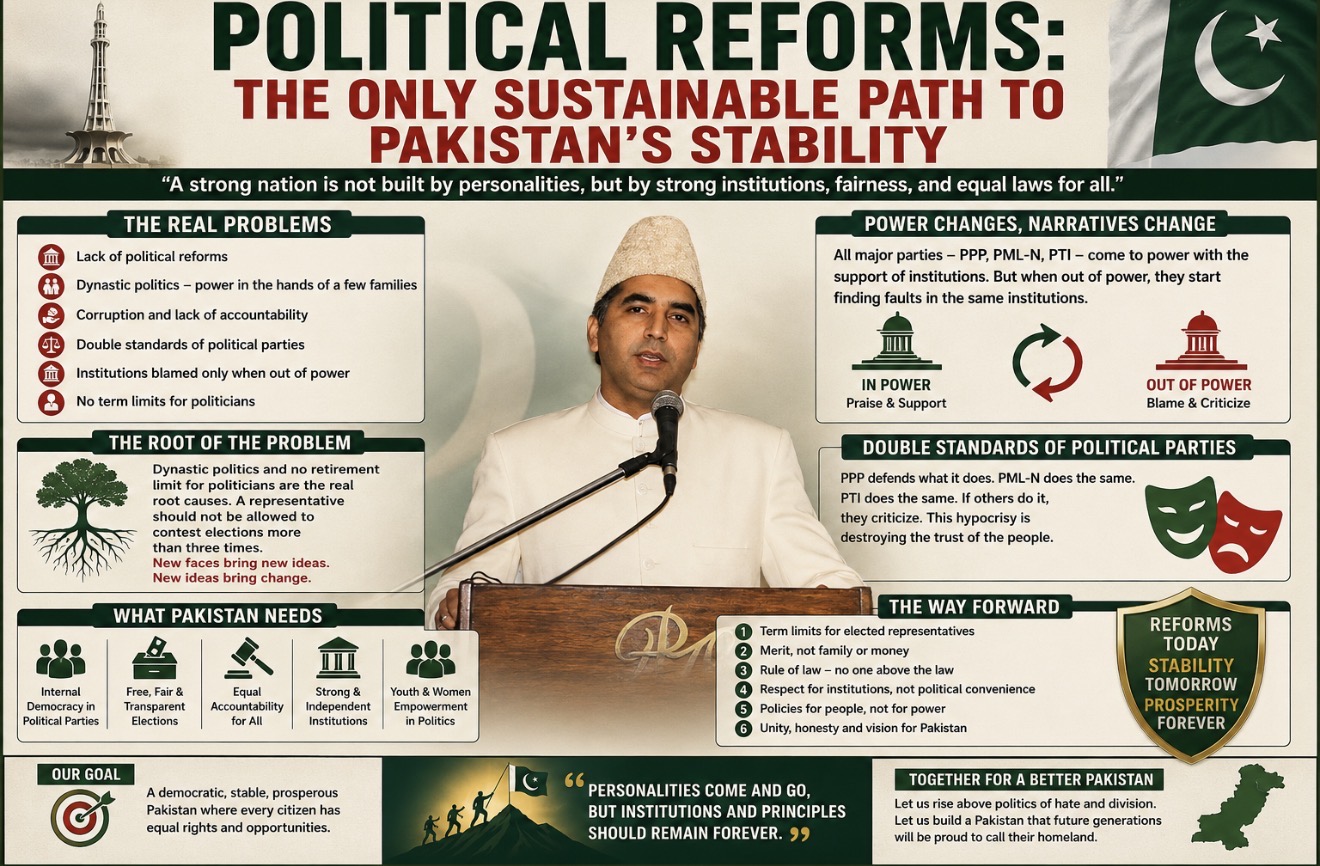
Political Reforms: The Only Sustainable Path to Pakistan’s Stability
Introduction
Pakistan has faced repeated political, economic, and governance crises for decades. Governments change, political narratives change, and alliances change, yet many of the country’s structural problems remain unresolved. This recurring cycle has led many citizens to conclude that personalities are not the core issue—the real challenge is the absence of meaningful institutional and political reforms.
Without reforming the political system, sustainable national progress will remain difficult.
The Cost of Dynastic Politics
One of the most frequently discussed concerns in Pakistan is the dominance of dynastic politics. Leadership in several major political parties has often remained concentrated within a limited number of families or long-established political figures.
Supporters argue that democratic elections give voters the final choice. Critics, however, contend that when leadership opportunities remain limited, internal party democracy weakens, fresh talent struggles to emerge, and innovation in governance suffers.
A healthy democracy should continuously produce new leaders rather than relying on the same political class generation after generation.
Power Changes, Narratives Change
Another issue often highlighted in Pakistan’s political landscape is the tendency for political narratives about state institutions to shift depending on whether a party is in government or in opposition.
Critics argue that parties sometimes praise institutions while in power but become highly critical after losing office. Similar observations have been made at different times regarding Pakistan’s major political parties, including the Pakistan Peoples Party (PPP), Pakistan Muslim League (N) (PML-N), and Pakistan Tehreek-e-Insaf (PTI).
Regardless of political affiliation, institutions should be viewed through the principles of constitutional accountability and the rule of law rather than through partisan interests.
Selective Accountability Weakens Democracy
A recurring criticism in Pakistan’s politics is the perception of selective standards. Actions considered acceptable when carried out by one political party are often condemned when undertaken by another.
This inconsistency undermines public confidence in democratic institutions and shifts political debate away from national interests toward partisan rivalry.
Democracy cannot flourish when principles change according to political convenience.
The Need for Political Term Limits
One reform that deserves serious national discussion is the introduction of reasonable limits on how many times an individual may serve as an elected representative.
Supporters of such reforms argue that limiting repeated terms could:
- Encourage the emergence of new leadership.
- Reduce the concentration of political influence.
- Strengthen internal democracy within political parties.
- Create opportunities for younger generations.
- Promote fresh ideas and modern governance.
Different democracies around the world adopt different approaches to term limits, and any proposal in Pakistan would require broad constitutional debate and public consensus.
Institutional Reforms Before Political Victories
No country becomes strong merely by changing governments.
Nations become stable when institutions become stronger than individuals.
Pakistan requires reforms that ensure:
- Independent and transparent elections.
- Strong parliamentary oversight.
- Internal democracy within political parties.
- Equal application of accountability laws.
- Respect for constitutional institutions.
- Merit-based governance instead of political patronage.
Strong institutions provide continuity even when governments change.
Beyond Personality Politics
Pakistan’s political discourse has increasingly become centered around personalities rather than policies.
Supporters defend their preferred leaders regardless of circumstances, while opponents criticize them regardless of performance.
A mature democracy requires citizens to evaluate governments on measurable outcomes—economic growth, education, healthcare, justice, security, and institutional performance—instead of personal loyalty.
A Vision for Democratic Renewal
The future of Pakistan depends not on replacing one political party with another but on reforming the political framework itself.
Real democratic renewal requires:
- Transparent governance.
- Institutional independence.
- Equal accountability for all.
- Opportunities for new political leadership.
- Constitutional supremacy.
- Respect for democratic norms.
Only when these principles become stronger than individual political interests can Pakistan achieve lasting political stability.
Conclusion
Pakistan possesses immense human potential, strategic importance, and resilient institutions. However, sustainable progress requires reforms that outlive individual governments.
A democratic system should continuously renew itself by encouraging fresh leadership, strengthening institutions, and applying the law equally to everyone.
History shows that nations prosper when institutions become stronger than personalities, when democracy becomes more inclusive, and when reforms take precedence over political rivalry.
Pakistan’s long-term stability will ultimately depend not on who governs today, but on whether the political system evolves to serve future generations with fairness, accountability, and genuine democratic participation.


Comments
Post a Comment