Nepal’s 2026 Flood Response vs Pakistan’s 2022 Flood Response.
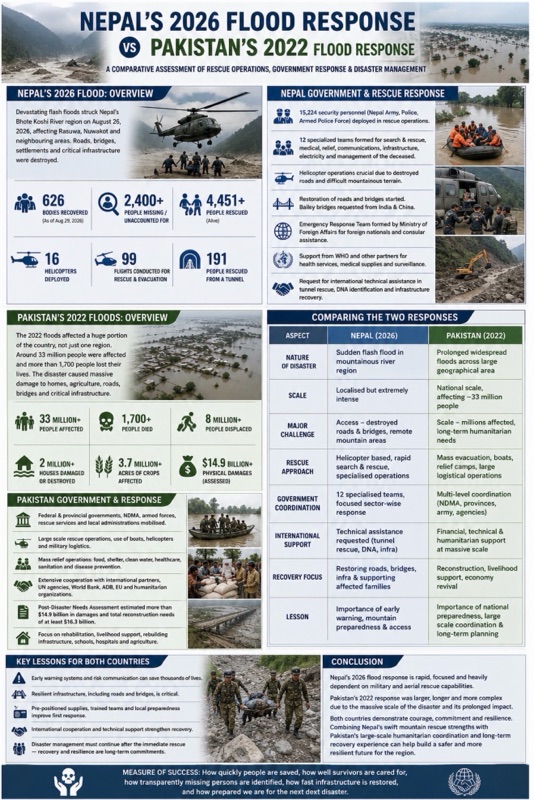
Nepal’s 2026 Flood Response vs Pakistan’s 2022 Flood Response
A Comparative Assessment of Rescue Operations, Government Response and Disaster Management
The devastating flash floods that struck Nepal’s Bhote Koshi River region on August 26, 2026, have created one of the country’s most serious recent humanitarian emergencies. The disaster has particularly affected Rasuwa, Nuwakot and neighbouring mountainous areas, destroying roads, bridges, settlements and critical infrastructure. According to the Government of Nepal, 626 bodies had been recovered and around 2,400 people remained unaccounted for as of August 29. More than 4,451 survivors had been rescued, including 191 people rescued from a tunnel. Sixteen helicopters had conducted 99 flights to support rescue and evacuation operations. (mofa.gov.np)
The scale and speed of the Nepalese response deserve recognition. The Nepal Army, Armed Police Force, Nepal Police and civilian authorities were mobilised immediately. The government divided the emergency response into specialised sectors covering search and rescue, medical assistance, relief distribution, communications, electricity, infrastructure and management of the deceased. (kathmandupost.com)
The use of helicopters has been particularly important. Mountainous terrain and destroyed roads have made many affected settlements extremely difficult to reach by land. Nepal has therefore relied heavily on military and private helicopters to evacuate survivors, transport medical teams and deliver emergency supplies. The government has also begun restoring road connections and has sought Bailey bridges from India and China to accelerate the restoration of damaged transport routes. (radionepalonline.com)
Another important element has been the government’s response to foreign nationals. Nepal’s Ministry of Foreign Affairs established an Emergency Response Team to coordinate information, rescue efforts and consular assistance for foreign citizens affected by the disaster. This has been particularly important because many foreign nationals were among those reported missing in the border region. (mofa.gov.np)
The Nepalese government has also begun the transition from immediate rescue to recovery. Technical teams are assessing damage to roads, bridges, electricity, drinking water, telecommunications and hydropower infrastructure. Emergency medical teams have been deployed, while the World Health Organization is supporting health surveillance, medical supplies and continuity of essential health services. (who.int)
However, Nepal’s response has faced extraordinary operational challenges. The disaster occurred in a mountainous border region where roads and bridges were destroyed almost immediately. Mud, rocks, debris and unstable terrain have made ground searches extremely dangerous. Poor weather has also periodically disrupted helicopter operations and search-and-rescue activities. Nepal has therefore requested international technical assistance in specialised areas such as tunnel rescue, DNA identification and infrastructure recovery rather than simply relying on additional foreign search-and-rescue teams. (reuters.com)
Pakistan’s 2022 Floods: A Much Larger National Emergency
The 2022 floods in Pakistan were different in both geography and duration. Rather than being concentrated primarily in a mountainous river corridor, the disaster affected a huge portion of the country. Around 33 million people were affected and more than 1,700 people lost their lives. More than 8 million people were displaced, while housing, agriculture, transport and communications suffered enormous damage. (worldbank.org)
Pakistan’s response involved federal and provincial governments, the National Disaster Management Authority, armed forces, rescue services, local administrations, humanitarian organisations and international agencies. The scale of the emergency required not only immediate evacuation and relief but also a prolonged humanitarian operation involving food, shelter, healthcare, clean water and disease prevention.
One of the biggest strengths of Pakistan’s response was its ability to mobilise large national institutions and military assets across multiple provinces. However, the sheer geographical scale of the floods created major coordination and logistical difficulties. Millions of people needed assistance simultaneously, while stagnant floodwater continued to create health risks long after the initial flooding.
The subsequent Post-Disaster Needs Assessment, led by Pakistan’s Ministry of Planning with the World Bank, Asian Development Bank, European Union, United Nations agencies and UNDP, estimated more than $14.9 billion in physical damages and around $15.2 billion in economic losses. Reconstruction and rehabilitation needs were estimated at at least $16.3 billion. (worldbank.org)
Comparing the Two Responses
There are important similarities between the two disasters. In both cases, the armed forces and government agencies became central to emergency rescue operations. Helicopters and military logistics were particularly important in areas where normal transportation systems were disrupted.
However, the nature of the challenges was very different.
Nepal’s greatest challenge is access. The affected areas are mountainous, roads and bridges have been destroyed, and some communities can only be reached by air. The government has therefore focused heavily on helicopter rescue, specialised search operations and rapid restoration of transport links.
Pakistan’s greatest challenge in 2022 was scale. The floods affected tens of millions of people across a huge geographical area. The response therefore required mass shelter, food distribution, healthcare, sanitation, disease control and long-term livelihood support on a national scale.
In terms of immediate rescue, Nepal’s response appears highly concentrated and operationally aggressive. Thousands of security personnel were mobilised, more than 4,400 survivors were rescued and dozens of air operations were conducted within the first few days. (radionepalonline.com)
Pakistan’s 2022 response, meanwhile, should be judged not only by its rescue operations but also by the enormous humanitarian and recovery effort required after the floodwaters spread across a large part of the country. The World Bank noted that federal and provincial authorities were working extensively with local, national and international partners to manage the relief operation. (documents.worldbank.org)
Government Coordination: Nepal’s Strength and Pakistan’s Lesson
Nepal’s early decision to divide the response into specialised teams is a positive feature. Rescue, medical response, infrastructure, communications, electricity and relief operations have been assigned specific responsibilities. This can reduce duplication and improve accountability during the critical first days of a disaster. (kathmandupost.com)
Pakistan’s experience demonstrates, however, that the emergency response is only the beginning. After the water recedes, governments face a much larger challenge: rebuilding homes, restoring agriculture, repairing roads and schools, supporting livelihoods and preventing disease.
Pakistan’s 2022 experience also demonstrated the importance of international cooperation. The scale of the disaster exceeded the capacity of any single institution. The subsequent international assessment and reconstruction framework brought together the government, World Bank, ADB, EU, UN agencies and UNDP. (climatepromise.undp.org)
Nepal is now entering a similar phase. Its immediate rescue operation must gradually evolve into a large reconstruction and resilience programme. The government has already indicated that the reconstruction requirement could reach several billion dollars, making international technical and financial cooperation increasingly important. (reuters.com)
Which Response Has Been More Effective?
It would be unfair to declare an outright winner because the two disasters were fundamentally different.
Nepal’s response can be described as rapid, highly focused and heavily dependent on specialised military and aerial rescue capabilities. The government’s ability to mobilise helicopters, security personnel, medical resources and technical teams within a very short period is a significant strength.
Pakistan’s 2022 response was far larger, longer and more complex, because the disaster affected approximately 33 million people and created a humanitarian crisis across much of the country. Its greatest challenge was not simply rescuing people but sustaining relief and eventually financing recovery and reconstruction. (worldbank.org)
The most important lesson from both countries is that disaster management cannot begin when the flood arrives. Early-warning systems, evacuation planning, resilient roads and bridges, emergency communications, pre-positioned relief supplies and trained local rescue teams can determine how many lives are saved in the first hours.
Conclusion
Nepal’s 2026 flood is a powerful reminder of the increasing danger posed by extreme weather and rapidly developing disasters in mountainous regions. The country’s rescue agencies have demonstrated strong commitment and operational capability, particularly through the use of helicopters, military personnel, specialised rescue teams and rapid infrastructure restoration.
Pakistan’s 2022 floods offer a different but equally important lesson: even when a government succeeds in the immediate rescue phase, the real national challenge may continue for years through reconstruction, economic losses, displacement, disease and climate adaptation.
The best disaster-management model would combine the strengths demonstrated by both countries: Nepal’s rapid and focused mountain rescue capability with Pakistan’s experience in large-scale humanitarian coordination, international assessment and long-term reconstruction planning.
Ultimately, the measure of a government’s disaster response should not be political statements or the number of officials deployed. It should be measured by how quickly people are rescued, how effectively survivors receive food and medical care, how transparently missing persons are identified, how quickly essential infrastructure is restored, and whether the country becomes safer and more resilient before the next disaster arrives.


Comments
Post a Comment