Debt, Development and Double Standards: A Comparative Analysis of Pakistan, India and Japan
Debt, Development and Double Standards: A Comparative Analysis of Pakistan, India and Japan
Introduction: Is Pakistan Really the “Most Indebted” Country?
Pakistan is frequently portrayed in public debate as a country drowning in debt. A common statement heard in political discussions and on social media is:
“Every Pakistani child is born with hundreds of thousands of rupees of debt.”
There is a mathematical basis for calculating a country’s debt on a per-person basis, but presenting this number without explaining the broader economic context can create a seriously misleading impression.
Debt by itself does not determine whether an economy is healthy or unhealthy.
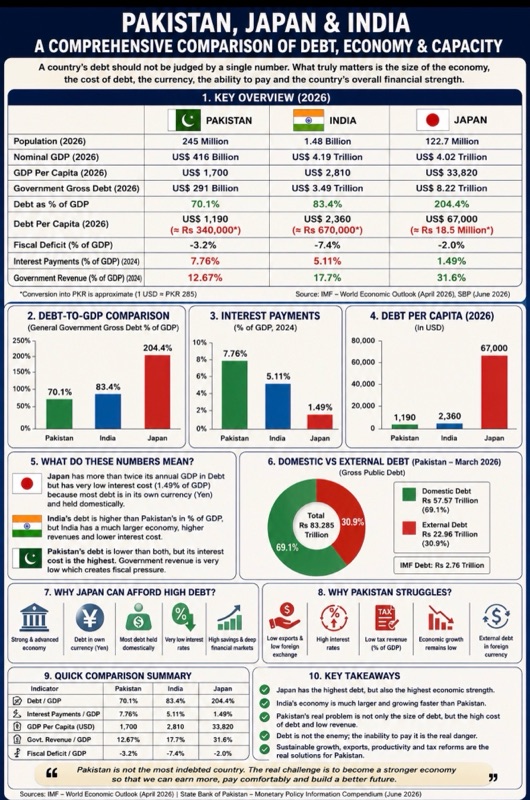
Japan, for example, has one of the highest government-debt ratios in the developed world. According to the IMF’s April 2026 World Economic Outlook, Japan’s general government gross debt is approximately 204.4% of GDP. India’s ratio is about 83.4%, while Pakistan’s is about 70.1%. (IMF)
Therefore, if debt-to-GDP is used as the primary international measure, Japan’s government debt burden is almost three times Pakistan’s.
Yet Japan is not normally described as a failed or bankrupt economy.
Why?
Because the real question is not simply:
“How much debt does a country have?”
The more important questions are:
- How large is the economy?
- How much government revenue is generated?
- What is the interest cost?
- Is the debt domestic or external?
- In what currency is the debt denominated?
- Does the country earn enough foreign exchange?
- How strong are its financial institutions?
- What productive assets and economic capacity stand behind the debt?
This comparison between Pakistan, India and Japan demonstrates why a simple “debt per citizen” figure is not sufficient to judge an economy.
1. The Three Countries at a Glance
The IMF’s April 2026 World Economic Outlook provides a consistent framework for comparing government debt across countries. (IMF)
|
Indicator |
🇵🇰 Pakistan |
🇮🇳 India |
🇯🇵 Japan |
|
Population, 2026 |
~245 million |
~1.48 billion |
~122.7 million |
|
Government gross debt / GDP |
70.1% |
83.4% |
204.4% |
|
Fiscal deficit / GDP |
-3.2% |
-7.4% |
-2.0% |
|
Public-debt interest, 2024 |
7.76% of GDP |
5.11% of GDP |
1.49% of GDP |
|
Economic classification |
Developing |
Emerging / Developing |
Advanced |
|
Major currency |
Pakistani Rupee |
Indian Rupee |
Japanese Yen |
The figures immediately reveal an important fact:
Pakistan has a much lower government debt-to-GDP ratio than Japan and a lower ratio than India.
But Pakistan faces a much greater problem with the cost and structure of that debt.
That distinction is central to understanding Pakistan’s economic situation. (IMF)
2. Japan: A Country With More Than Twice Its Annual GDP in Government Debt
Japan provides perhaps the clearest example of why debt must be analyzed in context.
The IMF estimates Japan’s general government gross debt at approximately:
204.4% of GDP in 2026
In other words, Japan’s gross government debt is more than two times the size of its annual economic output. (IMF)
This is an extraordinary number by international standards.
Japan’s government has accumulated enormous debt over decades because of:
- prolonged low economic growth;
- an ageing population;
- large social-security expenditures;
- repeated fiscal stimulus;
- long periods of very low interest rates;
- and the government’s extensive domestic borrowing.
Japan’s Ministry of Finance reported government bonds and borrowings at roughly ¥1,343.8 trillion around March 2026.
With a population of roughly 122.7 million, this produces an enormous debt-per-person figure.
However, it would be misleading to conclude that every Japanese citizen personally owes that amount to a foreign creditor.
A large proportion of Japanese government debt is held domestically, including by Japanese financial institutions and the Bank of Japan.
This is one of the fundamental differences between Japan and Pakistan.
3. Pakistan: The Debt Number Is Serious — But the Structure Matters More
Pakistan’s debt problem is real and should not be minimized.
The State Bank of Pakistan reported that by March 2026, Pakistan’s gross public debt had reached approximately:
Rs 83.285 trillion
This consisted mainly of:
- Government domestic debt: approximately Rs 57.57 trillion
- Government external debt: approximately Rs 22.96 trillion
- IMF-related debt: approximately Rs 2.76 trillion
The same SBP data puts Pakistan’s total debt and liabilities, including other categories beyond gross public debt, at approximately Rs 97.31 trillion. (State Bank of Pakistan)
This distinction is extremely important.
When someone says:
“Pakistan has Rs 97 trillion of debt”
they may be combining government debt, private-sector external debt, public-sector enterprise debt, external liabilities and other obligations.
When discussing government indebtedness, gross public debt is the more appropriate number.
4. Is Every Pakistani Really Born With Rs 250,000–300,000 of Debt?
This statement requires clarification.
If Pakistan’s public debt is divided by the population, one can mathematically calculate a debt-per-person figure.
Using approximately Rs 83.3 trillion of gross public debt and a population of roughly 245 million, the simple arithmetic produces:
Around Rs 340,000 per person
This is a statistical allocation, not an individual personal liability.
A newborn Pakistani does not receive a bill for Rs 340,000.
The government is the borrower, and the debt is serviced through:
- taxation;
- government revenues;
- economic growth;
- refinancing;
- asset sales;
- foreign exchange earnings;
- and other fiscal resources.
Therefore, saying:
“Every Pakistani child owes Rs 300,000”
may be mathematically derived from aggregate statistics, but it is economically incomplete.
A more accurate statement would be:
“If Pakistan’s gross public debt were mathematically divided equally among its population, the implied debt per person would be roughly Rs 340,000.”
That is a very different statement.
5. India: Larger Debt, but a Much Larger Economic Base
India’s situation is particularly interesting because it provides a regional comparison.
According to the IMF, India’s general government gross debt is approximately:
83.4% of GDP
This is higher than Pakistan’s approximately 70.1%. (IMF)
India’s population is approximately 1.48 billion, and its nominal GDP per capita is projected at approximately US$2,810 in 2026. (IMF)
India therefore carries a significantly larger total government debt burden in absolute terms than Pakistan, but it also has:
- a much larger domestic market;
- a much larger tax base;
- a much larger economy;
- substantial foreign-exchange reserves;
- a large domestic financial sector;
- significant services exports;
- a globally important technology sector;
- and a rapidly growing industrial base.
The IMF estimates India’s public-debt interest burden at approximately 5.11% of GDP, compared with 7.76% for Pakistan in 2024. (IMF)
This illustrates a critical principle:
The ability to service debt matters as much as the size of debt.
6. The Most Important Number: Interest Cost
Perhaps the most revealing comparison is not total debt but the amount a government must spend servicing that debt.
According to IMF data for 2024:
Pakistan
Interest paid on public debt: 7.76% of GDP
India
5.11% of GDP
Japan
1.49% of GDP (IMF)
This changes the entire picture.
Pakistan’s government debt is much smaller than Japan’s as a percentage of GDP.
Yet Pakistan’s interest burden is substantially larger relative to its economy.
This is one of the reasons Pakistan experiences severe fiscal pressure.
7. Why Can Japan Carry 204% Debt While Pakistan Struggles With 70%?
This is the central question.
The answer lies in the quality, structure and financing of debt.
Japan has:
1. A large advanced economy
Japan has a sophisticated industrial and technological base.
Its major sectors include:
- automobiles;
- electronics;
- robotics;
- machinery;
- chemicals;
- precision manufacturing;
- financial services;
- advanced technology.
2. A powerful domestic financial system
Japan has a deep domestic capital market capable of absorbing large quantities of government securities.
3. Debt denominated primarily in its own currency
Japan borrows mainly in Japanese yen.
This reduces the risk associated with having to earn foreign currency merely to repay domestic-currency obligations.
4. Very low historical interest rates
For many years Japan benefited from exceptionally low borrowing costs.
The IMF’s 2024 data show public-debt interest payments at only about 1.49% of GDP, despite the enormous debt stock. (IMF)
8. Pakistan’s More Difficult Position
Pakistan’s challenge is different.
Pakistan must manage both:
Domestic debt
and
Foreign-currency debt
Foreign debt creates an additional risk.
If the Pakistani rupee depreciates against the US dollar, the rupee value of dollar-denominated debt increases.
Pakistan therefore needs foreign exchange from:
- exports;
- remittances;
- foreign investment;
- tourism;
- external financing;
- and other sources
to meet its external obligations.
This is fundamentally different from simply borrowing in one’s own currency.
9. Debt-to-GDP: Pakistan vs India vs Japan
The IMF’s 2026 projections give us a very clear ranking:
🇯🇵 Japan —
204.4%
🇮🇳 India —
83.4%
🇵🇰 Pakistan —
70.1%
(IMF)
Therefore, on this particular measure:
Japan has the highest debt burden, India is second, and Pakistan is third.
But this does not mean Japan has a worse economy than Pakistan.
Nor does it mean Pakistan’s debt problem is insignificant.
It means that debt-to-GDP alone cannot determine economic health.
10. GDP Per Person Changes the Perspective
Another important factor is income.
The IMF estimates Pakistan’s 2026 GDP per capita at roughly US$1,700, while India’s is approximately US$2,810. (IMF)
Japan’s GDP per capita is dramatically higher. The IMF reported approximately US$33,820 per person in 2024, illustrating the enormous difference in economic capacity. (IMF)
This means that a dollar of debt does not have the same economic significance in every country.
A household earning Rs 100,000 per month and a household earning Rs 1 million per month may both owe Rs 500,000, but their ability to service that debt is completely different.
The same principle applies to countries.
11. India Is Not a Debt-Free Success Story Either
It is important to avoid another form of propaganda.
India’s economy is performing strongly in many areas, but India also carries significant public debt.
At approximately 83.4% of GDP, India’s government debt ratio is higher than Pakistan’s 70.1%. (IMF)
India also has a substantial fiscal deficit.
The IMF projects India’s general government net lending/borrowing balance at approximately -7.4% of GDP in 2026. (IMF)
Therefore, India should not be presented as a country without a debt problem.
The important difference is that India has a considerably larger and faster-growing economic base, giving it greater capacity to manage its obligations.
12. Pakistan’s Real Weakness Is Not Simply the Size of Debt
The fundamental problem can be summarized in five words:
Low Revenue, High Financing Costs
The IMF reports Pakistan’s government revenue at only about 12.67% of GDP in 2024, while interest payments alone were approximately 7.76% of GDP. (IMF)
This is an extraordinary fiscal constraint.
It means a very large portion of government resources can be absorbed by debt servicing before the government has sufficient room for:
- education;
- health;
- infrastructure;
- research;
- industrial development;
- social protection;
- and long-term investment.
Therefore, Pakistan’s real challenge is not simply:
“We have too much debt.”
It is:
“We have insufficient economic and fiscal capacity relative to the cost of servicing our debt.”
13. The Foreign Debt Question
Another important distinction is between domestic debt and external debt.
Japan can sustain a very high government-debt ratio partly because its financial system is deep and much of its government debt is domestically financed.
Pakistan has a much more significant foreign-exchange constraint.
External debt must ultimately be serviced in foreign currency.
This creates pressure on:
- foreign-exchange reserves;
- the exchange rate;
- imports;
- the current account;
- and balance-of-payments stability.
That is why Pakistan’s debt problem becomes particularly dangerous when foreign reserves fall sharply.
14. The “Every Child Is Born in Debt” Narrative
There is a legitimate reason to discuss debt per capita.
It helps ordinary citizens understand the scale of government borrowing.
But it becomes misleading when it is used as a political slogan without context.
A more responsible economic explanation would be:
Pakistan’s government has accumulated substantial public debt, and when that debt is divided statistically across the population, the implied amount per person is several hundred thousand rupees. However, this is not an individual personal liability. The economic burden depends primarily on the government’s ability to generate revenue, grow the economy and service the debt.
This is a much more accurate way of explaining the issue.
15. Japan’s Lesson for Pakistan
Japan should not be used as an excuse for Pakistan to borrow indefinitely.
Instead, Japan should be studied as an example of the importance of:
- domestic savings;
- industrial capacity;
- technological development;
- productivity;
- strong institutions;
- deep capital markets;
- stable monetary policy;
- and borrowing in one’s own currency.
Japan demonstrates that high debt does not automatically destroy an economy.
But Japan also demonstrates that high debt can become a long-term structural burden.
Pakistan therefore should not attempt to copy Japan’s debt level.
It should learn from Japan’s economic capacity.
16. India’s Lesson for Pakistan
India offers Pakistan another important lesson.
India has built a much larger economic ecosystem around:
- information technology;
- digital services;
- pharmaceuticals;
- manufacturing;
- telecommunications;
- domestic consumption;
- infrastructure;
- and exports.
Pakistan’s long-term solution cannot simply be another IMF programme or another foreign loan.
Pakistan needs to increase its ability to earn, not merely its ability to borrow.
17. What Pakistan Should Focus On
A sustainable debt strategy should focus on five major areas.
1. Increase exports
Pakistan needs substantially higher exports of:
- IT services;
- textiles;
- engineering goods;
- agriculture and processed food;
- pharmaceuticals;
- minerals;
- and high-value manufactured products.
2. Increase the tax base
The solution cannot be to repeatedly increase taxes on the already documented salaried and formal sectors.
Pakistan needs a broader and more efficient tax base.
3. Reduce the cost of borrowing
Lower inflation, stronger fiscal discipline and greater investor confidence can eventually reduce borrowing costs.
4. Increase productivity
Economic growth must come from higher productivity rather than simply population growth.
5. Build foreign-exchange earning capacity
A country with strong exports and sustainable foreign-exchange earnings is much better positioned to manage external debt.
18. The Numbers Tell a More Complicated Story
If we judge the three countries only by government debt-to-GDP:
Japan looks the worst.
If we judge them by debt-to-GDP:
Pakistan looks better than both Japan and India.
If we judge them by interest burden:
Pakistan looks significantly more vulnerable.
If we judge them by income per person:
Japan is far ahead.
If we judge them by economic scale:
India is vastly larger than Pakistan.
If we judge them by foreign-exchange vulnerability:
Pakistan faces a much more serious constraint than Japan.
Therefore, there is no single number that can honestly describe the economic health of a country.
19. The Correct Way to Compare Pakistan With Japan and India
A serious comparison should examine at least these ten indicators:
- Total government debt
- Debt-to-GDP ratio
- Debt per capita
- Domestic vs external debt
- Interest payments
- Government revenue
- GDP per capita
- Foreign-exchange reserves
- Exports
- Economic growth and productivity
Once these indicators are considered together, the picture becomes much clearer.
20. Conclusion: Pakistan Should Not Be Defended With Propaganda — But It Should Not Be Condemned With Propaganda Either
Pakistan unquestionably has a serious debt problem.
It would be wrong to deny it.
But it is equally wrong to reduce Pakistan’s entire economic story to a slogan such as:
“Every Pakistani child is born with Rs 250,000 or Rs 300,000 of debt.”
That statement describes only a mathematical division of aggregate debt.
It does not explain:
- who owns the debt;
- who borrowed it;
- what the money was used for;
- what assets were created;
- how much interest is being paid;
- how much revenue the government collects;
- whether the debt is domestic or external;
- or how much economic capacity exists to service it.
The international comparison is revealing.
Japan:
~204% debt-to-GDP
India:
~83% debt-to-GDP
Pakistan:
~70% debt-to-GDP
(IMF)
Yet Pakistan faces a much greater fiscal challenge because its income level is much lower, its government revenue base is narrow, its borrowing costs are high, and its foreign-exchange constraints are significant.
The real national question therefore should not be:
“How much debt does Pakistan have?”
It should be:
“Why is Pakistan unable to generate enough income, exports, productivity and government revenue to comfortably service its debt?”
That is the question Pakistan must answer.
And that is where the real debate about Pakistan’s economic future should begin.
Sources
- International Monetary Fund, World Economic Outlook — April 2026: government debt, GDP, population and fiscal indicators for Pakistan, India and Japan. (IMF)
- State Bank of Pakistan, Monetary Policy Information Compendium — June 2026: Pakistan’s domestic debt, external government debt, IMF debt and gross public debt. (State Bank of Pakistan)
- State Bank of Pakistan, Pakistan Debt and Liabilities data. (State Bank of Pakistan)
- IMF, 2026 Article IV Consultation with Japan: Japanese GDP, population and economic indicators. (IMF)


Comments
Post a Comment