The Farewell to a Great Leader: Why Was Ayatollah Ali Khamenei’s Burial Delayed?
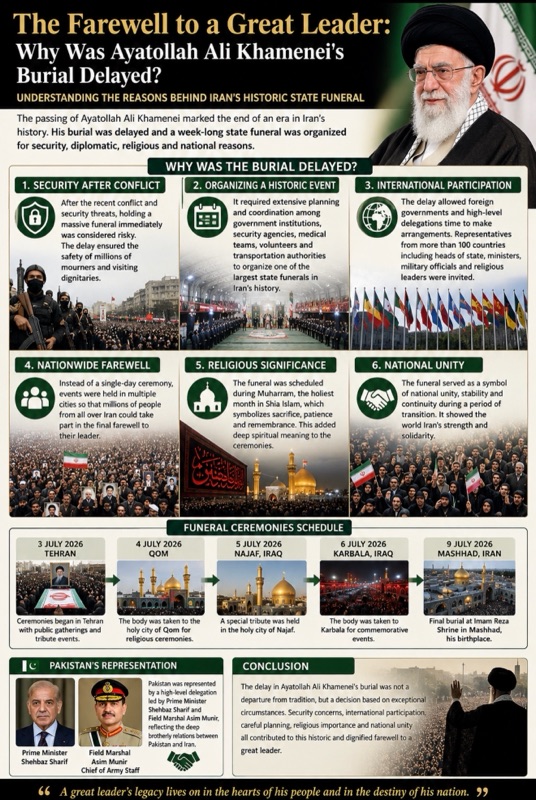 The Farewell to a Great Leader: Why Was Ayatollah Ali Khamenei’s Burial Delayed?
Understanding the Reasons Behind Iran’s Historic State Funeral
The passing of Ayatollah Ali Khamenei marked one of the most significant moments in the contemporary history of the Islamic Republic of Iran. As the country’s Supreme Leader for decades, his death was viewed not only as the loss of a political figure but also as the end of an era that shaped Iran’s domestic and foreign policies. Millions of people across Iran and the wider region mourned his passing, while governments around the world closely followed the developments surrounding his state funeral.
One question, however, attracted particular international attention: Why was his burial delayed when Islamic tradition generally encourages burial as soon as possible?
The answer lies in a combination of security, diplomatic, logistical, religious, and national considerations.
Security After a Period of Conflict
The foremost reason for delaying the burial was the security environment following the events surrounding his death. Iranian authorities considered the immediate period to be highly sensitive, with concerns about possible threats to large public gatherings. Organizing a funeral expected to attract millions of mourners required extraordinary security measures to ensure the safety of participants and visiting dignitaries.
Organizing One of the Largest State Funerals in Iran’s History
Iran planned an unprecedented state funeral rather than a single-day ceremony. Such an event required extensive coordination among government institutions, security agencies, religious organizations, medical services, transportation authorities, and volunteers. The additional time allowed officials to prepare a dignified farewell worthy of one of the country’s longest-serving leaders.
Allowing International Delegations to Participate
The delay also enabled foreign governments and international delegations to make arrangements for attendance. High-level representatives from numerous countries—including heads of government, ministers, military officials, diplomats, and religious leaders—were invited to pay their respects. Their presence transformed the funeral into a major international diplomatic event in addition to a national occasion of mourning.
A Nationwide Farewell
Instead of limiting the ceremonies to a single location, Iran organized commemorative events across multiple cities, allowing millions of citizens from different provinces to participate. This nationwide farewell reflected the government’s desire to give people throughout the country an opportunity to express their respect and condolences.
Religious Significance
The timing of the funeral was also linked to the sacred atmosphere of Muharram, a month that holds profound importance in Shia Islam. Holding the ceremonies during this period added deep spiritual symbolism, connecting the nation’s mourning with the broader themes of sacrifice, patience, and remembrance that characterize Muharram.
Demonstrating National Unity
Beyond the religious ceremonies, the funeral served as a symbol of national solidarity. Iranian leaders emphasized unity, continuity, and institutional stability during a period of transition. The participation of millions of mourners and numerous international guests projected an image of national resilience and continuity before the world.
Pakistan’s Representation
Pakistan was represented at the funeral by a high-level delegation, reflecting the longstanding relationship between the two neighboring countries. The participation of senior Pakistani leadership underscored the importance Islamabad attached to the occasion and conveyed condolences on behalf of the people and Government of Pakistan.
A Historic Farewell
The funeral of Ayatollah Ali Khamenei was far more than the burial of a national leader. It became a historic state event that combined religious devotion, diplomatic engagement, security planning, and national remembrance. The delay in his burial was therefore not a departure from tradition for its own sake, but the result of exceptional circumstances surrounding one of the most consequential figures in Iran’s modern history.
Conclusion
The farewell to Ayatollah Ali Khamenei represented a defining moment in Iran’s history. While the delay in burial prompted questions around the world, the reasons were rooted in ensuring security, facilitating international participation, organizing an unprecedented state funeral, and allowing the Iranian nation to bid farewell with dignity and respect. The ceremonies ultimately reflected both the political significance of his leadership and the profound emotional impact his passing had on millions of people.


Comments
Post a Comment