The Martyrs of Karbala: A Timeless Legacy of Sacrifice, Faith, and Human Dignity.
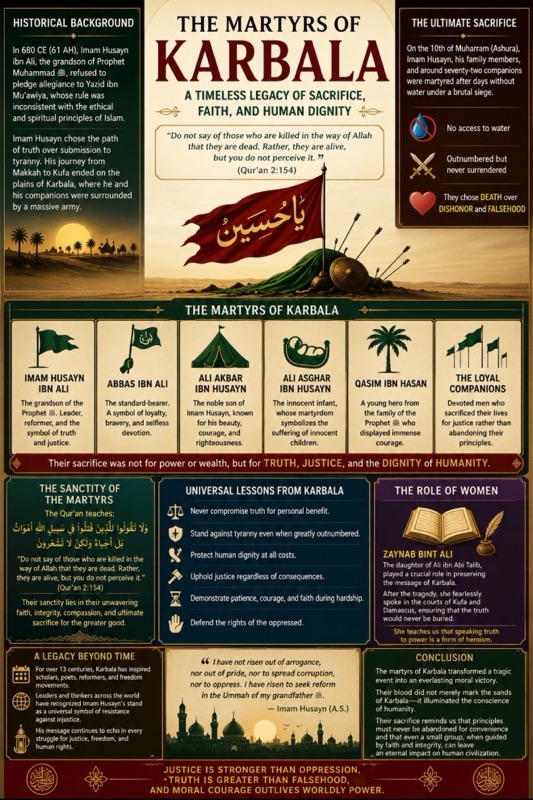 The Martyrs of Karbala: A Timeless Legacy of Sacrifice, Faith, and Human Dignity
The tragedy of Battle of Karbala stands as one of the most profound and transformative events in human history. More than a historical battle, Karbala represents the eternal struggle between justice and oppression, truth and falsehood, moral courage and worldly power. The sacrifice of Imam Husayn ibn Ali and his loyal companions continues to inspire millions of people across the world, regardless of their sect, ethnicity, or nationality.
The Historical Background
In 680 CE (61 AH), Imam Husayn ibn Ali, the beloved grandson of Prophet Muhammad, refused to pledge allegiance to Yazid ibn Mu’awiya, whose rule was widely regarded by many Muslim scholars as inconsistent with the ethical and spiritual principles of Islam.
Imam Husayn believed that remaining silent in the face of injustice would compromise the moral foundations of the Muslim community. His journey toward Kufa ultimately ended on the plains of Karbala in present-day Iraq, where he and a small group of family members and companions were surrounded by a vastly larger army.
The Ultimate Sacrifice
On the 10th of Muharram, known as Ashura, Imam Husayn, approximately seventy-two companions, and members of his family were martyred after enduring days without access to water.
Among those who sacrificed their lives were:
- Abbas ibn Ali, remembered for his extraordinary loyalty and bravery.
- Ali Akbar ibn Husayn, celebrated for his noble character.
- Ali Asghar ibn Husayn, whose death symbolizes the suffering of innocent children in times of conflict.
- Qasim ibn Hasan, a young member of the Prophet’s family who displayed remarkable courage.
- Numerous devoted companions who willingly gave their lives for justice rather than abandon their principles.
Their sacrifice was not driven by political ambition or worldly gain but by an unwavering commitment to truth, justice, and the preservation of human dignity.
The Sanctity of the Martyrs
The martyrs of Karbala occupy a place of immense reverence in Islamic tradition. The Qur’an teaches:
“Do not say of those who are killed in the way of Allah that they are dead. Rather, they are alive, but you do not perceive it.” (Qur’an 2:154)
This verse reflects the enduring spiritual honor accorded to martyrs. Across the Muslim world, the family of the Prophet and the martyrs of Karbala are remembered with profound respect and love.
Their sanctity lies not merely in their lineage but in their unwavering commitment to faith, integrity, compassion, and sacrifice under the most difficult circumstances.
Universal Lessons from Karbala
The message of Karbala extends far beyond religious boundaries.
It teaches:
- Never compromise truth for personal benefit.
- Stand against tyranny even when greatly outnumbered.
- Protect human dignity at all costs.
- Uphold justice regardless of consequences.
- Demonstrate patience, courage, and faith during hardship.
- Defend the rights of the oppressed.
These values resonate with people of many faiths and backgrounds and continue to inspire movements for justice around the world.
The Role of Women
The legacy of Karbala was preserved through the remarkable courage of Zaynab bint Ali. After the tragedy, she fearlessly addressed the courts of Kufa and Damascus, ensuring that the truth of Karbala would not be forgotten.
Her resilience demonstrates that moral courage is not limited to the battlefield; speaking truth in the face of power is itself a form of heroism.
A Legacy Beyond Time
For over thirteen centuries, Karbala has inspired scholars, poets, reformers, and freedom movements. Leaders from different traditions have recognized Imam Husayn’s stand as a universal symbol of resistance against injustice.
His famous principle is often summarized as a refusal to submit to humiliation in the face of tyranny, emphasizing that dignity and justice are worth every sacrifice.
Conclusion
The martyrs of Karbala transformed a tragic event into an everlasting moral victory. Their blood did not merely mark the sands of Karbala—it illuminated the conscience of humanity.
Imam Husayn and his companions demonstrated that true leadership is measured not by power or victory on the battlefield but by steadfastness in defending truth and justice. Their sacrifice remains a timeless reminder that principles must never be abandoned for convenience and that even a small group, when guided by faith and integrity, can leave an eternal impact on human civilization.
The message of Karbala continues to echo through history:
Justice is stronger than oppression, truth is greater than falsehood, and moral courage outlives worldly power.


Comments
Post a Comment