Strengthening Nations by Strengthening Institutions
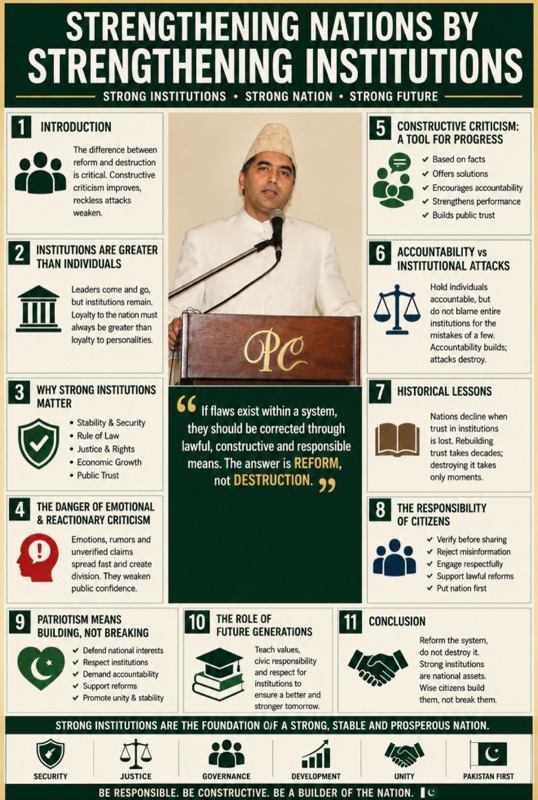 Strengthening Nations by Strengthening Institutions
Introduction: The Difference Between Reform and Destruction
Every nation experiences periods of political disagreement, public frustration, and debate over governance. Such discussions are healthy and necessary for progress. However, there is a significant difference between constructive criticism intended to improve institutions and reckless attacks that weaken them. Unfortunately, many people fail to recognize this distinction and, knowingly or unknowingly, contribute to the erosion of public trust in the institutions that safeguard the nation.
Institutions Are Greater Than Individuals
Individuals are temporary; institutions are permanent. Governments change, political leaders come and go, and public opinions evolve over time. Yet the institutions that maintain law and order, administer justice, protect national security, and uphold constitutional principles continue to serve the nation.
A mature society understands that loyalty to the nation must always be greater than loyalty to personalities. When people begin to equate institutions with individual office holders, they risk damaging the very foundations that ensure national continuity and stability.
Why Strong Institutions Matter
Strong institutions are the backbone of every successful nation. They provide:
- Stability during political transitions
- Protection of citizens’ rights
- Enforcement of laws and regulations
- National security and sovereignty
- Economic confidence and investment growth
- Public trust in governance
Without strong institutions, nations become vulnerable to instability, corruption, and uncertainty. Economic development slows, social divisions increase, and public confidence declines.
The Danger of Emotional and Reactionary Criticism
In today’s digital age, information spreads faster than ever before. Social media platforms often amplify emotional reactions, rumors, and unverified claims. Many people share opinions without examining facts or understanding the broader consequences of their words.
Emotional criticism may attract attention, but it rarely contributes to meaningful solutions. When criticism becomes driven by anger rather than reason, it can weaken public confidence in institutions and create unnecessary divisions within society.
Constructive Criticism: A Tool for National Progress
No institution is perfect. Mistakes, inefficiencies, and shortcomings can occur in any organization. Identifying and addressing these issues is essential for improvement.
Constructive criticism:
- Focuses on facts rather than emotions
- Offers solutions rather than merely highlighting problems
- Encourages accountability and transparency
- Strengthens institutional performance
- Promotes public confidence through reform
Constructive criticism seeks to repair weaknesses without damaging the institution itself.
The Difference Between Accountability and Institutional Attacks
Holding individuals accountable is a fundamental principle of good governance. However, blaming an entire institution for the mistakes of a few individuals is both unfair and harmful.
A responsible citizen distinguishes between:
Accountability
Seeking justice, transparency, and corrective action when mistakes occur.
Institutional Attacks
Attempting to delegitimize or discredit an entire institution because of isolated incidents or personal disagreements.
The first strengthens a nation; the second weakens it.
Historical Lessons from Around the World
History demonstrates that many nations have suffered not because of external threats alone, but because internal divisions weakened confidence in their institutions.
Countries that maintain strong institutions during difficult times often recover and prosper. Those that allow distrust and division to erode institutional credibility frequently experience political instability, economic decline, and social unrest.
The lesson is clear: rebuilding trust is far more difficult than preserving it.
The Responsibility of Citizens
Every citizen plays a role in shaping public discourse and national unity. Responsible citizenship requires:
- Verifying information before sharing it
- Avoiding misinformation and propaganda
- Engaging in respectful dialogue
- Supporting lawful reforms
- Prioritizing national interests over personal or political preferences
Citizens must recognize that their words and actions can either strengthen or weaken public confidence in national institutions.
Patriotism Means Building, Not Breaking
True patriotism is not blind support for every decision made by state institutions. Neither is it constant hostility toward them.
Real patriotism means:
- Defending national interests
- Respecting institutional dignity
- Demanding accountability where necessary
- Supporting reforms that improve performance
- Promoting unity and stability
A patriot seeks improvement without causing unnecessary damage to the foundations of the state.
The Role of Future Generations
The responsibility of preserving strong institutions does not belong only to current leaders. It belongs to every generation. Young people must be taught the importance of constitutional values, civic responsibility, and respect for institutions.
A nation that educates its citizens about these principles invests in long-term stability and prosperity.
Conclusion: Reform the System, Do Not Destroy It
If flaws exist within a system, they should be corrected through lawful, constructive, and responsible means. The answer to institutional shortcomings is reform—not destruction. The solution to mistakes is accountability—not the erosion of public trust.
Strong nations are built by citizens who understand that institutions are national assets, not political tools. Personalities may rise and fall, but institutions endure. Protecting, improving, and strengthening them is one of the highest forms of patriotism.
The future of every nation depends on the wisdom of its citizens. Wise citizens seek reform, accountability, and progress. They understand that weakening institutions weakens the nation itself. Therefore, they choose the path of responsibility, unity, and constructive engagement—the path that leads to national strength and lasting prosperity.


Comments
Post a Comment