Pakistan Save a Whole Civilization.
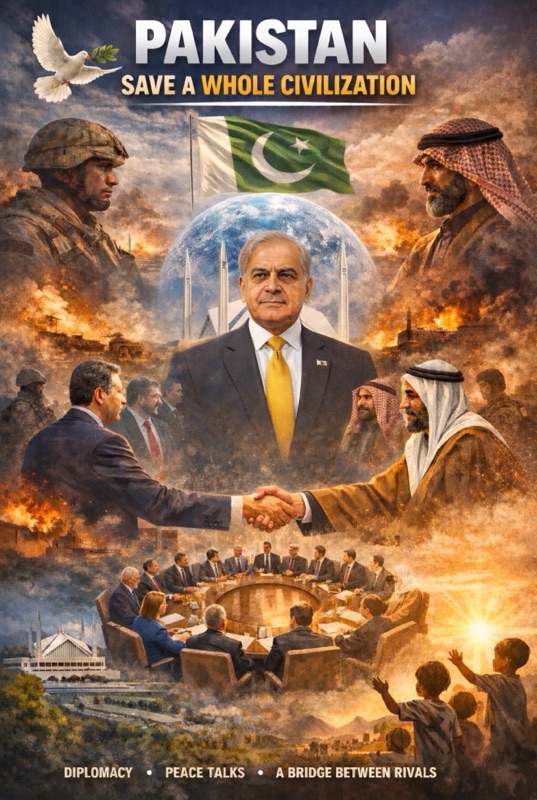
Pakistan Save a Whole Civilization
Introduction: A Defining Moment in Global History
In an era marked by rising conflicts and fragile alliances, the world stood at the edge of another dangerous escalation. The tensions between the United States and Iran had the potential to ignite a broader regional war—one that could have spiraled into a global crisis. Yet, at this critical juncture, Pakistan emerged not as a spectator, but as a decisive force for peace.
Today, leading international newspapers and television networks are acknowledging this unprecedented role, placing Pakistan at the center of global diplomacy.
Pakistan as a High-Stakes Mediator
As reported by Reuters,
“Pakistan Steps In as High-Stakes Mediator Between Iran and the U.S.”
This recognition reflects Pakistan’s ability to engage with both sides at a time when direct communication had nearly collapsed. Acting as a bridge, Pakistan helped reopen channels of dialogue that were essential to avoiding immediate escalation.
Islamabad: The New Global Diplomatic Hub
According to The Guardian,
“Islamabad Emerges as a Global Diplomatic Hub Amid Middle East Crisis.”
Islamabad transformed into a center of intense diplomatic activity, hosting key discussions and facilitating backchannel negotiations. This shift symbolizes trust—global powers now see Pakistan as a neutral and credible ground for dialogue.
A Bridge Between Rival Powers
Bloomberg highlighted,
“Pakistan Positions Itself as a Bridge Between Rival Powers.”
Maintaining balanced relations with the United States, Iran, and regional stakeholders, Pakistan demonstrated strategic maturity. In a polarized world, the ability to engage all sides without bias has become a rare and valuable strength.
Preventing War Through Quiet Diplomacy
As noted by Al Jazeera,
“Pakistan Leads Critical Backchannel Talks to Prevent Regional War.”
These quiet diplomatic efforts—often unseen—played a decisive role. Behind closed doors, Pakistan worked tirelessly to reduce tensions, proving that real diplomacy is measured not in speeches, but in outcomes.
A Fragile but Crucial Responsibility
However, as The New York Times cautioned,
“A Fragile Peace Hinges on Pakistan’s Diplomatic Gamble.”
The ceasefire remains delicate. Sustaining peace will require continued commitment, consistency, and careful navigation of complex geopolitical realities. Pakistan’s role is not over—it has only begun.
Reshaping Regional Power Dynamics
The Financial Times observed,
“Pakistan’s Quiet Diplomacy Reshapes Regional Power Balance.”
This development signals a deeper shift. Pakistan is not only mediating conflict—it is influencing the strategic architecture of the region, redefining how power and diplomacy interact in modern times.
Global Attention and Expectations
Mainstream voices like CNN ask,
“Can Pakistan Hold the Line Between Washington and Tehran?”
While BBC News states,
“Pakistan Takes Center Stage in Efforts to Avert Wider Conflict.”
These perspectives reflect a global consensus: Pakistan is now central to the peace process, carrying both recognition and responsibility.
A Vision Beyond Headlines
Beyond media narratives, a deeper truth is emerging:
Pakistan did not just mediate a ceasefire—it prevented a potential catastrophe.
This is why the defining headline resonates so powerfully:
“Pakistan Save a Whole Civilization.”
In today’s interconnected world, preventing war is not just a regional success—it is a service to humanity. It protects economies, preserves lives, and safeguards the future of generations.
Redefining Victory in the Modern World
For decades, victory has been measured through military strength and battlefield success. But Pakistan’s approach challenges this outdated notion.
Winning a war is not victory—establishing peace is.
This philosophy represents a new model of global leadership, where dialogue replaces destruction and diplomacy outweighs aggression.
Conclusion: The Rise of a Peace Architect
Pakistan is no longer a passive participant in international affairs. It is shaping outcomes, influencing decisions, and offering a path forward in a divided world.
If this peace effort holds and evolves into long-term stability, history will remember this moment not just as a diplomatic success—but as a turning point.
Pakistan is emerging as a guardian of peace—
a nation that chose humanity over conflict, and unity over division.
Author
Syed Ali Raza Naqvi Bukhari
Unity of Peace, Economic Reform, and Global Unity
Founder & Chairman of Tehreek Istehkam Pakistan, and the author of “Law of God” and “Social Democratic System.” advocates for truth, social justice, and reform in all sectors of society.


Comments
Post a Comment