Not the Victory of One Nation, but the Collective Triumph of Peace: Pakistan’s Bridge-Building, Saudi Arabia’s Restraint, Iran’s Patience, and the United States’ Strategic Prudence.
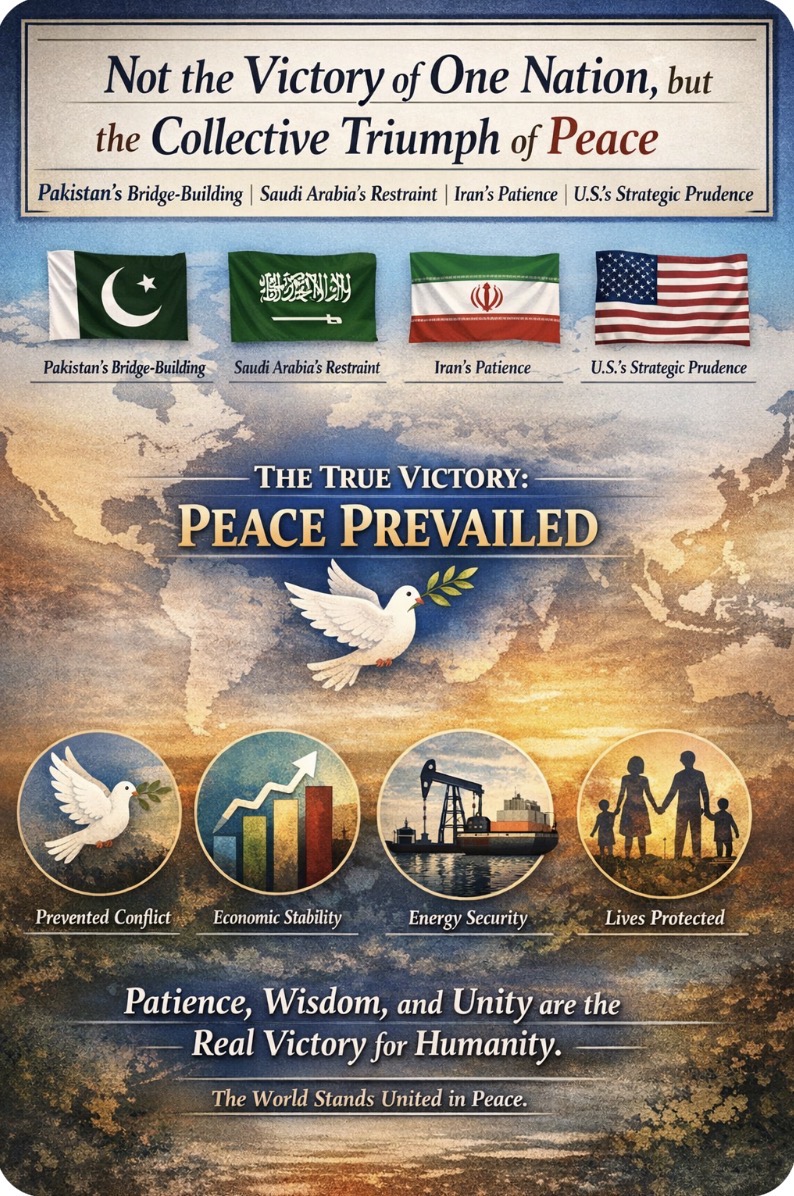
Not the Victory of One Nation, but the Collective Triumph of Peace: Pakistan’s Bridge-Building, Saudi Arabia’s Restraint, Iran’s Patience, and the United States’ Strategic Prudence
In times of global tension, the world often rushes to ask a familiar question: Who won? Was it Iran or the United States? Who suffered more losses? Who emerged stronger?
Yet, such questions reflect an outdated mindset—one that measures success through conflict rather than wisdom. The recent de-escalation involving Pakistan, Iran, United States, and Saudi Arabia offers a different answer:
No single nation has won—peace itself has prevailed.
A Shift from Power to Prudence
For decades, global politics has been shaped by displays of strength—military actions, economic sanctions, and strategic dominance. However, such approaches have often led to prolonged instability, human suffering, and economic disruption.
Today, a new paradigm is emerging—one where restraint is recognized as strength, and dialogue is valued over destruction. This shift is not merely philosophical; it is practical, necessary, and long overdue.
Pakistan: The Architect of Dialogue
Pakistan has played a vital role as a diplomatic bridge, connecting divergent interests and encouraging constructive engagement. In a fragmented world, Pakistan’s ability to facilitate dialogue reflects its strategic importance and its commitment to regional and global stability.
Rather than choosing sides, Pakistan chose a higher path—bringing sides together. This is the essence of modern diplomacy.
Saudi Arabia: Leadership Through Restraint
Saudi Arabia demonstrated remarkable patience and balance during a period of heightened tension. Despite facing challenges and potential provocations, it refrained from escalation.
This restraint is not a sign of weakness; it is a reflection of mature leadership. By choosing stability over retaliation, Saudi Arabia helped prevent a wider regional conflict—an outcome that benefits not just the Middle East, but the entire world.
Iran: The Power of Strategic Patience
Iran showed calculated patience in the face of pressure. Rather than allowing tensions to spiral into open confrontation, Iran’s measured approach contributed to de-escalation.
Such patience requires confidence and foresight. It reflects an understanding that true strength lies not in immediate reaction, but in long-term vision.
United States: Responsible Global Leadership
As a leading global power, the United States holds significant influence over international stability. Its decision to avoid further escalation and to support diplomatic avenues reflects responsible leadership.
Power, when exercised with restraint, becomes a force for stability rather than disruption. This moment demonstrates that even the strongest nations recognize the value of peace over conflict.
The Tangible Benefits of Peace
The collective restraint and cooperation among these nations have produced meaningful outcomes:
- Prevented Regional Conflict: A potentially devastating escalation was avoided.
- Economic Stability: Reduced tensions support global markets, trade, and investment.
- Energy Security: Stability in key regions ensures uninterrupted energy flows worldwide.
- Human Protection: Countless lives have been safeguarded from the horrors of war.
- Diplomatic Progress: A successful example that dialogue can replace confrontation.
Redefining Victory in the 21st Century
This moment challenges the conventional definition of victory. It tells us that:
- Victory is not defeating an opponent
- Victory is preventing destruction
- Victory is choosing wisdom over impulse
The roles played by Pakistan, Saudi Arabia, Iran, and the United States collectively redefine what it means to succeed in global politics.
Conclusion: Peace as the Ultimate Achievement
In the end, history will not remember who could have won a war—it will remember who prevented it.
This is not the victory of one nation.
It is the triumph of patience, wisdom, and peace.
And in that triumph, the entire world stands united.
Syed Ali Raza Naqvi Bukhari
Unity of Peace, Economic Reform, and Global Unity
Founder & Chairman of Tehreek Istehkam Pakistan, and the author of “Law of God” and “Social Democratic System.” advocates for truth, social justice, and reform in all sectors of society.


Comments
Post a Comment