Pakistan vs India: Command and Control in the Multi-Domain Battlespace.
Picture A/I Just for Reference
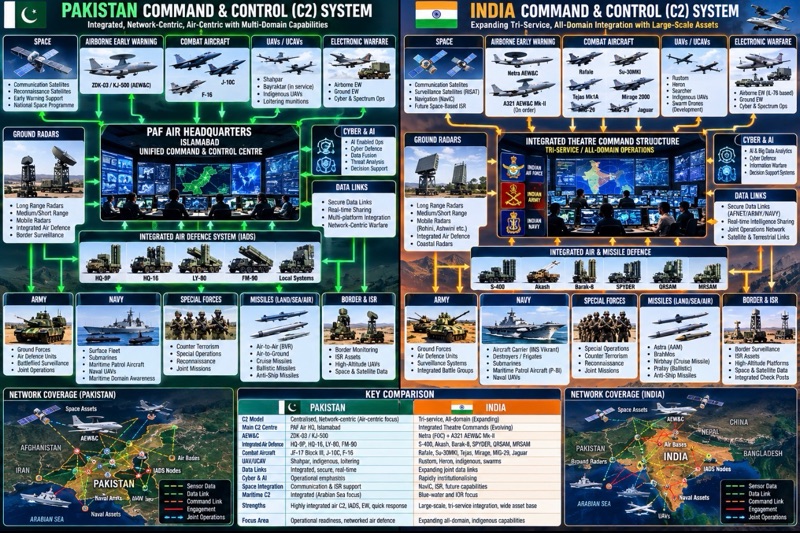
Pakistan vs India: Command and Control in the Multi-Domain Battlespace.
A Public-Source Analysis of Air Power, Sensors, Networks, Electronic Warfare and Joint Operations — 2026
Introduction
Modern military power is no longer determined simply by the number of fighter aircraft, tanks, ships or missiles a country possesses.
The decisive element increasingly lies in the ability to connect:
Sensors → Data → Command & Control → Decision → Electronic Warfare → Weapons → Assessment
This architecture is commonly described as Command and Control (C2), but modern forces are expanding it into a much broader system involving air, land, sea, space, cyber, electromagnetic operations, artificial intelligence and unmanned systems.
The accompanying graphic presents a public-source conceptual comparison of the Pakistan and India Command & Control architectures in 2026.
It should not be interpreted as a classified organizational chart or an exact representation of either country’s military network.
1. What Is a Modern Command-and-Control System?
A modern C2 system can be understood as a chain:
1. Detect
Radars, satellites, aircraft, ships, UAVs and other sensors identify activity.
↓
2. Collect
Information from multiple sensors is brought together.
↓
3. Fuse
The system attempts to create a common operational picture.
↓
4. Decide
Commanders evaluate the information and determine an appropriate response.
↓
5. Assign
The mission is passed to the most suitable available platform.
↓
6. Engage
Aircraft, air-defence systems, ships, missiles, UAVs or other forces may conduct the mission.
↓
7. Assess
The system evaluates the result and updates the operational picture.
The speed and reliability of this cycle are central to modern network-centric warfare.
2. Pakistan’s C2 Architecture
Pakistan’s publicly described air-force architecture places considerable emphasis on centralised, network-centric and air-centric command and control, while increasingly integrating space, cyber, electronic warfare and unmanned systems.
One of the clearest public examples came from Exercise Golden Eagle 2026.
According to Pakistan’s state broadcaster, the exercise was conducted under unified command and control from the Next-Generation All-Domain Command & Control Centre at Air Headquarters, Islamabad.
The exercise integrated:
- AI-enabled operations
- Network-centric operations
- Integrated Air Defence
- AEW&C
- Air-to-air refuelling
- Long-range BVR weapons
- Stand-off weapons
- Precision strike
- Cyber
- Space
- Electromagnetic-spectrum operations
- Manned-unmanned teaming
- Killer drones and loitering munitions
This is significant because it demonstrates that Pakistan’s publicly stated concept is not simply a fighter-control system.
It is moving toward an all-domain operational network.
3. Pakistan’s Sensor Layer
The first layer of the system is detection.
Publicly described components include:
Ground-Based Radars
Ground radars provide persistent surveillance and contribute to Pakistan’s integrated air-defence architecture.
AEW&C
Airborne Early Warning and Control aircraft provide an elevated sensor position and can support the wider air picture.
Space
Pakistan’s public defence statements increasingly refer to space-enabled communications, surveillance and information support.
UAVs
Unmanned systems can provide additional surveillance and reconnaissance capabilities.
The objective is to avoid depending on a single sensor.
Instead:
Radar + AEW&C + UAV + Space + Other Sensors
can contribute to a broader operational picture.
4. Pakistan’s Integrated Air Defence
An integrated air-defence system is more than a single missile battery.
Its basic concept is:
Detection → Identification → Tracking → Command → Interception
Different sensors and air-defence systems can contribute to this chain.
The public Golden Eagle description specifically stated that the exercise operated within a robust Integrated Air Defence System and combined kinetic operations with cyber, space and electromagnetic-spectrum operations.
This makes IADS an important component of Pakistan’s C2 architecture.
5. Pakistan’s Combat-Aircraft Layer
The fighter force represents the principal kinetic component of the air network.
Publicly discussed Pakistani aircraft include:
- JF-17
- JF-17 Block III
- J-10C
- F-16
- Other supporting aircraft
The important point from a C2 perspective is that the fighter is no longer treated as an isolated platform.
A modern fighter can function as:
Sensor + Shooter + Data Node + EW Platform + Information Consumer
depending on the mission and available systems.
6. Pakistan’s Electronic Warfare and Cyber Layer
Electronic warfare is becoming increasingly important because modern militaries depend heavily on the electromagnetic spectrum.
Electronic warfare can broadly involve:
- Electronic support
- Electronic protection
- Electronic attack
- Communications protection
- Radar-related operations
- Spectrum management
Pakistan’s Air Chief stated in February 2026 that the PAF had been integrating unmanned systems, electronic warfare, space and cyber assets, describing the result as a home-grown multi-domain kill chain.
This represents a major evolution from traditional aircraft-centric air defence.
7. Pakistan’s AI and Data Layer
Artificial intelligence can potentially assist with:
- Processing large quantities of sensor information
- Identifying patterns
- Prioritising information
- Decision support
- Threat classification
- Logistics
- Mission planning
The important distinction is that AI-enabled C2 does not necessarily mean autonomous warfare.
AI can also function as a decision-support tool for human commanders.
Pakistan’s Golden Eagle exercise specifically described AI-enabled, net-centric operations.
8. India’s C2 Architecture
India is pursuing a broader tri-service and all-domain architecture.
In February 2026, India’s Western Air Command conducted a Joint Operations Conclave under the All Domain Joint Operations (ADJO) Exercise 2026 framework.
Participants included representatives from:
- Indian Air Force
- Indian Army
- Indian Navy
- Integrated Defence Staff
- Defence Space Agency
- Defence Intelligence Agency
The Indian Ministry of Defence specifically highlighted:
joint planning + intelligence sharing + sensor-to-shooter links + interoperability + air/land/sea/space/cyber integration.
This is one of the clearest public indicators of India’s current direction.
9. India’s AEW&C Layer
India’s indigenous Netra AEW&C programme is an important component of its airborne C2 architecture.
In June 2026, DRDO handed over the Final Operational Clearance (FOC) for Netra to the Indian Air Force.
The Indian government described the system as enhancing:
- Airborne surveillance
- Situational awareness
- Battle management
India is also developing the AEW&C Mk-II programme.
In July 2026, DRDO signed contracts related to the conversion of six A321 aircraft and development of mission systems for the AEW&C Mk-II programme.
This indicates that airborne command-and-control is a significant long-term component of India’s architecture.
10. India’s Fighter Network
India’s combat-aircraft network includes several major platforms:
- Rafale
- Su-30MKI
- Tejas
- Mirage 2000
- MiG-29
- Jaguar
The C2 challenge is therefore not simply acquiring aircraft.
It is integrating different aircraft, weapons, sensors, communication systems and support infrastructure into a coherent operational network.
The future direction is toward:
Fighter + AEW&C + Ground Radar + Data Links + EW + Air Defence + Space
rather than individual aircraft operating independently.
11. India’s Integrated Air Defence
India is developing a layered air-defence architecture involving multiple systems and sensor types.
Publicly discussed systems include:
- S-400
- Akash
- Barak-8
- SPYDER
- MRSAM
- Other indigenous and jointly developed systems
The key principle is layering.
Different systems can address different threat categories and engagement conditions.
India is also developing newer indigenous air-defence capabilities. The Indian government reported a successful maiden flight test of the Kusha long-range surface-to-air missile system in July 2026.
12. India’s Multi-Domain Approach
India’s 2026 defence discussions increasingly use the concept of Multi-Domain Operations (MDO).
The domains include:
Land
Army formations and ground-based sensors.
Air
Fighters, AEW&C, transport and other aviation assets.
Maritime
Surface ships, submarines, maritime aircraft and naval aviation.
Space
Satellite communications, surveillance and navigation.
Cyber
Protection and disruption of digital networks.
Cognitive / Information
Information and decision-making effects.
India’s Ran Samwad 2026 seminar specifically described MDO as requiring interaction among land, sea, air, space, cyber and cognitive domains.
The Indian CDS subsequently stressed the need for faster decision-making and deeper integration in an AI-driven battlespace.
13. The Biggest Difference in the Publicly Described Models
The public information suggests an interesting difference in emphasis.
🇵🇰 Pakistan
Pakistan’s public PAF material strongly emphasises:
**Air-centric C2
- Integrated Air Defence
- AEW&C
- AI
- EW
- Cyber
- Space
- UAVs
- Rapid operational response**
Golden Eagle 2026 is a particularly clear example of this model.
🇮🇳 India
India is publicly emphasising:
**Tri-service C2
- Joint Operations
- Sensor-to-Shooter Integration
- Land-Air-Sea Integration
- Space
- Cyber
- Intelligence
- Multi-Domain Operations**
The ADJO 2026 framework is a clear example.
14. Sensor-to-Shooter Chain
This may ultimately be the most important part of the entire architecture.
A simplified system looks like:
Satellite / Ground Radar / AEW&C / UAV
↓
Data Network
↓
Command & Control
↓
Threat Identification
↓
Decision
↓
Fighter / UAV / Air Defence / Naval System
↓
Weapon
↓
Battle Damage / Mission Assessment
↓
Updated Operational Picture
The shorter, more reliable and more resilient this cycle becomes, the more effective the overall network can potentially be.
India’s Western Air Command specifically highlighted the importance of sensor-to-shooter linkages in its 2026 ADJO framework.
15. Manned-Unmanned Teaming
Another major development is the integration of crewed aircraft with unmanned systems.
The basic concept is:
Manned Fighter
- ●
UAV / UCAV / Loitering System
- ●
Data Link
- ●
C2
This can potentially extend surveillance, distribute missions and increase the number of available sensors or effectors.
Pakistan publicly demonstrated this concept during Golden Eagle 2026, where manned-unmanned teaming was specifically identified as a major feature of the exercise.
India is also pursuing increasingly sophisticated unmanned and autonomous systems as part of its broader MDO development.
16. Why Data Links Matter
The aircraft with the best radar is not necessarily the aircraft with the best information.
Consider two fighters:
Fighter A
Has its own radar.
Fighter B
Receives information from:
- Ground radar
- AEW&C
- Satellite systems
- Other fighters
- UAVs
- Naval sensors
The second aircraft may have a much broader picture of the battlespace.
That is why modern C2 increasingly depends on:
Secure communications + data links + information fusion.
17. Resilience Is as Important as Speed
A sophisticated C2 system must continue functioning when part of the network is degraded.
Potential disruptions include:
- Radar loss
- Communications interruption
- GPS/navigation problems
- Cyberattack
- Electronic interference
- Satellite disruption
- Aircraft losses
- Power or infrastructure failures
Therefore, an effective C2 architecture needs:
Redundancy + alternate communications + distributed sensors + backup command nodes + trained personnel.
Exact redundancy arrangements of Pakistan and India are not publicly disclosed in sufficient detail to make a reliable quantitative comparison.
18. The Role of Command Centres
A modern command centre is essentially an information-processing environment.
It may display:
- Air tracks
- Friendly forces
- Maritime activity
- Ground activity
- Intelligence
- Weather
- Communications status
- Threat information
- Mission status
The purpose is to give commanders a common operational picture.
Pakistan publicly identifies a Next-Generation All-Domain Command & Control Centre at Air Headquarters Islamabad as the command element used during Golden Eagle 2026.
India, meanwhile, is publicly pursuing joint mechanisms involving its service headquarters, Integrated Defence Staff and domain agencies.
19. What the Graphic Does — and Does Not — Show
The accompanying infographic is best understood as a conceptual public-source architecture diagram.
It illustrates:
- Major sensor categories
- AEW&C
- Combat aircraft
- UAVs
- Electronic warfare
- Cyber
- Space
- Air defence
- Command centres
- Data links
- Joint-service integration
- General network relationships
It should not be interpreted as:
- A classified network diagram
- Exact radar coverage
- Exact data-link architecture
- Current aircraft deployment
- Actual wartime command routes
- Exact missile batteries
- Exact response times
- Classified capabilities
Those details are generally not publicly available.
20. Pakistan vs India — Public C2 Comparison
|
Area |
Pakistan |
India |
|
Primary public emphasis |
Network-centric air C2 |
Tri-service/all-domain C2 |
|
Air C2 |
Strong public emphasis |
Strong and expanding |
|
AEW&C |
Integrated into PAF exercises |
Netra + AEW&C Mk-II programme |
|
Integrated Air Defence |
Major PAF component |
Multi-layered national architecture |
|
EW |
Major PAF modernization area |
Increasingly integrated into MDO |
|
Cyber |
Integrated into PAF multi-domain concept |
Integrated into wider defence architecture |
|
Space |
Increasingly integrated |
Strong institutional focus |
|
AI |
AI-enabled C2 publicly demonstrated in exercise |
AI-driven decision-making publicly emphasised |
|
UAVs |
Strong focus on MUM-T and unmanned systems |
Rapidly expanding unmanned ecosystem |
|
Tri-service integration |
Developing through joint/multi-domain framework |
Strong institutional emphasis |
|
Sensor-to-shooter |
Network-centric concept |
Explicitly highlighted in ADJO |
|
Future direction |
Next Generation Air Force / Multi-Domain Force |
All-Domain / Multi-Domain Joint Force |
21. What Actually Determines C2 Effectiveness?
A C2 system should not be judged by the number of screens in a command centre.
Its effectiveness depends on several factors:
1. Detection
Can the system see the threat?
2. Identification
Can it distinguish relevant targets from irrelevant information?
3. Data Fusion
Can information from different sensors be combined?
4. Communication
Can information move rapidly and securely?
5. Decision Speed
Can commanders act quickly enough?
6. Electronic Resilience
Can the network continue operating under electromagnetic pressure?
7. Cyber Resilience
Can the system survive attempts to disrupt or penetrate it?
8. Redundancy
Can another sensor or command node take over if one fails?
9. Interoperability
Can Army, Navy and Air Force systems exchange useful information?
10. Human Performance
Can trained personnel interpret the information correctly and make appropriate decisions?
22. The Future: From Network-Centric to AI-Assisted Warfare
Both countries are moving beyond the older model of:
Aircraft → Radar → Pilot → Weapon
toward something closer to:
Space + Sensors + AEW&C + Ground Radar + UAVs
↓
Secure Data Network
↓
AI / Information Fusion
↓
Command & Control
↓
Human Decision
↓
Fighter / UAV / Air Defence / Naval System
↓
Weapon / Effect
↓
Assessment
This is the fundamental transformation taking place in modern military C2.
Conclusion
The most important lesson from the Pakistan–India C2 comparison is that command and control is becoming a system-of-systems problem.
Pakistan’s publicly described 2026 model places particularly strong emphasis on an integrated air-centric network combining AEW&C, integrated air defence, AI, electronic warfare, cyber, space, UAVs and unified C2. Exercise Golden Eagle provides a concrete public example of this architecture in practice.
India’s publicly described 2026 model is expanding toward a broader tri-service all-domain architecture, linking the Army, Navy, Air Force, space, cyber and intelligence organisations. The ADJO framework and the country’s MDO initiatives demonstrate this direction.
India is also strengthening its airborne command-and-control layer through Netra AEW&C and the A321-based AEW&C Mk-II programme.
Pakistan, meanwhile, has publicly described its transformation toward a Next Generation Air Force with indigenous unmanned systems, EW, space, cyber and AI forming part of a multi-domain kill chain.
The ultimate comparison therefore is not simply:
Rafale vs J-10C
or
Su-30MKI vs JF-17.
It is:
Who can detect faster, fuse information better, communicate more reliably, decide faster, survive electronic/cyber disruption, and connect the right sensor to the right effect at the right time?
That is the real battlefield of modern Command & Control.


Comments
Post a Comment