In the Modern World, National Protection Is About Money
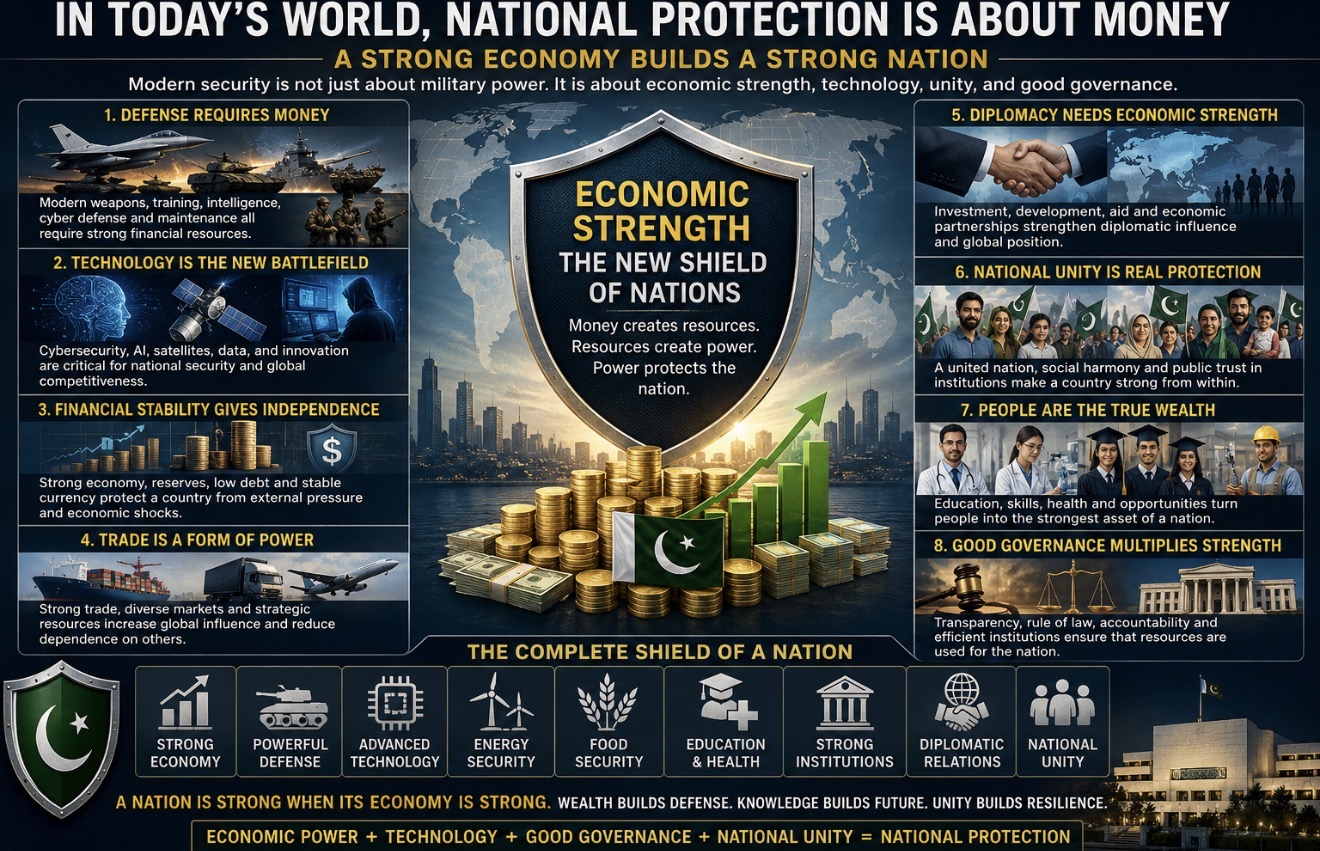
In the Modern World, National Protection Is About Money
Economic Power: The New Shield of Nations
In the past, the security of a country was largely measured by the size of its army, the number of its weapons, and the strength of its borders. Military power was considered the ultimate guarantee of national survival.
Today, the world has changed.
Modern national security is no longer limited to tanks, aircraft, missiles, or soldiers. A country’s economic strength has become one of its most powerful forms of protection. A strong economy provides the resources required to maintain defense, develop advanced technology, support national institutions, protect critical infrastructure, and withstand international pressure.
In the twenty-first century, money does not simply create wealth. It creates strategic choices.
Money Creates National Strength
A country with a strong and stable economy has greater freedom to make its own decisions.
It can invest in modern defense systems, cybersecurity, intelligence, artificial intelligence, education, healthcare, energy, food security, and infrastructure. It can support its citizens during economic crises and protect essential industries during international disruptions.
A financially weak country, even if it possesses a large population or a powerful military, can face serious limitations.
When a nation depends heavily on foreign loans, imported energy, foreign technology, or external financial assistance, its strategic independence can become vulnerable.
Therefore, economic independence is increasingly becoming a part of national security.
Defense Requires Economic Power
Military strength cannot be maintained without money.
Modern defense requires advanced aircraft, naval systems, satellites, missiles, drones, cybersecurity, intelligence networks, communications systems, research laboratories, and highly trained personnel.
All of these require enormous financial resources.
A country may purchase weapons once, but maintaining and upgrading them requires continuous investment. The same applies to cyber defense, artificial intelligence, space technology, and military research.
This creates an important principle:
A strong military ultimately requires a strong economy.
Economic power therefore acts as the foundation upon which sustainable military power is built.
Technology Has Become a New Battlefield
The definition of national security is expanding rapidly.
Cyberattacks can disrupt banks, airports, hospitals, power grids, communication networks, and government systems without a single traditional weapon being fired.
Artificial intelligence, semiconductors, satellites, telecommunications, biotechnology, drones, and data have become strategic assets.
Countries that control advanced technologies will have significant advantages in both economic competition and national security.
This means that investing in technology is no longer simply an economic decision.
It is a national-security decision.
Financial Stability Protects a Country From External Pressure
Economic weakness can create political vulnerability.
When a country faces severe debt, inflation, unemployment, currency instability, or shortages of essential goods, external actors can gain greater influence over its decisions.
On the other hand, a country with strong foreign-exchange reserves, diversified exports, reliable energy supplies, productive industries, and a stable financial system has greater ability to resist external pressure.
Financial stability gives governments time, options, and independence.
That is why economic resilience should be considered part of national defense.
Trade Is Also a Form of Power
International trade has become one of the most important instruments of national influence.
Countries that produce essential goods, control important supply chains, possess strategic resources, or operate major financial and technological networks can exercise enormous global influence.
Trade relationships can create partnerships, but economic dependence can also create vulnerabilities.
For this reason, countries increasingly seek to diversify their suppliers, markets, energy sources, and manufacturing capabilities.
A nation should not necessarily produce everything itself, but it should ensure that critical national needs cannot easily be used against it.
Diplomacy Needs Economic Strength
Money also increases diplomatic influence.
Countries with large economies can provide investment, development assistance, humanitarian support, infrastructure financing, and access to important markets.
Economic relationships can create political partnerships and strengthen a country’s position in international organizations.
This does not mean that wealthy countries always get their way.
Rather, economic strength gives a country more diplomatic tools.
A financially strong nation can negotiate from a position of greater confidence.
National Unity Is Another Form of Protection
Economic power alone is not enough.
A country can possess natural resources, a large population, and significant financial assets, yet remain vulnerable if its society is deeply divided or its institutions are weak.
National security ultimately depends on people.
Citizens need confidence in their institutions. Businesses need predictable laws. Investors need stability. Young people need education and opportunities. Different regions and communities need to believe that they have a meaningful place in the national future.
Therefore, social stability and national unity are economic assets as well as political assets.
The Real Wealth of a Nation Is Its People
Money is not only found in bank accounts or foreign-exchange reserves.
The greatest long-term wealth of a country is its human capital.
Educated engineers, scientists, doctors, entrepreneurs, programmers, skilled workers, researchers, teachers, and responsible citizens create economic and technological strength.
A country that invests in its young generation is investing directly in its future security.
The countries that will be strongest in the coming decades will not necessarily be those with the largest armies.
They will increasingly be those with the best combination of education, technology, innovation, economic productivity, institutional strength, and strategic vision.
Money Is a Shield—But Not the Whole Shield
It would be incorrect to say that money alone can protect a country.
A nation also needs:
Strong institutions.
Good governance.
Rule of law.
National unity.
Military capability.
Technological independence.
Energy security.
Food security.
Diplomatic relationships.
And a productive economy.
Money provides the resources, but leadership determines how those resources are used.
A wealthy country with poor governance can waste its potential. A country with limited resources but strong institutions, discipline, education, and strategic planning can achieve remarkable strength.
The New Definition of National Security
The traditional definition of national security was simple:
Protect the borders.
The modern definition is much broader:
Protect the economy, people, technology, energy, food supply, financial system, infrastructure, information, institutions, and sovereignty.
The battlefield of the future may not always be a physical battlefield.
It may be a financial market.
It may be a cyber network.
It may be a supply chain.
It may be a technological race.
It may be an energy crisis.
It may be a competition for investment, talent, data, or critical resources.
Therefore, countries must prepare for economic and technological competition just as seriously as they prepare for military conflict.
Conclusion: Wealth Creates Strategic Freedom
The world is entering an era in which economic power and national security are becoming inseparable.
A country with a strong economy can finance its defense, invest in technology, protect its citizens, support its industries, withstand international shocks, and negotiate with greater confidence.
A country with a weak economy may find that even its political and military independence becomes increasingly difficult to maintain.
The lesson is not that “money is everything.”
The deeper lesson is:
“In the modern world, economic strength is the foundation of national protection, because wealth gives a nation the resources, resilience, technology, and strategic freedom to defend its sovereignty.”
The countries that understand this reality and invest in their economies, people, technology, institutions, and national unity will be better prepared for the challenges of the future.
Today, the strongest shield of a nation may not be built only with steel and weapons. It is also built with capital, knowledge, technology, productivity, and the economic strength of its people.


Comments
Post a Comment