The Rising Tensions in Pakistan and Azad Kashmir.
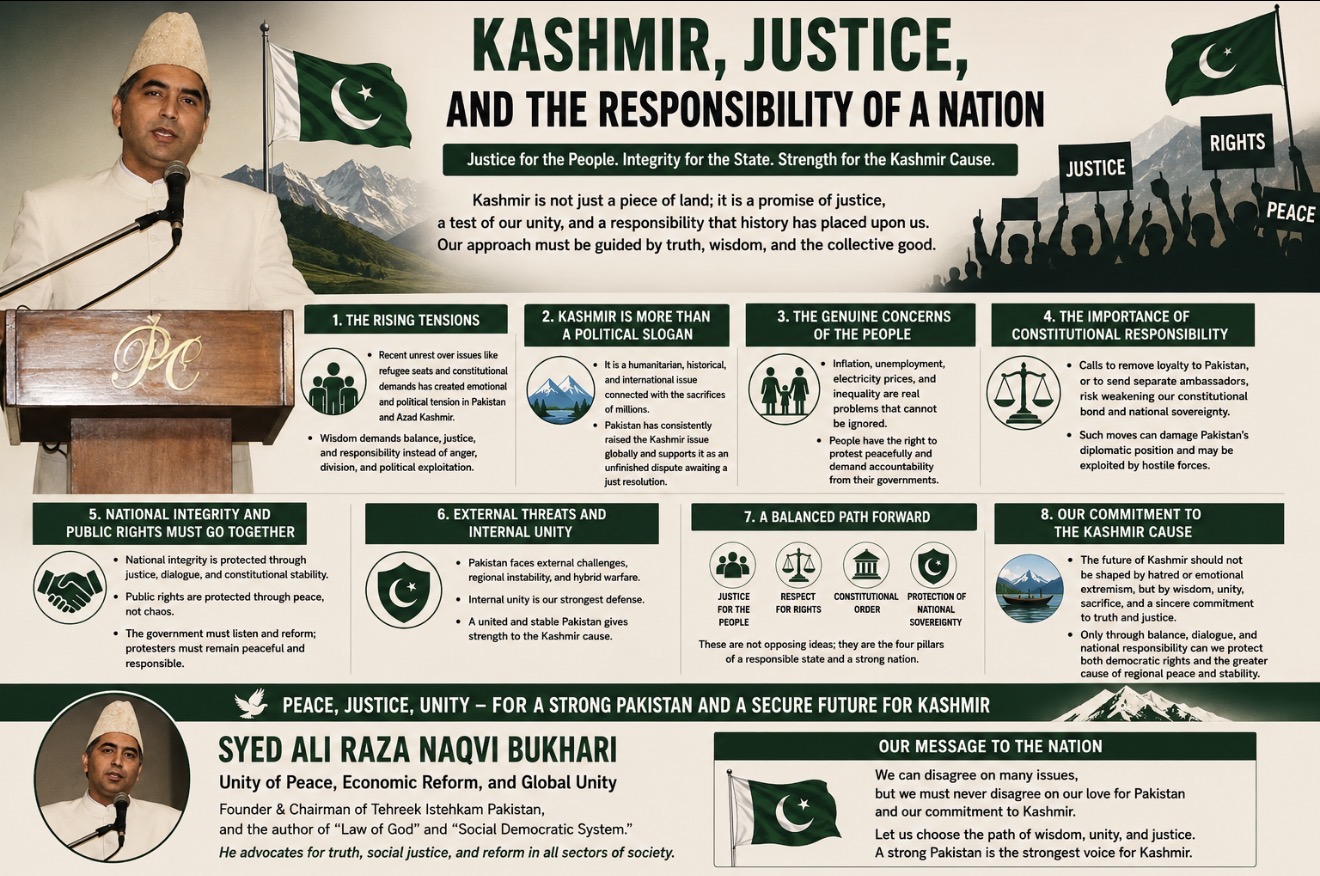 Kashmir, Justice, and the Responsibility of a Nation
The Rising Tensions in Pakistan and Azad Kashmir
The recent unrest surrounding Kashmir-related issues in Pakistan and Azad Jammu & Kashmir has once again exposed the deep emotions, frustrations, and political sensitivities attached to the Kashmir cause. From debates over refugee seats to demands for constitutional changes, the atmosphere has become emotionally charged. In such times, wisdom demands balance, justice, and responsibility instead of anger, division, and political exploitation.
Kashmir Is More Than a Political Slogan
Kashmir is not merely a political slogan. It is a humanitarian, historical, and international issue connected with the sacrifices of millions of people over decades. Pakistan has consistently raised the Kashmir issue at international forums and has spent enormous political, diplomatic, and economic resources to keep the cause alive.
The representation of Kashmiri refugees and the constitutional structure connected to the issue were never intended as ordinary administrative arrangements. They became symbols of an unresolved international dispute awaiting a fair resolution according to the will of the Kashmiri people.
The Genuine Concerns of the People
At the same time, it is equally true that the people of Azad Kashmir face genuine hardships. Inflation, unemployment, electricity prices, economic inequality, and public frustration are real issues that cannot be ignored.
In every democratic society, people have the right to protest peacefully and demand accountability from their governments. Public anger should not automatically be labeled as disloyalty, nor should every dissenting voice be treated as an enemy of the state.
The Importance of Constitutional Responsibility
However, there is also a line that responsible nations and societies must recognize.
Calls for removing loyalty to Pakistan from constitutional oaths, demands for parallel diplomatic representation abroad, or attempts to weaken the constitutional relationship between Pakistan and Azad Kashmir create serious concerns regarding national unity and state sovereignty.
Such demands may emotionally appeal to certain groups, but they also risk damaging Pakistan’s long-standing diplomatic position on Kashmir. More importantly, hostile forces in the region can exploit internal divisions to weaken both Pakistan and the Kashmir cause internationally.
National Integrity and Public Rights Must Go Together
National integrity is not maintained through force alone; it is protected through justice, inclusion, dialogue, and constitutional stability. Likewise, public rights are not protected through chaos, violence, or attacks on institutions.
Both the state and protesters must understand their responsibilities.
The government must avoid excessive force, listen to legitimate grievances, and engage with people politically instead of treating every issue solely through a security lens. On the other hand, protest movements must remain peaceful, constitutional, and mindful of the larger national interest.
When protests turn violent or when rhetoric begins to undermine the state itself, the entire society suffers.
External Threats and Internal Unity
Pakistan today faces external challenges, regional instability, economic pressures, and continuous hybrid warfare from hostile actors. In such circumstances, internal unity becomes essential.
This does not mean silence against injustice. Rather, it means pursuing reform and accountability without weakening the foundations of the state.
The Kashmir cause can only remain strong when it is supported by political maturity, national cohesion, and moral credibility. The world listens to nations that appear stable, united, and principled — not divided by internal conflict and mutual hostility.
A Balanced Path Forward
Justice for the people, respect for democratic rights, constitutional order, and protection of national sovereignty are not opposing ideas. They are interconnected pillars of a responsible state.
The future of Kashmir should not be shaped by hatred or emotional extremism, but by wisdom, unity, sacrifice, and a sincere commitment to truth and justice.
Only through balance, dialogue, and national responsibility can Pakistan and the people of Kashmir protect both democratic rights and the greater cause of regional peace and stability.
Syed Ali Raza Naqvi Bukhari
Unity of Peace, Economic Reform, and Global Unity
Founder & Chairman of Tehreek Istehkam Pakistan, and the author of “Law of God” and “Social Democratic System.” advocates for truth, social justice, and reform in all sectors of society.


Comments
Post a Comment