United Arab Emirates: From Desert Settlements to a Global Power.
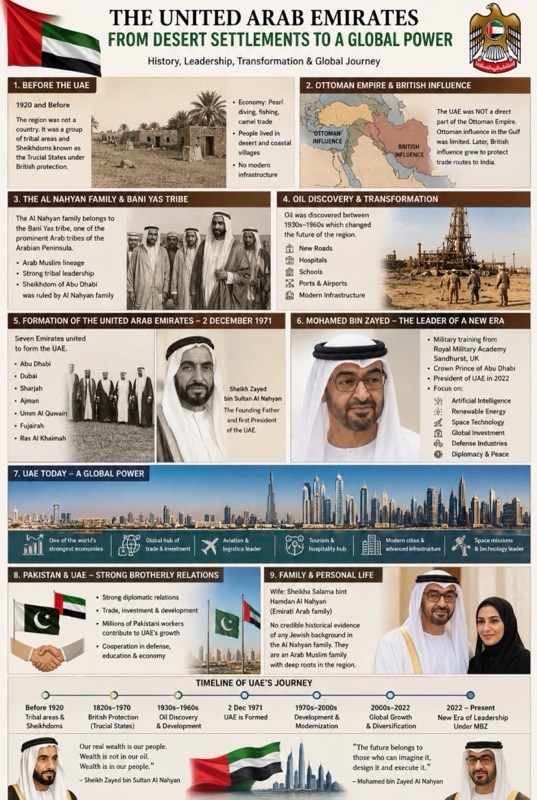 United Arab Emirates: From Desert Settlements to a Global Power.
Introduction
United Arab Emirates is today considered one of the world’s most modern, influential, and economically powerful nations. However, only a few decades ago, the region consisted mainly of desert tribes, coastal villages, pearl divers, and small trading communities.
Cities like Dubai and Abu Dhabi are now global centers of:
- Trade
- Tourism
- Aviation
- Technology
- International investment
This remarkable transformation is closely connected to the leadership of the Al Nahyan family, particularly Zayed bin Sultan Al Nahyan and Mohamed bin Zayed Al Nahyan.
The Region Before the UAE
The Arabian Gulf in the 1920s
Before 1971, the UAE did not exist as a unified country. The region was made up of separate tribal territories and Sheikhdoms known by the British as the “Trucial States.”
At that time:
- Most people lived in desert or coastal settlements
- The economy depended on pearl diving, fishing, and camel trade
- Infrastructure was extremely limited
- Tribal traditions shaped society and governance
The harsh desert environment made life difficult, and access to education, healthcare, and modern facilities was minimal.
Was the UAE Part of the Ottoman Empire?
Ottoman Empire controlled large parts of the Arab world for centuries, including regions such as Iraq, Syria, and the Hejaz. However, the territory of today’s UAE was not fully integrated as a permanent Ottoman province.
Instead:
- Local Arab tribes controlled most coastal areas
- The Ottoman influence in the Gulf remained limited
- British influence gradually became stronger during the 19th and 20th centuries
The British established agreements with local rulers to secure maritime trade routes connected to India.
The Al Nahyan Family and Bani Yas Tribe
Mohamed bin Zayed Al Nahyan belongs to the Bani Yas tribal confederation, one of the most prominent Arab tribes of the Arabian Peninsula.
The Al Nahyan family historically:
- Followed Bedouin Arab traditions
- Played important tribal leadership roles
- Emerged as rulers of Abu Dhabi
Claims About Jewish Origins
There are occasional rumors and conspiracy theories on social media regarding the origins of Gulf ruling families. However, there is no credible historical evidence that the Al Nahyan family had a Jewish ethnic background.
Historians and historical records consistently describe the family as an Arab Muslim ruling dynasty.
Similarly, Salama bint Hamdan Al Nahyan is publicly known as belonging to an Emirati Arab family.
Oil Discovery and Economic Transformation
The discovery of oil between the 1930s and 1960s dramatically changed the future of the Gulf region.
Oil revenues allowed the region to build:
- Roads and highways
- Hospitals and schools
- Modern ports and airports
- Advanced infrastructure
The transformation from desert settlements to modern cities happened within only a few decades.
Formation of the United Arab Emirates
On December 2, 1971, seven emirates united to form the UAE:
- Abu Dhabi
- Dubai
- Sharjah
- Ajman
- Fujairah
- Umm Al Quwain
- Ras Al Khaimah
Zayed bin Sultan Al Nahyan became the country’s first president and is widely regarded as the founding father of modern UAE.
His vision focused on:
- National unity
- Economic development
- Education
- Healthcare
- Public welfare
Rise of Mohamed bin Zayed
Mohamed bin Zayed received military training at the famous Royal Military Academy Sandhurst in the United Kingdom.
He later became:
- Crown Prince of Abu Dhabi
- A leading military figure
- President of the UAE in 2022
Under his leadership, the UAE expanded into:
- Artificial Intelligence
- Renewable Energy
- Space Technology
- Global Investment
- Defense Industries
Today, the UAE plays a major role in Middle Eastern diplomacy and global economics.
UAE’s Global Influence Today
The UAE is now recognized as:
- A major financial hub
- A center of international tourism
- One of the Middle East’s strongest economies
- A leading aviation and logistics center
Dubai and Abu Dhabi symbolize rapid modernization and strategic planning.
Pakistan–UAE Relations
Pakistan and the UAE have maintained strong relations for decades.
Areas of cooperation include:
- Trade and investment
- Employment opportunities for Pakistani workers
- Defense and diplomacy
- Infrastructure and development projects
Millions of Pakistanis have contributed to the UAE’s growth and development.
Conclusion
The story of the UAE is one of the most remarkable transformations in modern history. Within a relatively short period, the region evolved from isolated desert settlements into a globally influential state.
This transformation was driven by:
- Oil wealth
- Long-term planning
- Political stability
- Strategic leadership
- Economic diversification
The leadership of the Al Nahyan family, especially Sheikh Zayed and Mohamed bin Zayed, played a central role in shaping the modern UAE.
Syed Ali Raza Naqvi Bukhari
Unity of Peace, Economic Reform, and Global Unity
Founder & Chairman of Tehreek Istehkam Pakistan, and the author of “Law of God” and “Social Democratic System.” advocates for truth, social justice, and reform in all sectors of society.


Comments
Post a Comment