Pakistan Prevented a Global Economic Crisis and Averted World War III.
Picture just for Reference
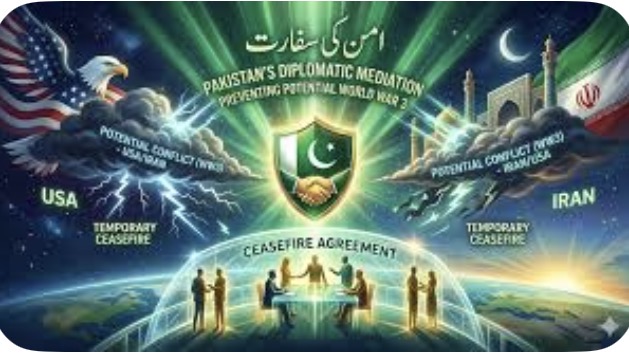
Pakistan Prevented a Global Economic Crisis and Averted World War III.
Islamabad
In a world standing on the edge of escalating conflict and economic instability, Pakistan has emerged not merely as a participant—but as a decisive peacemaker. The recent diplomatic developments centered in Islamabad reflect a powerful reality: preventing war is the greatest victory, and Pakistan has taken a historic step in that direction.
From Escalation to Engagement
At a time when tensions between the United States and Iran were intensifying—threatening not only regional stability but global peace—the possibility of confrontation loomed dangerously close. Such a conflict could have escalated into a broader war with global consequences.
Amid this volatile situation, Pakistan stepped forward as a neutral and trusted mediator.
The expected arrival of JD Vance, leading a high-level American delegation, signals the seriousness of these talks. Alongside him, key diplomatic figures are also expected, including Steve Witkoff, further strengthening the American negotiating team.
Iran’s High-Level Representation
On the Iranian side, the presence of senior leadership reflects equal commitment to dialogue. Among those expected:
- Abbas Araghchi
- Mohammad Bagher Ghalibaf
Their participation highlights that these are not routine diplomatic engagements, but high-stakes negotiations with global implications.
Islamabad: The New Center of Global Diplomacy
Islamabad has rapidly transformed into a global diplomatic hub, where rivals are willing to sit together. This reflects Pakistan’s:
- Strategic balance in foreign policy
- Quiet but effective diplomacy
- Credibility across geopolitical divides
Under the leadership of Shehbaz Sharif and Asif Ali Zardari, Pakistan has built bridges where others saw barriers.
Preventing an Economic Catastrophe
Strait of Hormuz
The importance of these negotiations goes far beyond diplomacy. Nearly 20% of global oil supply passes through the Strait of Hormuz. Any escalation in the region could have triggered:
- Massive oil price spikes
- Global inflation
- Financial market instability
- Severe economic disruption worldwide
By facilitating dialogue, Pakistan has played a critical role in preventing a potential global economic crisis.
A Model of Peace-Based Leadership
Pakistan’s approach reflects a new model of global leadership—one based not on force, but on facilitation and trust. It has demonstrated that:
- Dialogue can replace confrontation
- Neutrality can build credibility
- Mediation can reshape global outcomes
The True Meaning of Victory
This moment redefines victory in international relations:
“Winning a war is not victory; preventing one is.”
By bringing together leaders from opposing sides—including the United States and Iran—Pakistan has helped shift the world away from conflict and toward cooperation.
Conclusion
With the arrival of top leaders—including JD Vance, Steve Witkoff, Abbas Araghchi, and Mohammad Bagher Ghalibaf—Islamabad stands at the center of a defining global moment.
To say that Pakistan has helped prevent a global economic crisis and contributed to averting the possibility of a Third World War reflects a powerful and emerging geopolitical reality.
Pakistan did not just host negotiations—it helped change the course of history.
Author
Syed Ali Raza Naqvi Bukhari
Unity of Peace, Economic Reform, and Global Unity
Founder & Chairman of Tehreek Istehkam Pakistan, and the author of “Law of God” and “Social Democratic System.” advocates for truth, social justice, and reform in all sectors of society.


Comments
Post a Comment