Pakistan: A Safe Air Corridor While the Middle East Faces War Disruptions
Picture just for reference
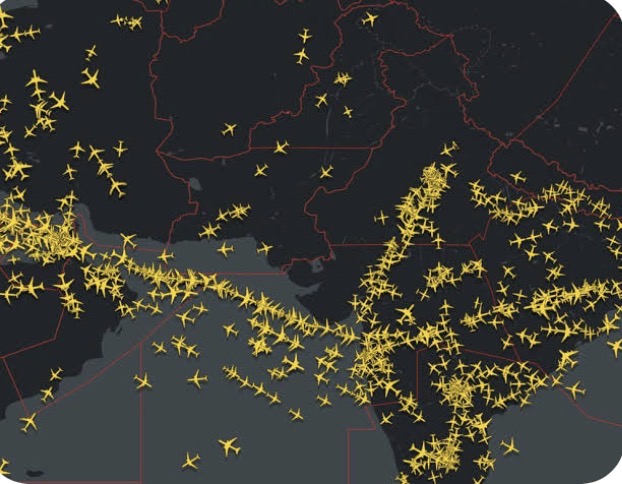
Pakistan: A Safe Air Corridor While the Middle East Faces War Disruptions
The escalating tensions and military confrontations across the Middle East have created one of the most serious aviation disruptions in recent years. As conflicts intensify across the region, several countries have restricted or temporarily closed their airspace, causing thousands of flight cancellations and major disruptions to global air travel.
However, in the midst of this crisis, Pakistan has emerged as one of the safest and most stable aviation corridors in the region.
Due to ongoing hostilities involving Iran, Israel, and the strategic involvement of the United States and other regional actors, multiple Middle Eastern airspaces have been either partially closed or heavily restricted. As a result, airlines around the world have been forced to reroute flights, avoid conflict zones, and suspend operations to several destinations.
Countries such as Iraq, Qatar, and parts of the Gulf region have witnessed severe aviation disruptions. Major airports have experienced delays, diversions, and temporary shutdowns as safety concerns for civilian aircraft continue to grow.
In contrast, Pakistan has maintained a fully operational and secure airspace. The country’s aviation authorities have confirmed that Pakistan’s skies remain open for both domestic and international flights, including overflight traffic from global airlines seeking safer alternative routes.
This stability has positioned Pakistan as an important strategic air corridor connecting Asia, Europe, and parts of the international aviation network during a time of geopolitical turbulence.
Pakistan’s ability to maintain aviation stability despite regional instability reflects not only effective airspace management but also the country’s broader role as a stabilizing factor in a volatile region. While much of the Middle East struggles with the consequences of escalating conflict, Pakistan continues to provide safe passage for global air traffic.
In times of global uncertainty, such stability becomes a valuable asset for international travel, commerce, and diplomacy.
Syed Ali Raza Naqvi Bukhari
Unity of Peace, Economic Reform, and Global Unity
Founder & Chairman of Tehreek Istehkam Pakistan, and the author of “Law of God” and “Social Democratic System.” Advocate for truth, social justice, and reform in all sectors of society.


Comments
Post a Comment