America–Israel Adventure Against Iran: Much Ado About Nothing
Picture just for Reference only
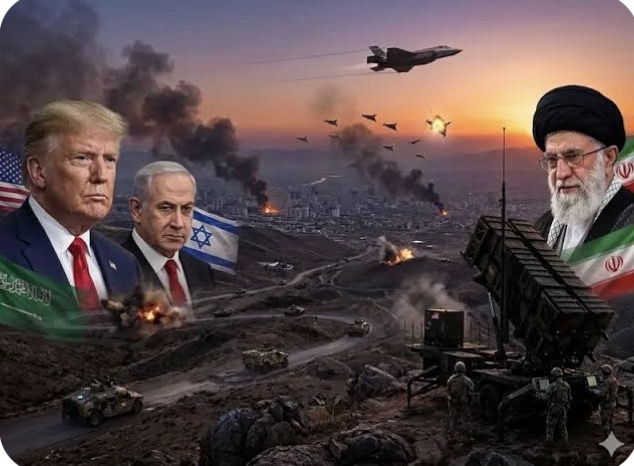
America–Israel Adventure Against Iran: Much Ado About Nothing
The Middle East has long remained a focal point of global geopolitical tensions. In recent developments, United States and Israel adopted an aggressive posture toward Iran, aiming to curb Tehran’s regional influence and strategic capabilities. However, when the dust settles, an important question emerges: What did America and Israel truly achieve from this confrontation?
1. The Historical Power Struggle in the Middle East
For decades, the Middle East has been a theater for global strategic competition due to its vast energy resources, geopolitical location, and critical trade routes.
The United States has traditionally supported Israel to maintain influence in the region, while Iran has positioned itself as an independent power challenging Western dominance.
This rivalry has produced recurring cycles of tension, sanctions, and limited military confrontations.
2. Strategic Objectives of the United States and Israel
The strategic objectives behind the pressure on Iran were widely understood to include:
- Limiting Iran’s nuclear ambitions
- Reducing Iran’s regional influence
- Strengthening Israel’s security position
- Preserving American dominance in the Middle East
While these goals were clear on paper, their realization in practice proved far more complicated.
3. The Dream of Regime Change
Certain policymakers in Washington and Tel Aviv believed that sustained pressure, sanctions, and military intimidation might trigger political change inside Iran.
However, Iran’s political system proved far more resilient than expected. Institutions such as the Islamic Revolutionary Guard Corps played a critical role in maintaining internal stability and defending the state structure.
External pressure often strengthened internal unity rather than weakening it.
4. Iran’s Strategic Resistance
Instead of capitulating, Iran adopted a strategy of resistance and strategic patience.
This included:
- Expanding missile capabilities
- Strengthening regional alliances
- Adjusting its economy to withstand sanctions
These measures allowed Iran to sustain pressure while avoiding total collapse under international sanctions.
5. Impact on the Global Economy
The confrontation did not remain confined to regional politics. It produced ripple effects across the global economy.
Key consequences included:
- Rising oil prices
- Increased global inflation
- Instability in financial markets
Because the Middle East is central to global energy supply, any major confrontation in the region inevitably affects international markets.
6. What Did the United States and Israel Gain?
When the outcomes are examined objectively, the results appear mixed at best.
- Iran’s regime remained intact
- Regional tensions increased
- Global economic uncertainty grew
- No decisive political or military victory emerged
These realities have led many analysts to question whether the confrontation achieved its intended strategic objectives.
7. Lessons for the Region and the World
The situation highlights a broader lesson: conflicts driven by power politics often produce instability without delivering lasting solutions.
Diplomacy, regional cooperation, and economic engagement may ultimately prove more effective than confrontation in ensuring long-term stability.
Conclusion
In the end, the confrontation between United States, Israel, and Iran appears to have yielded limited strategic gains.
For many observers, the episode resembles a costly political gamble whose results fell short of expectations—an adventure that generated tension and economic consequences without delivering decisive success.
Syed Ali Raza Naqvi Bukhari
Unity of Peace, Economic Reform, and Global Unity
Founder & Chairman of Tehreek Istehkam Pakistan, and the author of “Law of God” and “Social Democratic System.” Advocate for truth, social justice, and reform in all sectors of society.


Comments
Post a Comment