US–Iran Conflict: Escalation, Diplomacy, and the Future of Middle East Stability.
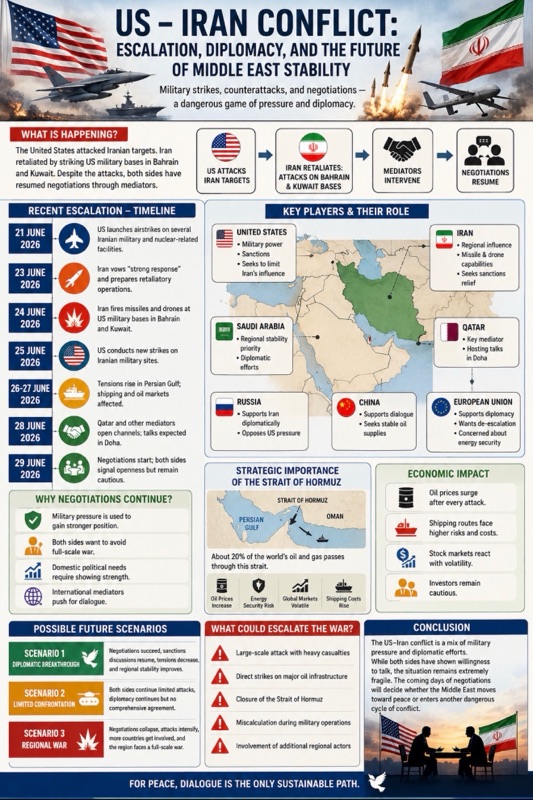 US–Iran Conflict: Escalation, Diplomacy, and the Future of Middle East Stability
Introduction
The confrontation between the United States and Iran has once again become one of the most dangerous geopolitical crises in the world. Following a series of military strikes, retaliatory attacks, and renewed diplomatic efforts, the region stands at a critical crossroads. While missiles and drones continue to shape the battlefield, negotiations are simultaneously taking place behind closed doors. This unusual combination of military confrontation and diplomacy reflects the complexity of modern international relations.
Background of the Conflict
For decades, tensions between the United States and Iran have revolved around Iran’s nuclear program, regional influence, economic sanctions, and security concerns in the Middle East. The rivalry intensified after repeated disagreements over nuclear activities, support for regional armed groups, and the security of maritime routes in the Persian Gulf.
Recent Military Escalation
The latest crisis escalated after U.S. military strikes targeted Iranian positions. Iran responded by launching missile and drone attacks against U.S. military facilities in Bahrain and Kuwait, while also threatening strategic maritime routes. Both sides accused each other of violating previous understandings and increasing regional instability.
Why Are Negotiations Continuing Despite Military Attacks?
At first glance, it may appear contradictory that both countries continue military operations while simultaneously preparing for negotiations. However, this is a common feature of international diplomacy.
Several strategic factors explain this approach:
- Military pressure is used to strengthen negotiating positions.
- Diplomatic channels remain open to prevent uncontrolled escalation.
- Both governments seek to satisfy domestic political audiences while avoiding a prolonged regional war.
- International mediators encourage dialogue to reduce the risk of wider conflict.
The Strategic Importance of the Strait of Hormuz
One of the most critical issues is the Strait of Hormuz, through which roughly one-fifth of the world’s oil and natural gas supplies pass. Any disruption to this shipping lane immediately affects global energy prices, financial markets, and international trade.
Recent attacks have once again highlighted the vulnerability of this strategic waterway.
Role of Regional and International Mediators
Several countries have attempted to reduce tensions by encouraging dialogue.
Key diplomatic actors include:
- Qatar
- Oman
- Pakistan
- European partners
- Other regional mediators
These governments have worked to establish communication channels between Washington and Tehran in an effort to preserve ceasefire arrangements and resume formal negotiations.
Economic Consequences
The conflict has immediate global economic implications.
Major impacts include:
- Rising oil prices
- Increased shipping insurance costs
- Market volatility
- Concerns over energy security
- Greater uncertainty for international investors
Although energy exports have continued, markets remain highly sensitive to every military development.
Can the War Expand?
Most strategic analysts believe neither Washington nor Tehran seeks a full-scale conventional war.
However, several developments could rapidly worsen the situation:
- A large-scale attack causing heavy casualties
- Direct strikes on major energy infrastructure
- Closure of the Strait of Hormuz
- Miscalculation during military operations
- Involvement of additional regional actors
Such events could transform the current confrontation into a much broader regional conflict.
Possible Future Scenarios
Scenario One: Diplomatic Breakthrough
Negotiations succeed, military operations gradually decrease, sanctions discussions resume, and regional stability improves.
Scenario Two: Limited Military Confrontation
Both countries continue occasional military strikes while maintaining diplomatic contacts without achieving a comprehensive agreement.
Scenario Three: Regional War
Negotiations collapse, attacks intensify, additional countries become involved, and the conflict spreads throughout the Middle East.
Current developments suggest that the second scenario remains the most likely in the near term.
Conclusion
The current U.S.–Iran confrontation demonstrates that modern conflicts are no longer fought exclusively on the battlefield. Military operations and diplomacy often proceed simultaneously as governments seek both strategic advantage and political flexibility.
Although the recent exchange of attacks has raised fears of a wider regional war, ongoing diplomatic initiatives indicate that neither side appears eager for a prolonged full-scale conflict. The coming rounds of negotiations will likely determine whether the Middle East moves toward de-escalation or enters another dangerous cycle of confrontation.


Comments
Post a Comment