The Islamabad Memorandum: A Historic Path Toward Peace Between the United States and Iran.
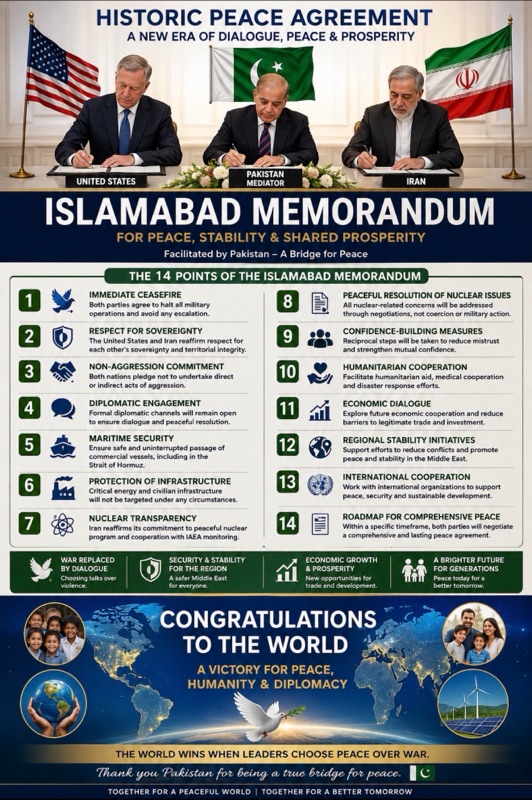
The Islamabad Memorandum: A Historic Path Toward Peace Between the United States and Iran
Introduction
The Islamabad Memorandum represents one of the most significant diplomatic achievements of the 21st century. Facilitated by Pakistan and supported by the international community, the agreement seeks to end years of hostility between the United States and the Islamic Republic of Iran. At a time when the Middle East faces unprecedented security challenges, economic uncertainty, and geopolitical tensions, this memorandum offers a framework for peace, stability, and constructive engagement.
Pakistan’s role as a mediator has been widely recognized as a demonstration of responsible diplomacy and regional leadership. By bringing both parties to the negotiating table, Islamabad has helped create an opportunity for dialogue where confrontation once prevailed.
Objectives of the Memorandum
The primary goals of the Islamabad Memorandum are:
- To establish an immediate ceasefire and prevent further military escalation.
- To promote regional stability and international security.
- To ensure freedom of navigation and trade in strategic waterways.
- To address concerns regarding Iran’s nuclear program through peaceful means.
- To create a framework for long-term diplomatic engagement.
The Fourteen Principles of the Islamabad Memorandum
1. Immediate Ceasefire
Both parties agree to halt military operations and refrain from actions that could escalate tensions.
2. Respect for Sovereignty
The United States and Iran reaffirm their commitment to respecting each other’s sovereignty, territorial integrity, and political independence.
3. Non-Aggression Commitment
Both nations pledge not to undertake direct or indirect acts of aggression against one another.
4. Diplomatic Engagement
Formal diplomatic channels will remain open to facilitate continuous dialogue and conflict resolution.
5. Maritime Security
Both parties support the safe and uninterrupted passage of commercial vessels through international waterways, including the Strait of Hormuz.
6. Protection of Energy Infrastructure
Critical energy facilities and civilian infrastructure shall not be targeted during periods of disagreement or tension.
7. Nuclear Transparency
Iran reiterates its commitment to the peaceful use of nuclear technology and agrees to cooperate with international monitoring mechanisms.
8. Peaceful Resolution of Nuclear Issues
All nuclear-related concerns shall be addressed through negotiations rather than coercion or military action.
9. Gradual Confidence-Building Measures
A series of reciprocal confidence-building initiatives will be implemented to reduce mistrust and enhance cooperation.
10. Humanitarian Cooperation
The parties agree to facilitate humanitarian assistance, medical cooperation, and disaster response efforts.
11. Economic Dialogue
Mechanisms will be established to explore future economic cooperation and reduce barriers to legitimate trade.
12. Regional Stability Initiatives
Both nations will support efforts aimed at reducing conflicts and promoting stability throughout the Middle East.
13. International Cooperation
The agreement encourages collaboration with international organizations to support peace and development objectives.
14. Roadmap for a Comprehensive Peace Agreement
Within a specified timeframe, negotiations will continue toward a broader and more comprehensive peace settlement.
Pakistan’s Diplomatic Achievement
The Islamabad Memorandum highlights Pakistan’s growing role as a bridge-builder in international affairs. By maintaining constructive relations with both Washington and Tehran, Pakistan demonstrated its ability to facilitate meaningful dialogue during a period of heightened tension.
The success of this initiative reflects the importance of diplomacy, patience, and mutual respect in resolving complex international disputes.
Global Significance
The implications of the Islamabad Memorandum extend far beyond the United States and Iran. Reduced tensions can contribute to:
- Greater stability in global energy markets.
- Improved security in the Persian Gulf region.
- Enhanced investor confidence.
- Reduced risk of military confrontation.
- Stronger international cooperation on security and economic development.
Conclusion
The Islamabad Memorandum is more than a political agreement; it is a symbol of hope in an increasingly divided world. While challenges remain, the framework established through this memorandum provides a realistic pathway toward peace, stability, and mutual understanding.
History has repeatedly shown that lasting peace is achieved not through conflict but through dialogue. The Islamabad Memorandum stands as a testament to the power of diplomacy and the belief that even the most difficult disputes can be resolved through negotiation, trust, and shared commitment to a better future.
Syed Ali Raza Naqvi Bukhari
Founder & Chairman, Tehreek Istehkam Pakistan. Author of “Law of God” and “Social Democratic System.” Advocate of peace, reform, and social justice.


Comments
Post a Comment