The Iran–Israel–Lebanon Crisis and the Lessons of Power, Diplomacy, and Human Fragility.
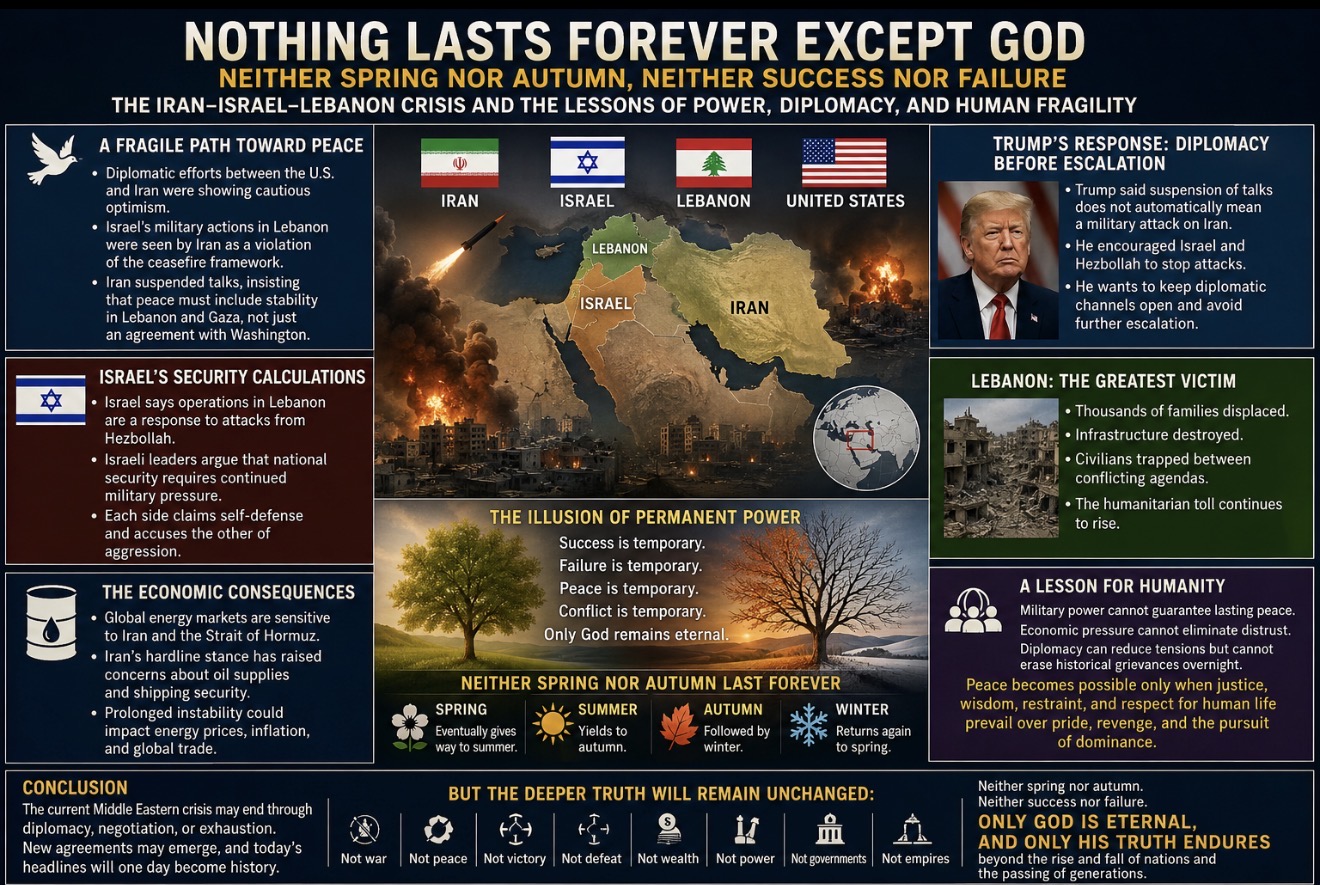 The Iran–Israel–Lebanon Crisis and the Lessons of Power, Diplomacy, and Human Fragility
The Middle East once again finds itself at the center of a dangerous geopolitical storm. What began as a fragile ceasefire and diplomatic effort between the United States and Iran has been shaken by renewed Israeli military operations in Lebanon, leading Iran to suspend negotiations and raising fears of a broader regional confrontation.
Yet beyond the headlines, missiles, and political statements lies a deeper lesson about the temporary nature of power, conflict, and political victory. Nations rise and fall, alliances change, wars begin and end, but one truth remains constant: nothing lasts forever except God.
A Fragile Path Toward Peace
Recent diplomatic efforts had created cautious optimism that tensions between the United States and Iran could be reduced through indirect negotiations. However, Iranian officials argued that Israeli military actions in Lebanon represented a violation of the broader ceasefire framework and therefore justified suspending talks.
According to reports, Tehran insists that any meaningful peace arrangement must include stability in Lebanon and Gaza, not merely an understanding between Washington and Tehran. Iran’s leadership has repeatedly stated that peace cannot be selective; it must apply across all fronts of conflict.
The suspension of negotiations demonstrates how interconnected the region has become. A military action in one country can instantly affect diplomatic efforts hundreds of miles away.
Trump’s Response: Diplomacy Before Escalation
President Donald Trump responded by emphasizing that the suspension of talks would not automatically lead to military action against Iran. Reports indicate that he sought to prevent further escalation and worked to preserve diplomatic channels despite growing tensions.
Trump also claimed to have encouraged both Israel and Hezbollah to halt attacks in order to preserve the possibility of broader negotiations and regional stability.
Whether these efforts ultimately succeed remains uncertain, but they reveal an important reality: even powerful nations often discover that diplomacy can achieve what military force cannot.
Israel’s Security Calculations
From Israel’s perspective, military operations in Lebanon are presented as necessary responses to attacks originating from Hezbollah-controlled areas. Israeli leaders argue that no government can tolerate continued rocket or drone attacks against its citizens without responding.
Israeli officials have therefore maintained that security concerns justify continued military pressure, even when international actors call for restraint.
This reflects one of the enduring dilemmas of international politics: every side claims self-defense, while every side also accuses the other of aggression.
Lebanon: The Greatest Victim
While global powers debate strategy and regional actors pursue their interests, Lebanon continues to suffer the most immediate consequences.
Thousands of families have faced displacement, infrastructure has been damaged, and ordinary citizens have become trapped between competing military and political agendas. Reports indicate that the humanitarian toll continues to grow as fighting persists.
History repeatedly demonstrates that wars are rarely won by civilians. They are usually the first victims and the last beneficiaries.
The Economic Consequences
The crisis is not limited to military and political dimensions. Global energy markets remain highly sensitive to developments involving Iran and the Strait of Hormuz.
Iran’s decision to tighten its position regarding maritime routes and suspend diplomatic engagement has increased concerns about global oil supplies and shipping security. Analysts warn that prolonged instability could significantly affect energy prices and international trade.
In today’s interconnected world, a missile launched in the Middle East can influence fuel prices, inflation, and economic stability across continents.
The Illusion of Permanent Power
Perhaps the most profound lesson from this crisis is the illusion of permanence.
Throughout history, empires have believed their dominance would last forever. Kings imagined their kingdoms eternal. Political leaders assumed their influence was unshakable. Yet history tells a different story.
The mighty empires of ancient Persia, Rome, the Ottomans, and countless others eventually faded. Powerful leaders became historical footnotes. Military victories that once appeared decisive became distant memories.
The current crisis reminds us that neither military strength nor political authority guarantees permanence.
Success is temporary.
Failure is temporary.
Peace is temporary.
Conflict is temporary.
Only God remains eternal.
Neither Spring Nor Autumn Last Forever
Nature itself teaches this lesson.
Spring eventually gives way to summer.
Summer yields to autumn.
Autumn is followed by winter.
And winter once again returns to spring.
Similarly, nations experience periods of prosperity and hardship. Individuals experience moments of triumph and disappointment. Political movements rise and decline. Governments come and go.
Those who achieve success should remain humble because success does not last forever.
Those who experience hardship should remain hopeful because hardship does not last forever either.
A Lesson for Humanity
The ongoing tensions among Iran, Israel, Lebanon, and the United States reveal both the strengths and limitations of modern politics. Military power can influence events, but it cannot guarantee lasting peace. Economic pressure can shape behavior, but it cannot eliminate distrust. Diplomacy can reduce tensions, but it cannot erase historical grievances overnight.
Ultimately, humanity’s greatest challenge is not technological or military—it is moral and spiritual.
Peace becomes possible only when justice, wisdom, restraint, and respect for human life prevail over pride, revenge, and the pursuit of dominance.
Conclusion
The current Middle Eastern crisis may eventually end through diplomacy, negotiation, or exhaustion. New agreements may emerge, and today’s headlines will one day become history.
But the deeper truth will remain unchanged:
Nothing lasts forever.
Not war.
Not peace.
Not victory.
Not defeat.
Not wealth.
Not power.
Not governments.
Not empires.
Neither spring nor autumn.
Neither success nor failure.
Only God is eternal, and only His truth endures beyond the rise and fall of nations and the passing of generations.
Syed Ali Raza Naqvi Bukhari
Unity of Peace, Economic Reform, and Global Unity
Founder & Chairman of Tehreek Istehkam Pakistan, and the author of “Law of God” and “Social Democratic System.” advocates for truth, social justice, and reform in all sectors of society.


Impressive
ReplyDelete