Pakistan: From a Nation of Promise to a State Seeking Renewal.
Pakistan: From a Nation of Promise to a State Seeking Renewal
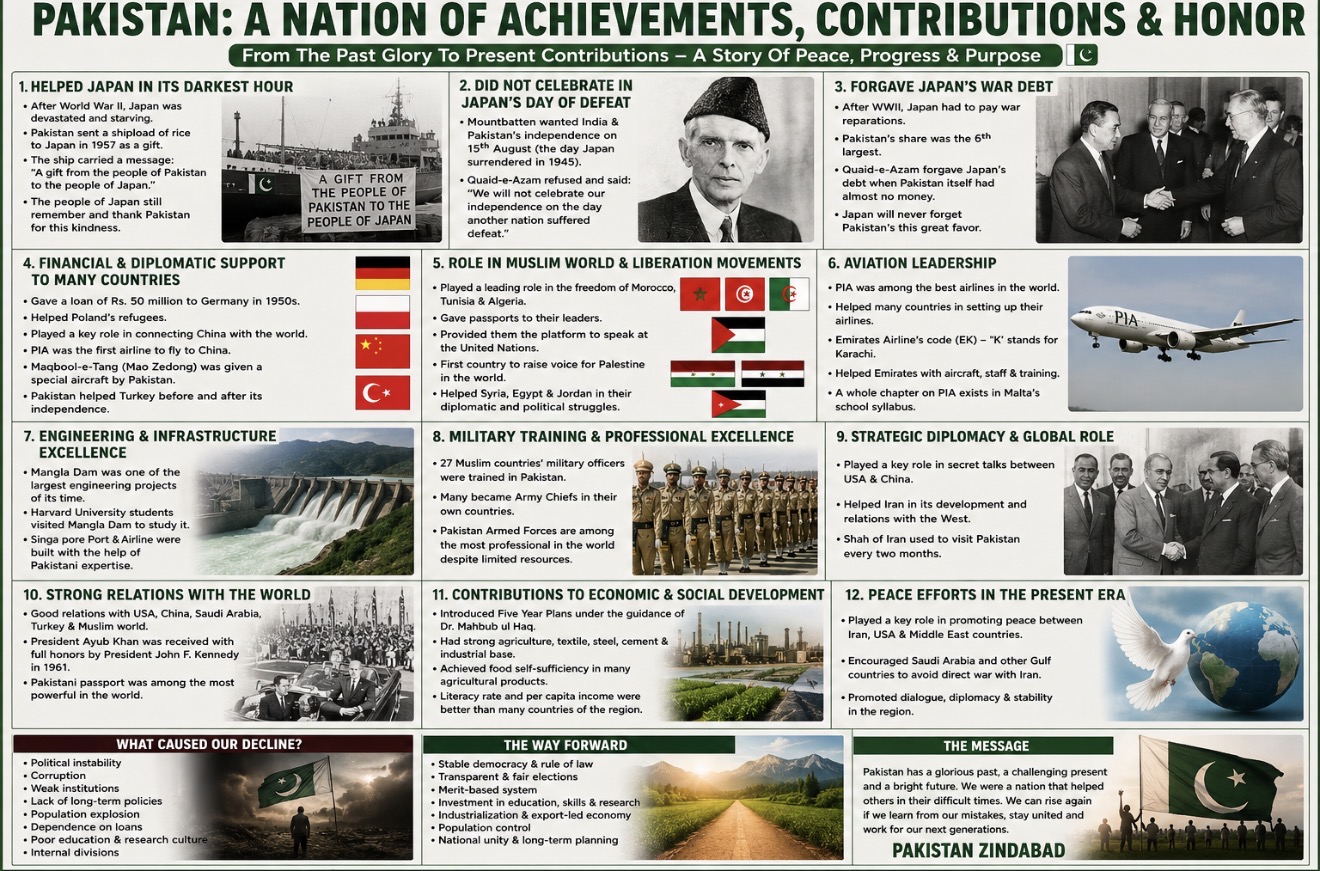
There was a time when Pakistan stood among the most respected emerging nations of the world. In the decades following independence, the country was not merely surviving—it was shaping regional diplomacy, helping newly independent states, building strategic partnerships, and presenting itself as a confident and capable Muslim nation.
Today, many young Pakistanis find it difficult to believe that their country once provided assistance to nations that are now economic giants. Yet history records a different Pakistan: a country with vision, confidence, diplomatic influence, and extraordinary strategic importance.
Pakistan and Japan: A Forgotten Chapter of Humanity
After the Second World War, Japan was devastated. Cities had been destroyed, the economy had collapsed, and millions faced hunger and hardship. During those difficult years, Pakistan extended humanitarian support to Japan, including shipments of rice and essential supplies. This act of goodwill created deep respect among many Japanese citizens toward Pakistan.
Historical narratives also suggest that Pakistan adopted a sympathetic diplomatic stance toward Japan after the war. While some popular stories may contain exaggerations, the broader reality remains true: Pakistan and Japan enjoyed remarkably warm relations in the early decades after independence.
This reflected a larger philosophy that Pakistan attempted to project in its formative years—a belief in dignity, cooperation, and respect among nations.
The Early Rise of Pakistan
In the 1950s and 1960s, Pakistan was often viewed as one of Asia’s most promising developing countries. Its economy was growing, its institutions were functioning comparatively well, and its international standing was surprisingly strong for a newly formed state.
Pakistan played an important role in connecting the Muslim world, the West, and Asia. It became a bridge between nations during the Cold War era and earned influence far beyond its economic size.
The country contributed diplomatically to relations between the United States and China, especially during the secret diplomacy that eventually led to the historic opening between Washington and Beijing. Pakistan International Airlines (PIA) became one of Asia’s leading airlines and was among the first foreign airlines to operate flights into China.
Pakistan also supported liberation movements and diplomatic causes in parts of Africa and the Muslim world, including Morocco, Algeria, Tunisia, and Palestine. In many international forums, Pakistan positioned itself as a voice for decolonization, Muslim solidarity, and developing nations.
Engineering, Aviation, and Strategic Prestige
Pakistan’s infrastructure projects once attracted global admiration. The Mangla Dam project was considered one of the great engineering achievements of its era. International experts and students studied its design and implementation as a symbol of modern development.
PIA was regarded among the better airlines in Asia and helped several countries develop aviation expertise. Pakistani pilots, engineers, and trainers were respected across the Middle East and beyond.
Military academies in Pakistan trained officers from dozens of Muslim countries, many of whom later rose to senior positions in their own states. Pakistan’s armed forces developed a reputation for professionalism despite limited economic resources.
Even global powers recognized Pakistan’s importance. During President Ayub Khan’s visit to the United States in 1961, he received a level of ceremonial welcome that reflected Pakistan’s strategic value during that period.
The Great Contradiction: Strong Strategy, Weak Economy
One of the most fascinating aspects of Pakistan’s history is the contrast between its strategic success and its economic struggles.
Despite economic instability, Pakistan has remained geopolitically significant for decades. It is a nuclear power situated at the crossroads of South Asia, Central Asia, China, the Middle East, and the Indian Ocean. Few countries occupy such a sensitive and important geographic position.
Pakistan has managed relationships with China, the United States, Saudi Arabia, Turkey, and Gulf states simultaneously while also dealing with Afghanistan and Iran—two highly complex neighbors.
This balancing act requires diplomatic sophistication and strategic flexibility that many stronger economies would struggle to maintain.
Pakistan’s Role in Regional Peace
In recent years, Pakistan has again attempted to position itself as a mediator and stabilizing force in regional crises.
During periods of rising tension involving Iran, the United States, and Middle Eastern states, Pakistan emphasized diplomacy, restraint, and dialogue. Rather than becoming part of a military bloc, it attempted to encourage negotiation and prevent wider regional escalation.
Many observers believe Pakistan quietly encouraged Gulf states to avoid direct large-scale confrontation with Iran and instead pursue diplomatic engagement. Whether publicly acknowledged or not, Pakistan’s strategic importance often allows it to influence regional conversations behind closed doors.
This reflects an old principle of Pakistani foreign policy:
maintaining relations with competing powers while avoiding complete alignment with any one side.
Why Did Pakistan Decline?
If Pakistan possessed such promise, why did it struggle to sustain its rise?
The reasons are complex:
- Political instability
- Repeated interruptions of democratic continuity
- Weak governance
- Corruption
- Inconsistent economic policies
- Poor investment in education and technology
- Population pressures
- Institutional conflicts
- Dependence on foreign loans
While other Asian nations focused on industrialization, technological innovation, exports, and educational reform, Pakistan often remained trapped in cycles of political confrontation and short-term policymaking.
The tragedy of Pakistan is not the absence of talent or resources.
The tragedy is the absence of continuity.
Can Pakistan Rise Again?
The answer is yes—but only through serious national reform.
Pakistan still possesses enormous strengths:
- A young population
- Strategic geography
- Military capability
- Agricultural potential
- Entrepreneurial talent
- International connections
- A resilient society
However, future success will depend on transforming strategic potential into economic strength.
To achieve this, Pakistan needs:
- Political stability
- Transparent and fair elections
- Rule of law
- Long-term economic planning
- Educational reform
- Industrial growth
- Technological investment
- Merit-based governance
- Population management
- Skill development for youth
Nations do not rise through emotion alone.
They rise through discipline, institutions, productivity, and vision.
A Nation at a Crossroads
Pakistan’s story is neither a story of total failure nor unlimited glory. It is the story of a nation with extraordinary potential that repeatedly touched greatness but struggled to sustain it.
Yet history also teaches another lesson:
nations can recover.
Germany and Japan rebuilt themselves after destruction.
China transformed itself within a generation.
South Korea rose from poverty into technological leadership.
Pakistan too can rebuild its reputation and strength—if it chooses national development over division, institutions over personalities, and long-term strategy over short-term politics.
The world still watches Pakistan carefully because despite all its crises, it remains too important to ignore.
The question is no longer whether Pakistan has potential.
The real question is whether Pakistan can once again convert that potential into progress.
Syed Ali Raza Naqvi Bukhari
Unity of Peace, Economic Reform, and Global Unity
Founder & Chairman of Tehreek Istehkam Pakistan, and the author of “Law of God” and “Social Democratic System.” advocates for truth, social justice, and reform in all sectors of society.


Comments
Post a Comment