New Chapter of Diplomacy Amid Global Uncertainty.
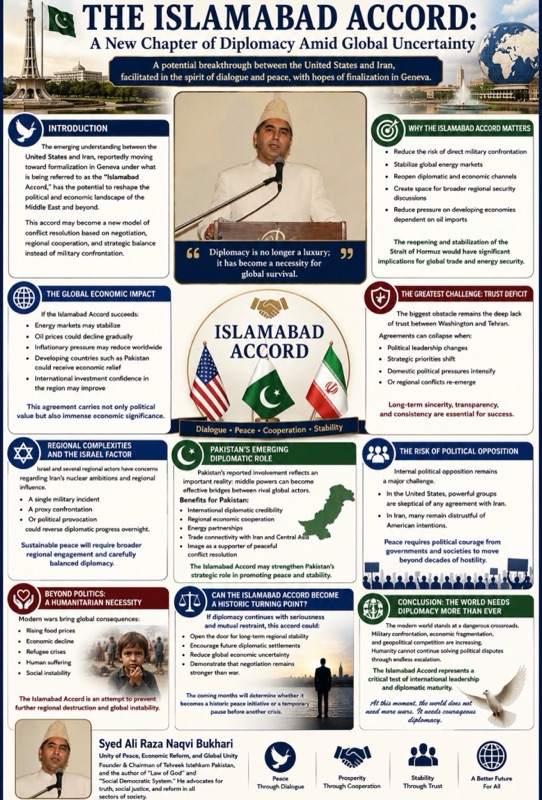
The Islamabad Accord ( Geneva
A )
New Chapter of Diplomacy Amid Global Uncertainty
Introduction: A Defining Moment in Modern Diplomacy
The emerging understanding between the United States and Iran, reportedly moving toward formalization in Geneva under what is being referred to as the “Islamabad Accord,” has the potential to reshape the political and economic landscape of the Middle East and beyond. At a time when the world is struggling with war, economic instability, rising polarization, and declining trust in international institutions, this diplomatic breakthrough has created cautious hope across global capitals.
If finalized successfully, the Islamabad Accord may become more than a temporary political arrangement. It could represent a new model of conflict resolution based on negotiation, regional cooperation, and strategic balance instead of military confrontation.
However, the path ahead remains extremely challenging.
Why the Islamabad Accord Matters
For decades, tensions between the United States and Iran have influenced nearly every major crisis in the Middle East. Sanctions, military threats, proxy conflicts, and nuclear disputes repeatedly pushed the region toward instability.
The proposed accord carries importance because it may:
- Reduce the risk of direct military confrontation.
- Stabilize global energy markets.
- Reopen diplomatic and economic channels.
- Create space for broader regional security discussions.
- Reduce pressure on developing economies dependent on oil imports.
The reopening and stabilization of the Strait of Hormuz alone would have significant implications for global trade and energy security.
The Global Economic Impact
The world economy remains vulnerable to geopolitical shocks. Every escalation in the Gulf region increases uncertainty in international markets. Oil prices rise rapidly, inflation spreads globally, and economically weaker nations suffer the most.
If the Islamabad Accord succeeds:
- Energy markets may stabilize.
- Oil prices could decline gradually.
- Inflationary pressure may reduce worldwide.
- Developing countries such as Pakistan could receive economic relief.
- International investment confidence in the region may improve.
This agreement therefore carries not only political value but also immense economic significance.
The Greatest Challenge: Trust Deficit
Despite the optimism, the biggest obstacle remains the deep lack of trust between Washington and Tehran.
History has shown that agreements can collapse when:
- Political leadership changes,
- Strategic priorities shift,
- Domestic political pressures intensify,
- Or regional conflicts re-emerge.
Previous diplomatic understandings failed because implementation mechanisms remained weak and political commitment faded over time.
The Islamabad Accord will only succeed if all sides move beyond symbolic diplomacy and demonstrate long-term sincerity, transparency, and consistency.
Regional Complexities and the Israel Factor
No Middle East agreement can succeed without considering regional security dynamics.
Israel continues to maintain serious concerns regarding Iran’s nuclear ambitions and regional influence. Several regional actors also fear that easing tensions with Iran may alter existing power balances.
This creates a fragile environment where:
- A single military incident,
- A proxy confrontation,
- Or political provocation
could reverse diplomatic progress overnight.
Therefore, sustainable peace will require broader regional engagement and carefully balanced diplomacy.
Pakistan’s Emerging Diplomatic Role
One of the most significant aspects of this development is Pakistan’s reported diplomatic involvement.
If Pakistan has indeed contributed toward facilitating dialogue, it reflects an important geopolitical reality: middle powers can still become effective bridges between rival global actors.
For Pakistan, the Islamabad Accord may strengthen:
- Its international diplomatic credibility,
- Regional economic cooperation,
- Energy partnerships,
- Trade connectivity with Iran and Central Asia,
- And its image as a supporter of peaceful conflict resolution.
This moment presents Pakistan with an opportunity to promote a foreign policy based on balance, stability, and constructive engagement.
The Risk of Political Opposition
Internal political opposition remains another major challenge.
Within the United States, there are powerful political groups skeptical of any agreement with Iran. Similarly, within Iran, many remain deeply distrustful of American intentions.
Diplomatic agreements often fail when domestic politics becomes stronger than long-term strategic vision.
Peace requires political courage — not only from governments but also from societies willing to move beyond decades of hostility.
Beyond Politics: A Humanitarian Necessity
Modern wars no longer remain limited to military battlefields. Their consequences spread across the world:
- Rising food prices,
- Economic decline,
- Refugee crises,
- Human suffering,
- And social instability.
Ordinary people pay the highest price for geopolitical conflicts they never created.
The Islamabad Accord should therefore not only be viewed as a political understanding between states. It should be understood as an attempt to prevent further regional destruction and global instability.
Can the Islamabad Accord Become a Historic Turning Point?
The answer depends entirely on implementation.
If diplomacy continues with seriousness and mutual restraint, this accord could:
- Open the door for long-term regional stability,
- Encourage future diplomatic settlements,
- Reduce global economic uncertainty,
- And demonstrate that negotiation remains stronger than war.
But if mistrust, political rivalry, or regional confrontation dominate again, the agreement may become another missed opportunity in modern history.
The coming months will determine whether the Islamabad Accord becomes:
- A historic peace initiative,
- Or merely a temporary pause before another crisis.
Conclusion: The World Needs Diplomacy More Than Ever
The modern world stands at a dangerous crossroads. Military confrontation, economic fragmentation, and geopolitical competition are increasing rapidly. Humanity cannot continue solving political disputes through endless escalation.
The Islamabad Accord represents a critical test of international leadership and diplomatic maturity.
History will ultimately remember those nations and leaders who chose dialogue over destruction, wisdom over hostility, and peace over permanent conflict.
At this moment, the world does not need more wars.
It needs courageous diplomacy.
Syed Ali Raza Naqvi Bukhari
Unity of Peace, Economic Reform, and Global Unity
Founder & Chairman of Tehreek Istehkam Pakistan, and the author of “Law of God” and “Social Democratic System.” He advocates for truth, social justice, and reform in all sectors of society.


Comments
Post a Comment