National Institutions, Accountability, and the Need for Balanced Thinking
 National Institutions, Accountability, and the Need for Balanced Thinking
Introduction
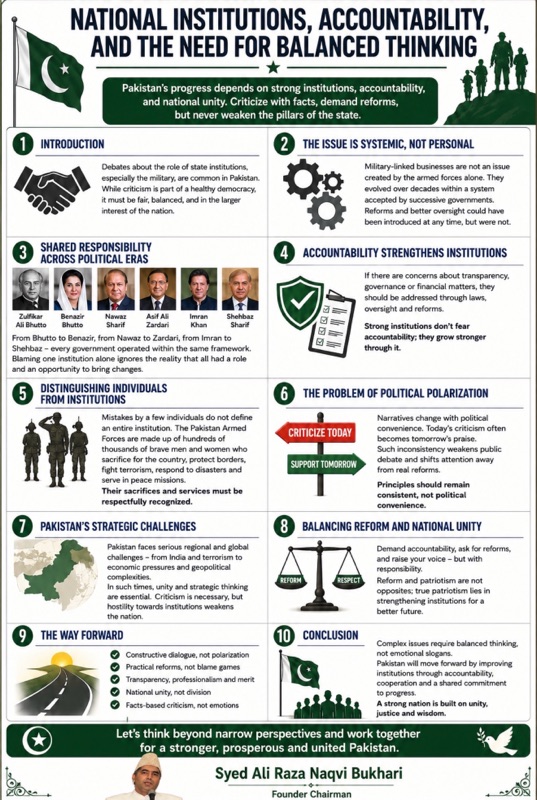
Pakistan has long witnessed debates regarding the role of state institutions, particularly the military, in politics, governance, and economic activities. Among the most discussed issues are the business enterprises associated with the armed forces. While public scrutiny and criticism are essential elements of a democratic society, it is equally important to approach these matters with objectivity, fairness, and a broader understanding of national interests.
The Issue Is Systemic, Not Personal
Many critics portray military-owned or military-linked companies as a problem created solely by the armed forces. However, the reality is far more complex. These enterprises evolved over decades within a system that was accepted, regulated, or tolerated by successive governments.
Civilian administrations had both the authority and the opportunity to introduce reforms, establish stronger oversight mechanisms, or transfer such entities into different forms of public ownership. Yet governments led by different political parties chose not to pursue substantial structural changes. Therefore, the issue should be viewed as a systemic challenge rather than the responsibility of a single institution.
Shared Responsibility Across Political Eras
Pakistan’s political history demonstrates that every major political leadership has operated within the same national framework.
From Zulfikar Ali Bhutto to Benazir Bhutto, from Nawaz Sharif to Asif Ali Zardari, from Imran Khan to Shehbaz Sharif, each government interacted with state institutions according to the realities of its time. As a result, assigning all responsibility for long-standing structural issues to one institution oversimplifies a much broader historical and political reality.
Meaningful reforms require acknowledging the shared responsibility of all stakeholders rather than searching for a single institution to blame.
Accountability Strengthens Institutions
Support for national institutions should never be confused with opposition to accountability.
If concerns exist regarding transparency, governance, financial management, or commercial activities, they should be addressed through legal reforms, parliamentary oversight, and institutional accountability. Strong institutions do not fear scrutiny; they become stronger through transparency and public trust.
Constructive criticism is beneficial because it seeks solutions. Destructive criticism, however, often promotes division without offering practical alternatives.
Distinguishing Individuals from Institutions
One of the greatest mistakes in public discourse is the tendency to judge entire institutions based on the actions of a few individuals.
Every organization—whether political, governmental, corporate, or military—may contain individuals who make errors in judgment or engage in misconduct. However, fairness requires distinguishing between individual actions and institutional contributions.
The Pakistan Armed Forces consist of countless officers and soldiers who dedicate their lives to national defense, border security, counterterrorism operations, disaster relief efforts, and international peacekeeping missions. Their sacrifices should not be overlooked because of controversies involving a limited number of individuals.
The Problem of Political Polarization
Political polarization has become one of the defining features of modern Pakistani politics.
Public narratives often change according to political circumstances. Political groups may criticize institutions when they feel disadvantaged and praise the same institutions when circumstances favor them. Such inconsistency weakens the credibility of public debate and shifts attention away from genuine reform.
National institutions should be evaluated according to consistent principles rather than temporary political interests.
Pakistan’s Strategic Challenges
Pakistan faces a complex regional and international environment that demands national unity and strategic thinking.
The country must navigate diplomatic challenges, economic pressures, security concerns, and regional rivalries. In such circumstances, unnecessary hostility toward national institutions can weaken public confidence and distract from more pressing national priorities.
This does not mean avoiding criticism; rather, it means ensuring that criticism is constructive, evidence-based, and aimed at improvement rather than institutional damage.
Balancing Reform and National Unity
A mature society is capable of demanding accountability while simultaneously respecting its institutions.
Citizens have every right to question policies, seek transparency, and advocate reforms. At the same time, they also have a responsibility to avoid unfair generalizations that undermine national cohesion.
Reform and patriotism are not opposing concepts. In fact, genuine reform is often one of the highest expressions of patriotism because it seeks to strengthen institutions for future generations.
The Way Forward
Pakistan’s future depends upon strengthening all national institutions through transparency, professionalism, merit, and accountability.
The country needs constructive dialogue instead of polarization, practical reforms instead of blame games, and national unity instead of division. Sustainable progress can only be achieved when criticism is guided by facts, reforms are driven by national interest, and public discourse remains respectful and responsible.
Conclusion
The debate surrounding military-linked enterprises and the role of national institutions should not be reduced to emotional slogans or partisan narratives. These are complex issues that require thoughtful discussion and balanced analysis.
Pakistan will move forward not by weakening its institutions, but by improving them through accountability, cooperation, and a shared commitment to national progress. A strong nation is built when criticism is fair, reforms are meaningful, and the collective interest of the country remains above political differences.
The rest, as always, remains a matter of personal opinion.


Comments
Post a Comment