Islamabad Accord: A Victory of Peace, Diplomacy, and Humanity
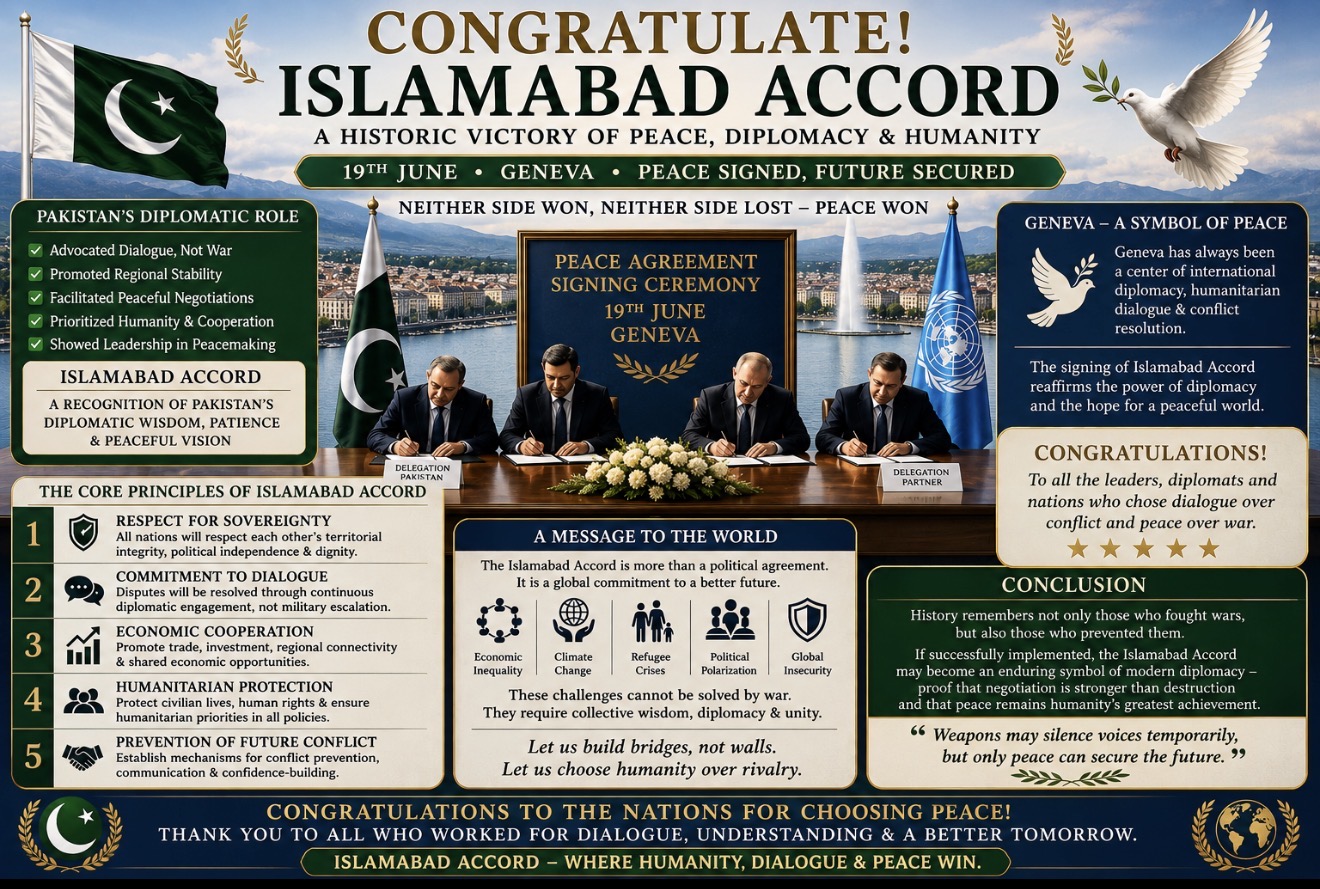
Islamabad Accord: A Victory of Peace, Diplomacy, and Humanity
On June 19, a new chapter in modern diplomacy is expected to be written with the signing of a historic peace agreement in Geneva — a moment that many are beginning to describe as the “Islamabad Accord.” The name reflects the diplomatic spirit, constructive engagement, and peace-oriented efforts led by Pakistan in facilitating dialogue and reducing tensions between conflicting sides.
This agreement is not merely a political document; it symbolizes the triumph of wisdom over hostility, dialogue over destruction, and peace over conflict.
In a world increasingly divided by wars, economic instability, and geopolitical rivalries, the Islamabad Accord offers a powerful reminder that sustainable peace can only emerge through negotiation, mutual respect, and sincere diplomacy.
Neither Side Won — Peace Won
The most remarkable aspect of this agreement is that it does not celebrate the defeat of one side by another. Instead, it reflects a mature understanding that in modern conflicts, prolonged hostility ultimately harms all nations involved.
The Islamabad Accord sends a global message:
“No one truly wins in war. The real victory belongs to peace, stability, and humanity.”
This principle is especially important in today’s interconnected world, where regional conflicts quickly transform into global economic and humanitarian crises.
Pakistan’s Diplomatic Role
Pakistan’s contribution to the peace process deserves recognition. Despite facing its own economic and political challenges, Pakistan continued to advocate dialogue, regional stability, and diplomatic engagement instead of confrontation.
For decades, Pakistan has consistently emphasized that peaceful coexistence, strategic balance, and international cooperation are essential for long-term global security. The Islamabad Accord reinforces this vision and demonstrates that Pakistan can play a constructive and responsible role in international diplomacy.
The recognition of the agreement as the “Islamabad Accord” would therefore symbolize acknowledgment of Pakistan’s diplomatic efforts and its commitment to peacebuilding.
Geneva: A Symbolic Venue for Peace
The choice of Geneva as the signing venue also carries deep symbolic importance. Geneva has historically served as a center for international diplomacy, humanitarian dialogue, and conflict resolution.
From global treaties to humanitarian conventions, Geneva has long represented neutrality and peaceful negotiation. The signing of the Islamabad Accord there strengthens the message that diplomacy remains humanity’s most powerful tool for resolving disputes.
The Core Principles of the Islamabad Accord
For this agreement to become meaningful and sustainable, several essential principles must guide its implementation:
1. Respect for Sovereignty
All participating nations must respect each other’s territorial integrity, political independence, and national dignity.
2. Commitment to Dialogue
Disputes should be addressed through continuous diplomatic engagement instead of military escalation.
3. Economic Cooperation
Peace cannot survive without economic stability. The accord should encourage trade, investment, regional connectivity, and shared economic opportunities.
4. Humanitarian Protection
Civilian lives, human rights, and humanitarian concerns must remain central priorities in all future negotiations and policies.
5. Prevention of Future Conflict
The agreement should include mechanisms for conflict prevention, communication channels, and confidence-building measures to avoid future escalation.
A Message to the World
The Islamabad Accord represents more than a temporary ceasefire or political settlement. It reflects a broader global need for cooperation in an era marked by uncertainty and division.
Today, humanity faces common challenges:
- Economic inequality
- Climate change
- Refugee crises
- Political polarization
- Global insecurity
None of these problems can be solved through war. They require collective wisdom, diplomacy, and international unity.
The world now needs leaders who can build bridges instead of walls, and agreements that prioritize humanity over political rivalry.
Conclusion
History remembers not only those who fought wars, but also those who prevented them.
If successfully implemented, the Islamabad Accord may become an enduring symbol of modern diplomacy — proof that negotiation is stronger than destruction and that peace remains humanity’s greatest achievement.
The agreement reminds the world of a timeless truth:
“Weapons may silence voices temporarily, but only peace can secure the future.”
May this accord become the beginning of a more stable, cooperative, and peaceful world for future generations.
Syed Ali Raza Naqvi Bukhari
Unity of Peace, Economic Reform, and Global Unity
Founder & Chairman of Tehreek Istehkam Pakistan, and the author of “Law of God” and “Social Democratic System.” advocates for truth, social justice, and reform in all sectors of society.


Comments
Post a Comment