From Versailles to Versailles: A Century of Peace Diplomacy When History Echoes Across Generations
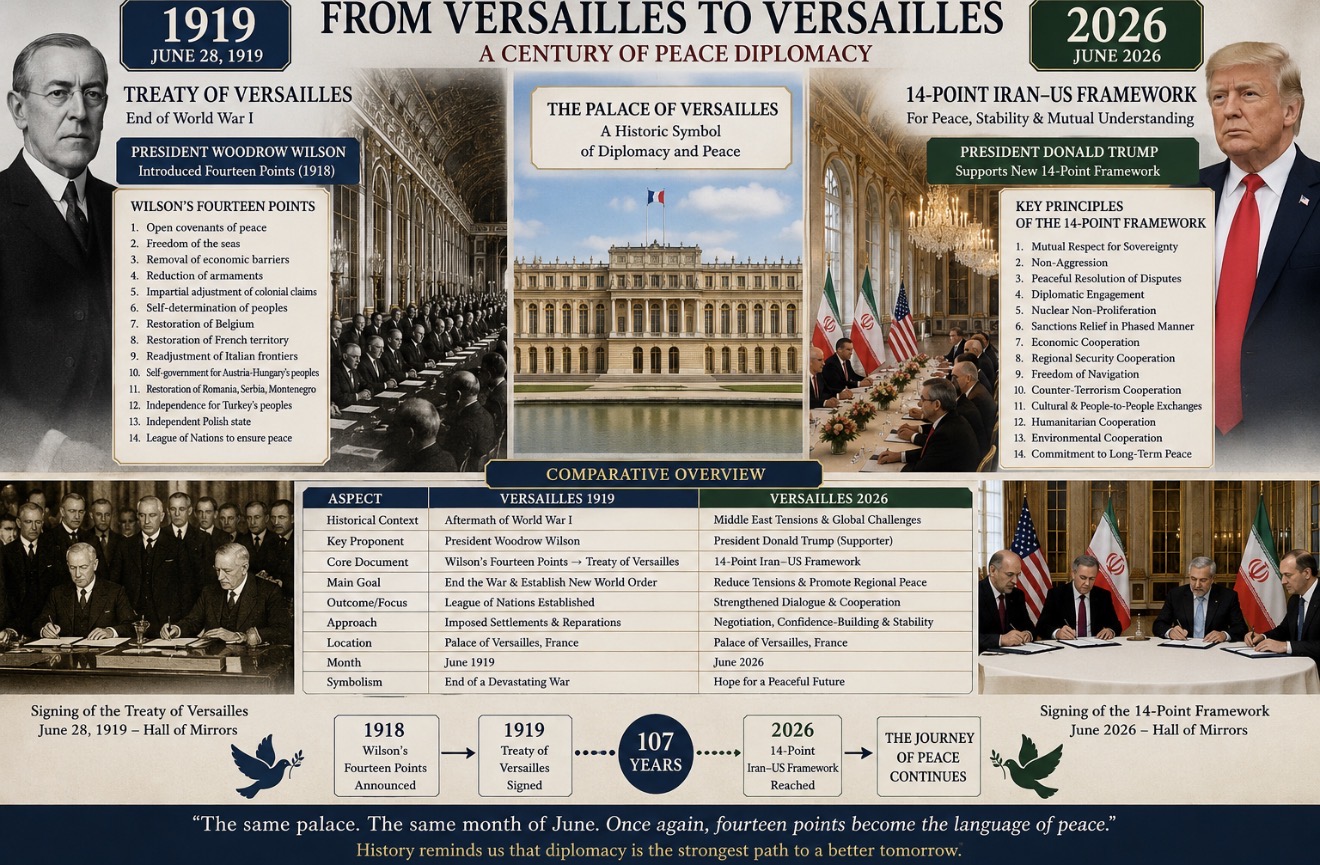 From Versailles to Versailles: A Century of Peace Diplomacy
When History Echoes Across Generations
History occasionally presents moments so remarkable that they appear to transcend time itself. One such moment emerged in June 2026, when the historic Palace of Versailles once again became the stage for a significant diplomatic breakthrough. More than a century after the Treaty of Versailles was signed in June 1919 following the First World War, the same iconic venue hosted a new 14-point agreement aimed at reducing tensions and promoting peace in one of the world’s most volatile regions.
The coincidence is striking. The same palace, the same month of June, and once again, a framework built around fourteen key principles intended to create a path toward peace.
The Legacy of President Woodrow Wilson’s Fourteen Points
In January 1918, American President Woodrow Wilson presented his famous Fourteen Points to the world. These principles were designed to prevent future wars and establish a more just international order.
Wilson’s vision emphasized:
- Open diplomacy
- Freedom of navigation
- Reduction of armaments
- Fair trade among nations
- Self-determination of peoples
- Respect for national sovereignty
- Creation of an international organization to preserve peace
His ideas inspired hope across war-torn Europe and became a foundation for discussions at the Paris Peace Conference.
The Treaty of Versailles: A Peace Agreement with Lasting Consequences
On June 28, 1919, leaders of the victorious Allied powers gathered at the historic Palace of Versailles to sign the Treaty of Versailles.
The treaty officially ended the First World War, one of the deadliest conflicts in human history. However, while Wilson envisioned reconciliation and lasting peace, the final treaty imposed severe economic and territorial penalties on Germany.
Many historians believe that these harsh conditions contributed to political instability in Europe and ultimately helped create the circumstances that led to the Second World War.
Nevertheless, Versailles became forever associated with the pursuit of peace through diplomacy.
June 2026: The Return of Versailles
More than one hundred years later, the Palace of Versailles once again attracted global attention.
In June 2026, representatives of the United States and Iran met at this historic venue and endorsed a new 14-point framework aimed at easing tensions, promoting dialogue, and reducing the risk of wider conflict in the Middle East.
The symbolism was impossible to ignore.
A century earlier, world leaders had gathered at Versailles seeking to heal the wounds of a devastating global war. In 2026, diplomats returned to the same location seeking solutions to modern geopolitical challenges.
The message was clear: diplomacy remains humanity’s strongest alternative to conflict.
The Power of Fourteen Points
The number fourteen carries profound historical significance.
Wilson’s Fourteen Points represented a vision for a safer and more cooperative world. More than a century later, another set of fourteen principles emerged as a roadmap for dialogue and de-escalation.
While the circumstances differ greatly, both initiatives share common objectives:
- Preventing conflict
- Encouraging negotiations
- Building mutual trust
- Strengthening international stability
- Promoting peaceful coexistence
These principles reflect a timeless truth: lasting peace is achieved not through military victories alone, but through understanding, compromise, and diplomacy.
Lessons from History
The story of Versailles teaches an important lesson. Peace agreements are not merely documents signed by leaders; they are commitments that require sincerity, implementation, and political courage.
The successes and shortcomings of the 1919 Treaty of Versailles continue to remind policymakers that sustainable peace must be built on fairness, respect, and cooperation.
As modern leaders confront increasingly complex global challenges, the lessons of history remain as relevant as ever.
A Symbol of Hope for the Future
The Palace of Versailles stands today not only as a monument to history but also as a symbol of humanity’s enduring desire for peace.
From President Wilson’s Fourteen Points in 1918 to the new diplomatic framework of 2026, more than a century separates these events. Yet both reflect the same aspiration: a world where disputes are resolved through dialogue rather than destruction.
The return of diplomacy to Versailles serves as a powerful reminder that while history cannot be changed, its lessons can guide the future.
As the world watches the implementation of new agreements and new commitments, one truth remains unchanged:
Peace is not merely the absence of war. It is the presence of understanding, cooperation, and the collective determination to build a better future for generations yet to come.


Comments
Post a Comment