The Quality of Leadership and the Condition of Society Are Often Mirrors of Each Other: When We Change Ourselves, We Begin to Change the World Around Us.
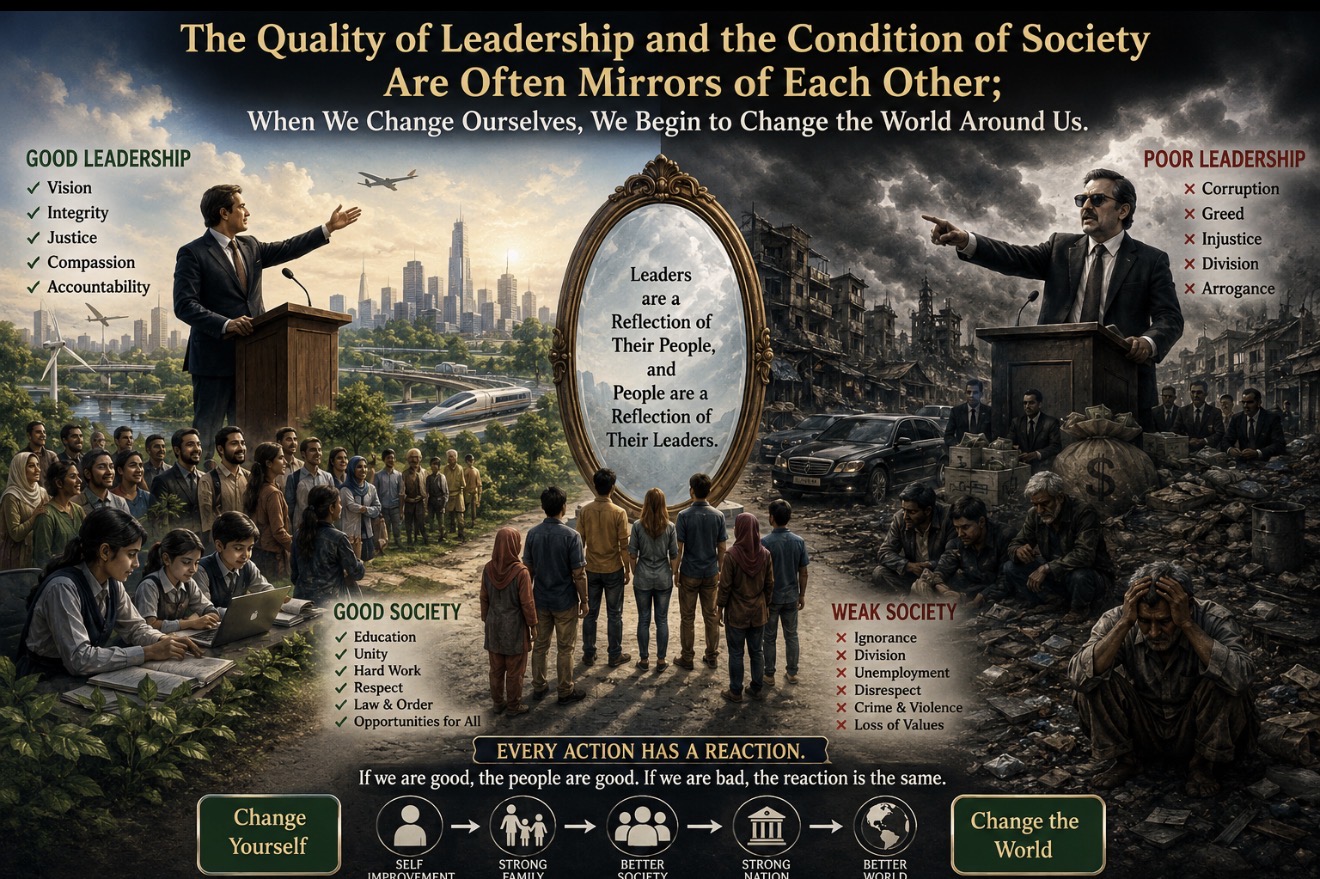
The Quality of Leadership and the Condition of Society Are Often Mirrors of Each Other: When We Change Ourselves, We Begin to Change the World Around Us
Introduction
Throughout human history, societies have often reflected the character, values, and vision of their leadership. At the same time, leaders themselves emerge from the societies they govern. This creates a powerful relationship in which leadership and society act as mirrors of one another. The condition of a nation is rarely the result of leadership alone; it is also shaped by the attitudes, priorities, and actions of its people.
Today, many people across the world blame political leaders for economic difficulties, social injustice, corruption, and instability. While leadership undoubtedly plays a crucial role, history teaches us that lasting change begins not only at the top but also within the hearts and minds of ordinary citizens.
Lessons from History
History provides countless examples of the connection between leadership and society.
The rise of great civilizations such as ancient Egypt, Greece, the Islamic Golden Age, and various European powers was not solely due to exceptional rulers. These societies also possessed strong institutions, a commitment to learning, social discipline, and a shared sense of purpose.
Likewise, the decline of many powerful empires was often accompanied by moral decay, internal divisions, corruption, and a weakening of civic responsibility. Leaders may have accelerated the decline, but the broader society also played a role in creating the conditions that allowed such failures to occur.
The Roman Empire, for example, did not collapse overnight because of a single ruler. It weakened gradually through political corruption, social fragmentation, economic inequality, and a loss of collective values. Similar patterns can be observed in many civilizations throughout history.
The Relationship Between Leaders and the People
A leader does not emerge from a vacuum. Political leaders, business leaders, religious leaders, and social influencers are products of the environments in which they are raised.
If a society values honesty, competence, education, and public service, it is more likely to produce leaders who embody those qualities. Conversely, if a society tolerates corruption, dishonesty, and selfishness, those characteristics often become visible within its leadership.
This does not mean that every leader perfectly reflects the people. However, over time, the overall quality of leadership tends to mirror the values that prevail within society.
As the saying goes, “People often get the leadership they tolerate.”
The Modern World: A Global Challenge
The challenges facing humanity today are not limited to one country. Whether in Asia, Europe, Africa, the Americas, or the Middle East, many nations struggle with economic uncertainty, political polarization, social inequality, environmental concerns, and declining trust in institutions.
The concentration of wealth in the hands of a small minority has become a global issue. Technological advancement has created immense opportunities, yet millions still struggle with poverty and insecurity. Political conflicts continue to divide societies, while misinformation and social media often deepen existing tensions.
These problems are not exclusive to any single nation. They represent a broader challenge facing modern civilization.
Looking at Pakistan and Beyond
In Pakistan, many citizens express frustration regarding governance, economic pressures, inflation, unemployment, and institutional weaknesses. Similar concerns can be heard in many countries around the world.
The tendency to blame leaders alone is understandable, but true national progress requires a broader perspective. A society cannot expect honesty from leaders while tolerating dishonesty in everyday life. It cannot demand accountability from governments while neglecting civic responsibility. It cannot seek unity while promoting division among its own people.
National development begins with a culture that values truth, discipline, education, hard work, and justice.
The Principle of Action and Reaction
One of the most fundamental laws of life is that every action has a reaction. This principle applies not only to science but also to human societies.
When people promote integrity, integrity spreads. When communities encourage education, knowledge grows. When individuals practice kindness, social harmony increases. Likewise, when corruption, hatred, and selfishness become widespread, societies inevitably experience the consequences.
The condition of a nation is therefore not merely the result of government policies. It is also the cumulative outcome of millions of individual choices made every day.
Personal Reform as the Foundation of Social Change
Many great thinkers, philosophers, and spiritual leaders have emphasized that meaningful change begins with self-improvement.
A society is made up of individuals, families, communities, and institutions. When individuals improve their character, families become stronger. Strong families build healthy communities, and healthy communities create stable nations.
The path toward national progress does not begin in government buildings alone. It begins in homes, schools, workplaces, and local communities.
Every citizen has the power to contribute by being honest, responsible, respectful, and committed to the common good.
A Vision for the Future
The future of any nation depends upon a partnership between responsible leadership and an engaged, principled society.
Leaders must demonstrate integrity, competence, and a commitment to public welfare. Citizens must uphold ethical values, respect the rule of law, and actively participate in the development of their communities.
Neither leaders nor citizens can succeed without the other. Progress occurs when both work together toward a shared vision of justice, prosperity, and social harmony.
Conclusion
History repeatedly demonstrates that leadership and society are reflections of one another. The strengths and weaknesses of a nation can often be traced to both the character of its leaders and the values of its people.
While it is easy to criticize those in power, lasting change requires self-reflection as well. If we wish to see better leadership, stronger institutions, and a more prosperous society, we must begin by improving ourselves.
The transformation of a nation begins with the transformation of its people. When we change ourselves, we begin to change the world around us.
Syed Ali Raza Naqvi Bukhari
Unity of Peace, Economic Reform, and Global Unity
Founder & Chairman of Tehreek Istehkam Pakistan, and the author of “Law of God” and “Social Democratic System.” advocates for truth, social justice, and reform in all sectors of society.


Insightful
ReplyDelete