May 2025 Victory: Pakistan Emerged as a Strong Defensive, Political, and Responsible State
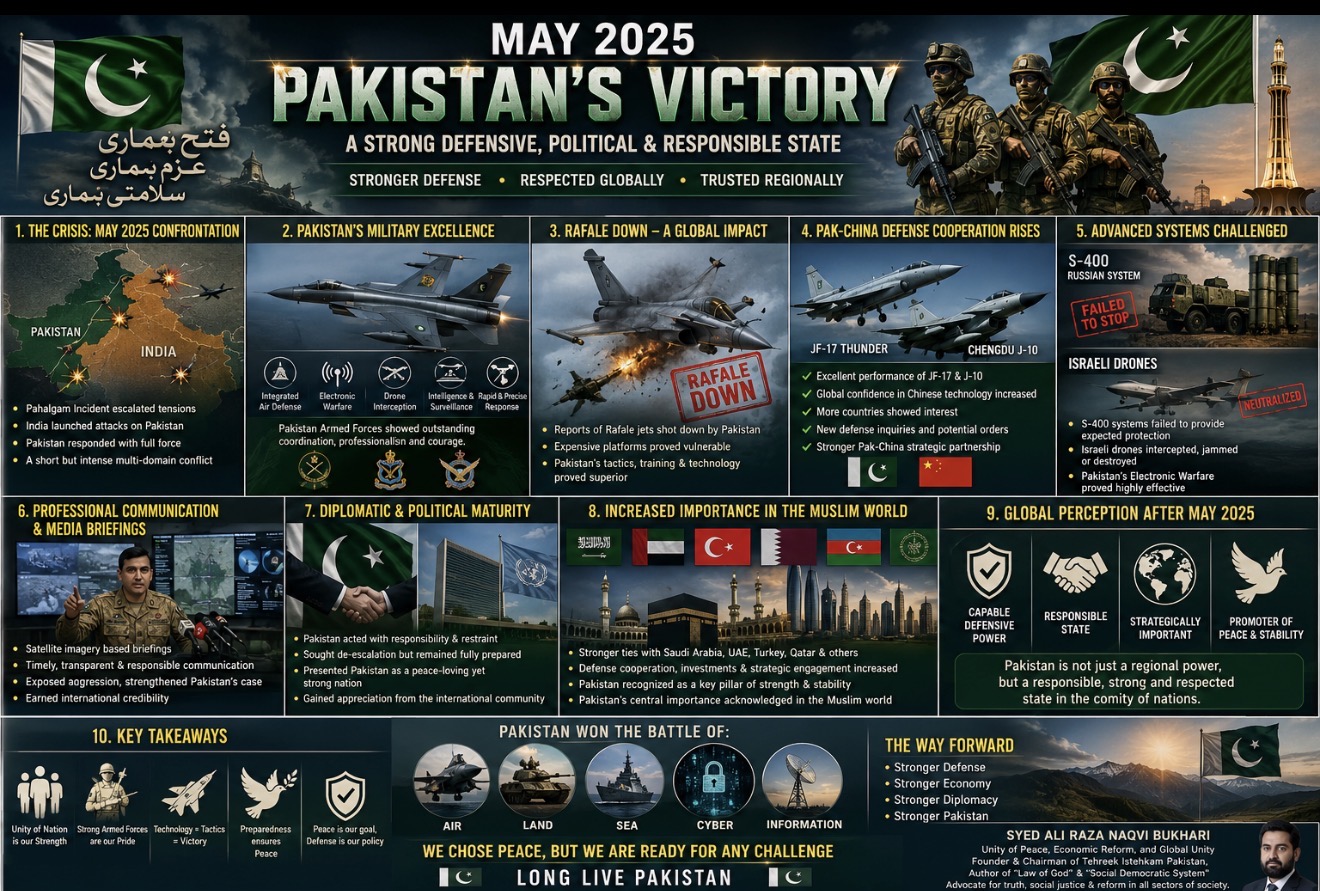 May 2025 Victory: Pakistan Emerged as a Strong Defensive, Political, and Responsible State
Introduction
The military confrontation between Pakistan and India in May 2025 became one of the most important strategic developments in recent South Asian history. Although the conflict remained limited in duration, it carried major military, diplomatic, and geopolitical consequences. The events of May 2025 reshaped global perceptions regarding Pakistan’s defense capabilities, political maturity, and strategic importance in the Muslim world and beyond.
Beginning of the Crisis
The crisis intensified after the Pahalgam incident in Indian-administered Kashmir, which sharply increased tensions between the two nuclear powers. India accused Pakistan of involvement and launched military operations targeting areas inside Pakistan and Azad Kashmir. Pakistan rejected the allegations and responded with coordinated military and diplomatic measures.
The situation quickly evolved into aerial engagements, drone warfare, missile exchanges, and border confrontations that attracted worldwide attention.
Pakistan’s Military Preparedness and Strategic Response
One of the most significant aspects of the conflict was the disciplined and coordinated response of Pakistan Armed Forces. Pakistan demonstrated advanced military planning involving:
- Air defense systems,
- Electronic warfare,
- Drone interception,
- Intelligence coordination,
- And rapid operational response.
The professionalism of Pakistan Air Force became a major subject of international defense discussions. Military analysts highlighted Pakistan’s ability to respond effectively against a technologically advanced opponent.
The Rafale Debate and Air Warfare Lessons
A major international debate emerged regarding reports that Indian Dassault Rafale jets were shot down during the conflict. Although official positions differed between both countries, the issue received significant attention in global defense circles.
The confrontation raised serious questions about modern air warfare and showed that expensive military platforms are not invincible in highly contested combat environments. The conflict demonstrated that operational strategy, pilot training, electronic warfare, and battlefield coordination remain decisive factors.
Rise of Pakistan-China Defense Cooperation
The conflict also increased international attention toward Pakistan-China defense cooperation. Military platforms such as the JF-17 Thunder and Chengdu J-10 gained global recognition after their reported operational performance.
Many defense experts observed that confidence in Chinese defense technology increased following the crisis. Countries seeking affordable and effective military systems began paying greater attention to Pakistan-China joint defense production and strategic cooperation.
Questions Over Advanced Defense Systems
The performance of India’s S-400 Triumf and Israeli-origin drones also became part of international military analysis. Pakistani defense strategies reportedly challenged advanced systems through electronic warfare, tactical coordination, and multi-layered operational planning.
The conflict highlighted an important reality of modern warfare: no defense system is completely untouchable, and adaptability remains critical in contemporary military strategy.
Pakistan’s Diplomatic and Political Maturity
Beyond military operations, Pakistan’s diplomatic conduct during the crisis strengthened its international image. Pakistan presented itself as a responsible state seeking regional stability while maintaining strong defensive readiness.
Military officials briefed international media using satellite imagery and strategic evidence to support Pakistan’s position. This professional communication strategy improved Pakistan’s credibility in international discussions and demonstrated political maturity during a dangerous regional crisis.
Increased Importance in the Muslim World
Following the conflict, Pakistan’s strategic importance in the Muslim world increased significantly. Countries such as Saudi Arabia, United Arab Emirates, and other regional partners strengthened engagement with Pakistan in defense, investment, and security matters.
Pakistan’s:
- Nuclear capability,
- Professional armed forces,
- Geographical position,
- And strategic partnerships
made it an increasingly important state in discussions related to regional stability and defense cooperation.
Global Perception After May 2025
The events of May 2025 changed how many observers viewed Pakistan. The country was increasingly seen not only as a military power, but also as a politically responsible state capable of balancing restraint with strength.
The conflict demonstrated that national unity, discipline, strategic planning, and diplomatic communication can significantly influence modern geopolitical outcomes.
Conclusion
The May 2025 confrontation became more than a military clash between two neighboring states. It emerged as a defining moment that elevated Pakistan’s international standing and strategic relevance.
Pakistan’s response during the crisis strengthened its reputation as:
- A capable defensive power,
- A resilient nation,
- A strategically important Muslim state,
- And a responsible actor in regional politics.
The events of May 2025 will likely remain an important chapter in South Asian history and a turning point in global perceptions regarding Pakistan’s military and political stature.
Syed Ali Raza Naqvi Bukhari
Unity of Peace, Economic Reform, and Global Unity
Founder & Chairman of Tehreek Istehkam Pakistan, and the author of “Law of God” and “Social Democratic System.” advocates for truth, social justice, and reform in all sectors of society.


Nice
ReplyDelete