Did America Put the Global Economy and World Peace at Risk Based Merely on Suspicion?
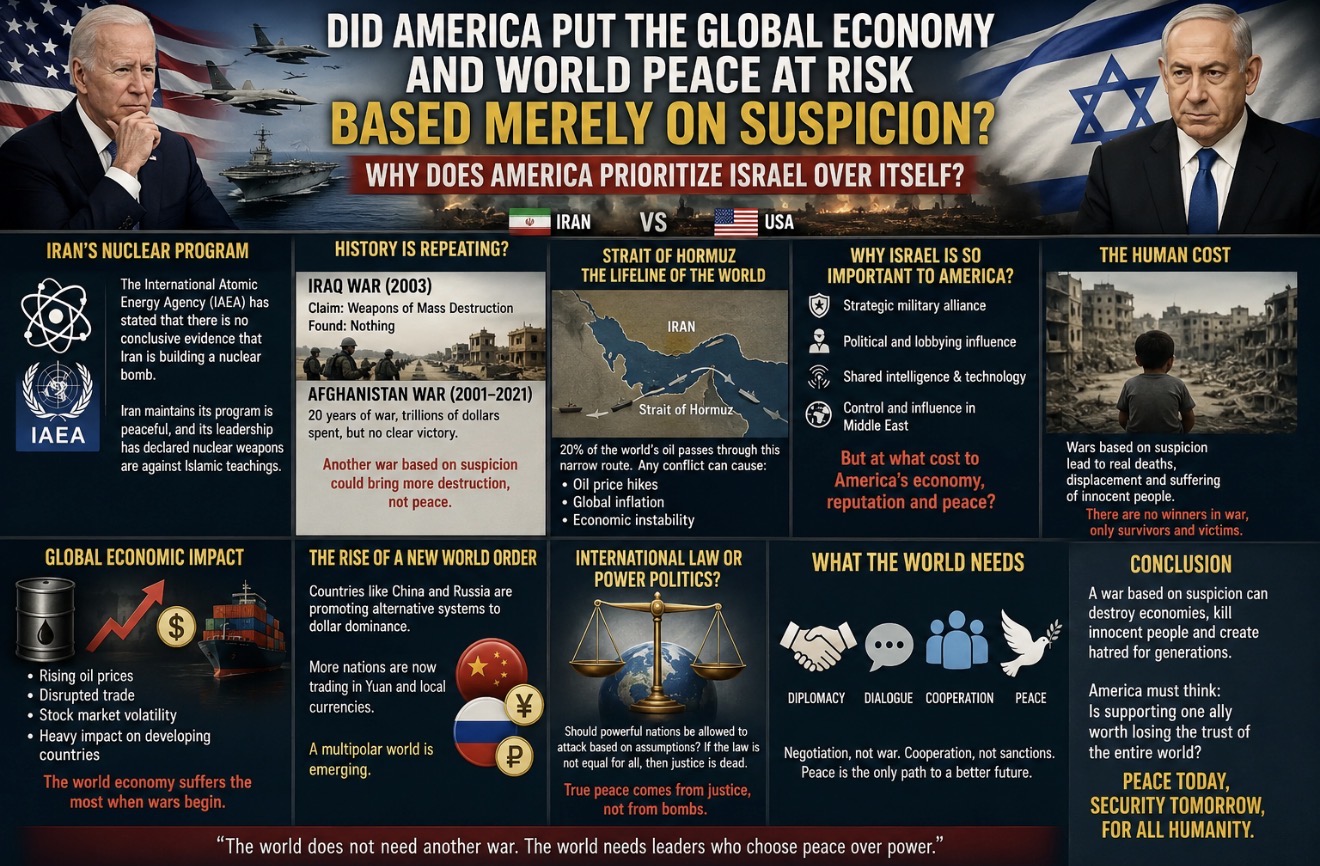
Did America Put the Global Economy and World Peace at Risk Based Merely on Suspicion?
Why Does America Prioritize Israel Over Itself?
Introduction
The growing tensions between United States and Iran have once again pushed the world toward uncertainty, fear, and economic instability. Across the globe, millions of people are asking an important question:
Does any country have the right to push the world toward war based on suspicion rather than proven facts?
This debate is not only about Iran’s nuclear program. It is about international law, global justice, economic stability, human lives, and the future of world peace.
Iran’s Nuclear Program and the Question of Evidence
International Atomic Energy Agency has repeatedly stated that while some aspects of Iran’s nuclear activities required clarification and monitoring, there was no conclusive public evidence proving that Iran had officially decided to build a nuclear bomb.
At the same time, Ali Khamenei publicly declared that nuclear weapons are against Islamic teachings and issued religious statements rejecting their use.
Despite this, the United States and Israel continued to present Iran as a major threat to regional and global security.
This raises a critical question:
If diplomatic negotiations were still possible, why did military escalation become the preferred option?
From Iraq to Iran — Is History Repeating Itself?
Many people compare today’s tensions with the events leading to the Iraq War.
The Iraq war was justified on claims that Iraq possessed “Weapons of Mass Destruction.” However, those weapons were never found. The consequences were devastating:
- Hundreds of thousands of lives lost
- Massive destruction across the region
- Rise in extremism and instability
- Loss of global trust in American foreign policy
- Severe economic consequences worldwide
Similarly, the War in Afghanistan lasted for two decades and ended without a clear strategic victory.
Today, critics fear that another military conflict with Iran could create even greater instability across the Middle East and beyond.
Strait of Hormuz — The Lifeline of the Global Economy
Strait of Hormuz is one of the world’s most critical oil routes. A significant portion of global energy supplies passes through this narrow waterway.
Any conflict involving Iran immediately threatens:
- Global oil prices
- International trade
- Financial markets
- Inflation worldwide
Developing countries such as Pakistan are especially vulnerable because rising energy prices directly affect inflation, debt, and economic stability.
This is why many nations fear that regional conflict could trigger a wider global economic crisis.
Why Is Israel So Central to American Foreign Policy?
One of the most debated questions in global politics is why the United States consistently places extraordinary importance on Israel.
Several reasons are often cited:
- Strategic military cooperation
- Political alliances
- Shared intelligence networks
- Influence of pro-Israel lobbying groups in American politics
- America’s long-term Middle East strategy
However, growing numbers of Americans — including academics, students, journalists, and politicians — are now questioning whether unconditional support for every Israeli policy truly serves America’s own national interests.
Many argue that decades of wars in the Middle East have:
- Damaged America’s global reputation
- Increased national debt
- Created instability instead of peace
- Weakened trust in Western leadership
The Rise of China and the Decline of Dollar Dominance
China, Russia, and several developing nations are increasingly exploring alternatives to the US dollar in international trade.
Many countries are now discussing:
- Trade in Chinese Yuan
- Regional currency agreements
- Independent financial systems outside Western control
Continued instability in the Middle East could accelerate this shift and weaken America’s economic influence over time.
The world appears to be slowly moving toward a multipolar global order rather than a system dominated by a single superpower.
Can Military Power Replace International Law?
Perhaps the most important question is this:
Should powerful nations be allowed to launch military actions based on assumptions, fears, or future possibilities rather than verified evidence?
If international law applies only to weaker countries while powerful nations act without accountability, then global trust in justice and diplomacy begins to collapse.
This is why millions of people around the world increasingly support:
- Diplomacy over war
- Negotiation over military intervention
- Economic cooperation over sanctions
- International law over unilateral action
Conclusion
The conflict surrounding Iran is not simply a dispute between two nations. It is a test of the future of global politics, economic stability, international law, and the balance of power in the modern world.
History has already shown the devastating consequences of wars launched on uncertain grounds. If the world fails to learn from those mistakes, another large-scale conflict in the Middle East could have catastrophic consequences for humanity.
Military power may create temporary dominance, but lasting peace can only be achieved through justice, dialogue, balance, and respect for human life.
Syed Ali Raza Naqvi Bukhari
Unity of Peace, Economic Reform, and Global Unity
Founder & Chairman of Tehreek Istehkam Pakistan, and the author of “Law of God” and “Social Democratic System.” advocates for truth, social justice, and reform in all sectors of society.


Comments
Post a Comment