Could the Condition of Recognizing Israel Break the Iran–US Agreement?
AI Generated
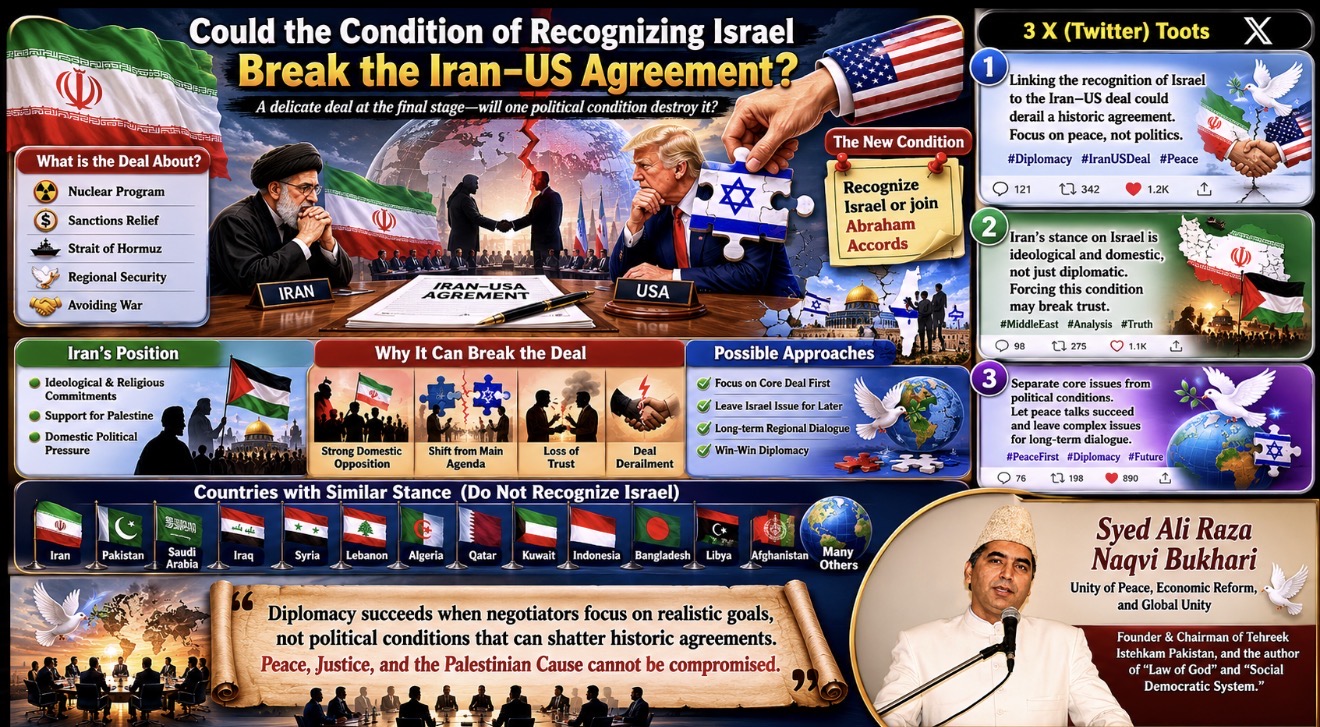 Could the Condition of Recognizing Israel Break the Iran–US Agreement?
Introduction
As reports emerge about progress in negotiations between the United States and Iran, a new and controversial issue has entered the debate: the possibility of linking any future agreement to the recognition of Israel. While the primary focus of the talks has been Iran’s nuclear program, sanctions relief, regional security, and freedom of navigation in strategic waterways, discussions surrounding Israel’s place in the Middle East have raised concerns among analysts and policymakers alike.
The critical question now is whether introducing the recognition of Israel as a condition could jeopardize an agreement that may otherwise be within reach.
The Core Objectives of the Iran–US Negotiations
For years, tensions between Washington and Tehran have revolved around several key issues:
- Iran’s nuclear activities.
- Economic sanctions imposed on Iran.
- Regional security and military tensions.
- Stability in the Persian Gulf and the Strait of Hormuz.
- The prevention of a wider regional conflict.
Both sides have strong incentives to avoid military escalation. The United States seeks stability in the Middle East, while Iran aims to reduce economic pressure and improve its strategic position.
These objectives form the foundation of the ongoing negotiations.
Why Has the Israel Question Entered the Discussion?
The issue of Israel is not directly related to Iran’s nuclear program. However, some policymakers in Washington view broader regional normalization as an essential part of a long-term Middle East peace strategy.
The expansion of the Abraham Accords has already brought several Arab states into formal diplomatic relations with Israel. Some observers believe that American policymakers would like to see a future regional framework in which hostility toward Israel is significantly reduced.
As a result, the idea of linking regional normalization with broader diplomatic agreements has gained attention.
Iran’s Position on Israel
For the Islamic Republic of Iran, the issue is far more than a diplomatic matter. It is deeply connected to the country’s ideological foundations and its long-standing support for the Palestinian cause.
Recognizing Israel would represent a major shift in Iranian foreign policy and could generate significant political opposition within Iran itself.
Therefore, even if Tehran were willing to compromise on certain economic or security matters, recognition of Israel would likely remain one of the most difficult issues for Iranian leaders to accept.
Could This Condition Derail the Agreement?
The answer is yes.
If recognition of Israel were presented as a mandatory and immediate condition for a final agreement, it could become a major obstacle to successful negotiations.
There are several reasons:
1. Domestic Political Pressure in Iran
Iranian leaders must consider public opinion, political institutions, and ideological commitments. Any sudden change in policy toward Israel could face strong resistance.
2. Shift Away from the Main Negotiating Agenda
The primary purpose of the talks is to address nuclear concerns, sanctions, and regional security. Introducing additional political conditions could complicate discussions and reduce the chances of success.
3. Risk of Losing Mutual Trust
Diplomatic negotiations often succeed when both sides focus on achievable objectives. Expanding the agenda at the final stage can create suspicion and undermine trust between negotiating parties.
An Alternative Approach
Many diplomatic experts argue that the most practical approach would be to separate the issues.
Under this framework:
- The United States and Iran would focus first on the core agreement.
- Regional normalization questions would be addressed later.
- More complex political disputes, including relations with Israel, would remain part of a longer-term diplomatic process.
This approach would allow both sides to secure immediate gains while avoiding unnecessary obstacles.
Pakistan’s Perspective
Pakistan has consistently maintained that it will consider recognizing Israel only after a just and lasting resolution of the Palestinian issue. This position reflects Pakistan’s long-standing support for Palestinian self-determination and remains an important element of its foreign policy.
Several other Muslim-majority countries continue to hold similar positions, although their diplomatic approaches vary.
The debate surrounding the Iran–US negotiations therefore resonates strongly across the Muslim world, where the Palestinian issue remains a matter of deep political and emotional significance.
Conclusion
The emerging Iran–US agreement has the potential to reduce tensions, improve regional stability, and prevent future conflict. However, diplomacy often succeeds when negotiators focus on realistic and attainable goals.
If the recognition of Israel becomes a non-negotiable condition at the final stage of the talks, it could create serious complications and potentially derail an otherwise achievable agreement. Conversely, if the issue is treated as part of a broader long-term regional dialogue, the chances of a successful deal may increase significantly.
The coming weeks may determine whether diplomacy prevails—or whether a highly sensitive political condition becomes the factor that prevents a historic breakthrough.
Syed Ali Raza Naqvi Bukhari
Unity of Peace, Economic Reform, and Global Unity
Founder & Chairman of Tehreek Istehkam Pakistan, and the author of “Law of God” and “Social Democratic System.” advocates for truth, social justice, and reform in all sectors of society.


Comments
Post a Comment