UAE’s Possible Exit from OPEC: A Turning Point in Global Energy Politics.
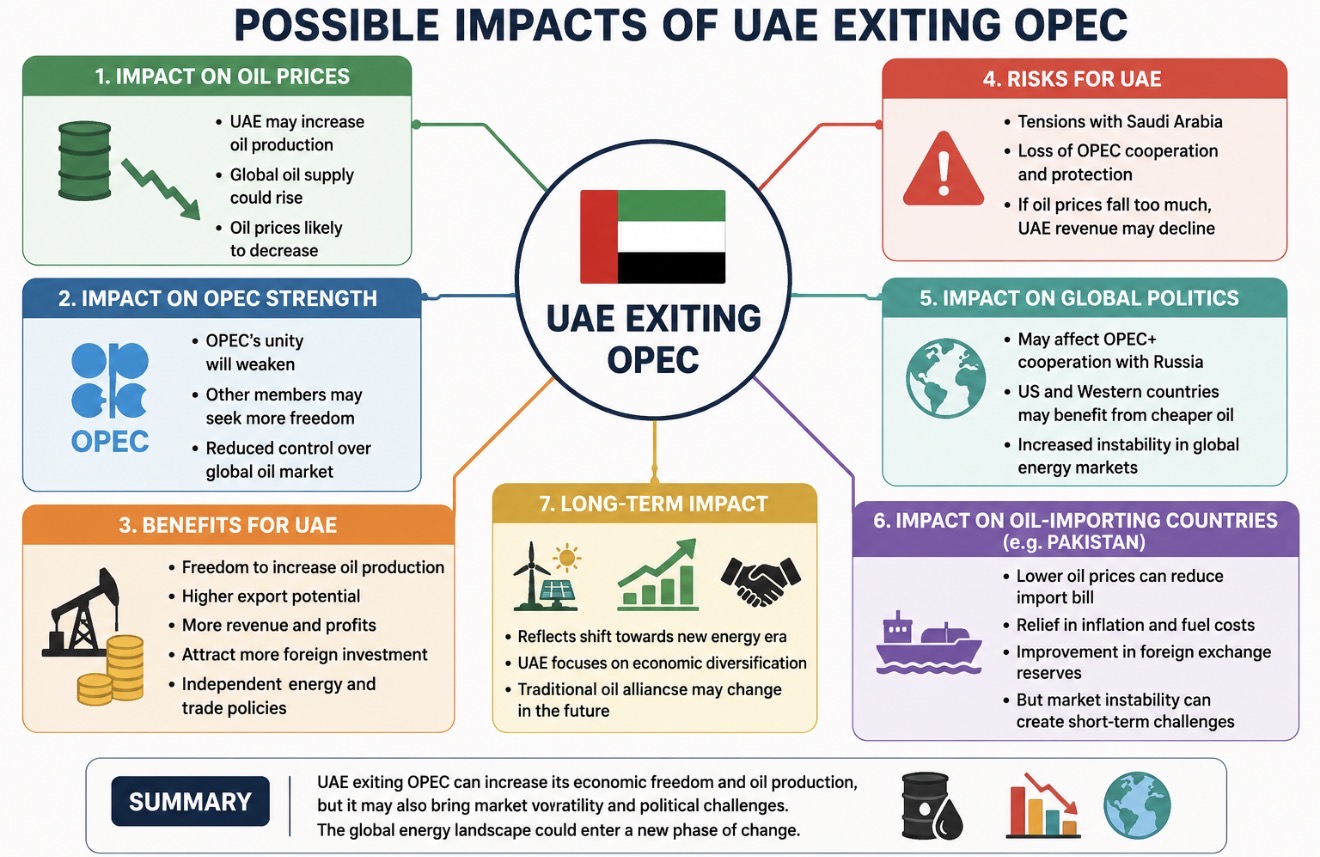 UAE’s Possible Exit from OPEC: A Turning Point in Global Energy Politics
The possibility of United Arab Emirates leaving Organization of the Petroleum Exporting Countries has become a topic of growing international discussion. While no official withdrawal has been confirmed, repeated reports and policy disagreements have raised important questions about the future of global oil markets, Middle Eastern alliances, and energy economics.
For decades, OPEC has played a central role in controlling oil production and stabilizing global prices. However, changing economic priorities, technological advancement, and geopolitical competition are reshaping the interests of member states — especially the UAE.
Why Would the UAE Consider Leaving OPEC?
One of the main reasons is production freedom. The UAE has invested billions of dollars in expanding its oil production capacity. However, OPEC production quotas often limit how much oil member countries can produce and export.
From the UAE’s perspective, these restrictions may reduce its ability to maximize revenue and fully utilize its energy infrastructure. As a rapidly modernizing economy, the country seeks greater flexibility in managing its own energy strategy.
Another important factor is the growing economic competition between the UAE and Saudi Arabia. Although both countries remain close regional allies, they are increasingly competing to become the Middle East’s leading hub for business, tourism, finance, technology, and global investment.
The UAE is also diversifying its economy beyond oil. Massive investments in artificial intelligence, renewable energy, logistics, tourism, and financial services indicate that the country wants a more independent and globally adaptive economic policy.
Impact on Global Oil Markets
If the UAE were to leave OPEC, global oil markets could experience significant shifts.
The UAE might increase oil production independently, which could lead to higher global supply and potentially lower oil prices. This would especially affect countries that rely heavily on oil exports for national revenue.
At the same time, such a move could weaken OPEC’s unity and influence. Other member states may begin reconsidering their own commitments if they believe independent production policies serve their national interests better.
The decision could also affect the broader OPEC+ framework, particularly cooperation with Russia in managing global energy supply.
Economic Effects on Oil-Importing Countries
For oil-importing countries such as Pakistan, lower oil prices could provide economic relief.
Cheaper oil may help:
- Reduce fuel and electricity costs
- Lower inflation
- Decrease import expenses
- Improve foreign exchange stability
However, instability in oil markets can also create uncertainty in trade and investment, especially if tensions rise among major energy-producing nations.
A Symbol of a Changing Energy Era
The UAE’s possible departure from OPEC reflects a broader transformation in the global energy landscape. The world is gradually shifting toward renewable energy, electric vehicles, and reduced carbon dependence.
In this changing environment, energy-producing countries are reassessing long-term strategies. The UAE appears to be positioning itself not only as an oil exporter, but as a diversified global economic power with independent decision-making capabilities.
Whether or not the UAE officially exits OPEC, the discussion itself highlights the growing tension between traditional oil alliances and modern economic ambitions. The coming years may redefine how energy power is structured in the Middle East and across the world.
Syed Ali Raza Naqvi Bukhari
Unity of Peace, Economic Reform, and Global Unity
Founder & Chairman of Tehreek Istehkam Pakistan, and the author of “Law of God” and “Social Democratic System.” advocates for truth, social justice, and reform in all sectors of society.


Comments
Post a Comment