Cockroach Janta Party: How a Satirical Campaign Became India’s Gen Z Movement.
Picture just for Reference
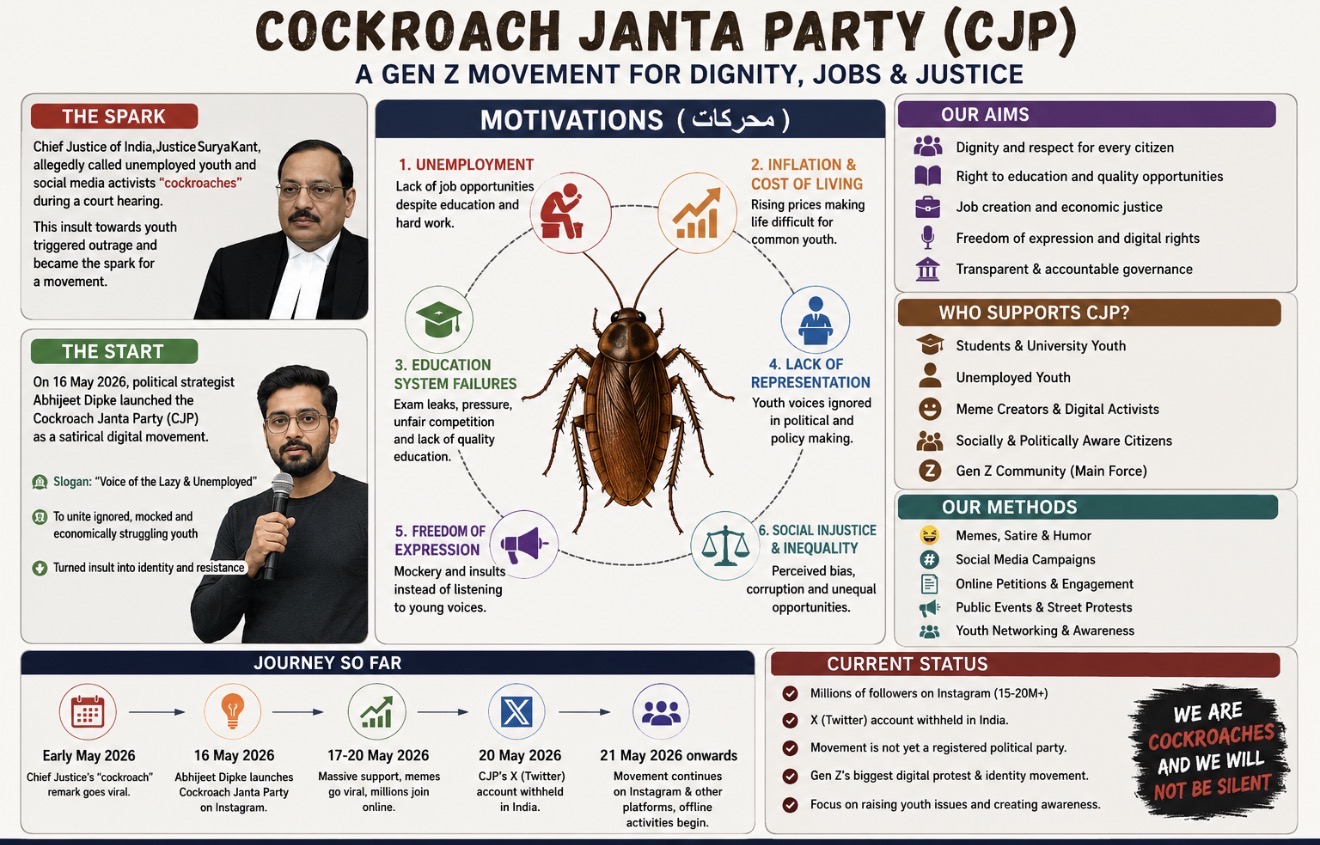 Cockroach Janta Party: How a Satirical Campaign Became India’s Gen Z Movement.
Introduction
In May 2026, India witnessed the sudden rise of a unique online political movement called the Cockroach Janta Party (CJP). What began as a sarcastic response to controversial remarks by India’s Chief Justice quickly transformed into one of the biggest Gen Z-led internet movements in South Asia. Within days, millions of young Indians joined the campaign through Instagram, X (Twitter), memes, satire, and online activism.
The movement reflected deep frustration among India’s youth regarding unemployment, inflation, educational pressures, political polarization, and lack of representation.
The Origin of the Movement
The “Cockroach” Remark
The controversy began after India’s Chief Justice, Justice Surya Kant, allegedly referred to some unemployed and activist youth as “cockroaches” during a court hearing. The statement caused outrage among many young Indians who already felt ignored by the political and economic system.
According to reports, the remark suggested that some unemployed young people had become “parasites” on society and social media activism. Critics considered the statement insulting and disrespectful toward struggling youth.
The Birth of Cockroach Janta Party
Founded by Abhijeet Dipke
On 16 May 2026, political communications strategist Abhijeet Dipke launched the “Cockroach Janta Party” as a satirical digital movement. He embraced the insult and turned it into a symbol of resistance.
The movement adopted the slogan:
“Voice of the Lazy & Unemployed.”
Its social media pages humorously invited:
- unemployed youth,
- meme creators,
- frustrated students,
- social media activists,
- and politically ignored citizens
to become part of the “cockroach community.”
Why the Campaign Went Viral
Gen Z and Meme Politics
India’s Gen Z rapidly connected with the movement because it mixed:
- humor,
- sarcasm,
- memes,
- digital activism,
- and real social frustration.
The campaign used internet culture instead of traditional political speeches. Rather than angry slogans alone, it used comedy and satire to criticize the establishment.
Young people turned the word “cockroach” into a badge of identity, essentially saying:
“If the system sees us this way, we will unite and speak louder.”
Massive Social Media Growth
Instagram Explosion
The movement became one of the fastest-growing political internet campaigns in India.
Within days:
- CJP crossed millions of Instagram followers,
- surpassed major Indian political parties online,
- and reportedly even exceeded the Instagram following of the ruling BJP.
Reports stated:
- over 15–20 million followers joined quickly,
- nearly 70% of supporters were aged between 19–25,
- and hundreds of thousands signed up through its online platform.
Main Issues Raised by the Movement
Youth Frustration in India
Although the movement began as satire, it highlighted serious issues, including:
1. Youth Unemployment
Many educated young Indians struggle to find stable jobs despite degrees and qualifications.
2. Inflation and Cost of Living
Rising prices and financial stress have made independent living difficult for young people.
3. Education System Problems
Students expressed frustration over exam leaks, pressure, competition, and unequal opportunities.
4. Freedom of Expression
Many supporters claimed young voices are mocked rather than heard seriously.
From Internet Meme to Public Movement
Offline Activities
The movement eventually expanded beyond social media.
Reports showed volunteers:
- attending protests dressed as cockroaches,
- organizing symbolic public events,
- and even participating in social campaigns such as cleanup drives.
This demonstrated that the campaign was evolving from a meme into a broader youth identity movement.
Government and Platform Response
X Account Withheld in India
As the movement gained popularity, its official X (Twitter) account was withheld in India following a legal demand.
Supporters criticized the action as suppression of dissent, while others argued authorities were monitoring the movement because of its political influence.
Despite restrictions:
- Instagram activity continued,
- new accounts appeared,
- and the campaign kept growing online.
Criticism of the Movement
“Meme Politics” Debate
Not everyone supported the campaign.
Critics argued:
- social media followers do not equal real political power,
- internet virality cannot replace organization,
- and satire alone cannot solve national problems.
Some analysts described it as temporary “meme politics,” while others viewed it as the beginning of a new style of digital democracy led by Gen Z.
Why the Movement Matters
A New Political Language
The Cockroach Janta Party revealed something important about modern politics:
Today’s youth no longer communicate politically in traditional ways alone. They use:
- memes,
- humor,
- short videos,
- online communities,
- and viral campaigns
to express anger and demand attention.
The movement also showed how quickly Gen Z can organize digitally when they feel insulted or ignored.
Present Situation
As of now:
- CJP is still primarily a digital and satirical movement,
- it is not officially registered as a political party,
- but it has become one of the biggest online youth campaigns in recent Indian political culture.
Whether it eventually becomes a real political force or remains an internet phenomenon is still uncertain. However, it has already succeeded in forcing national discussion around youth frustration and political representation.
Conclusion
The rise of the Cockroach Janta Party is more than a viral meme story. It reflects a generation that feels unheard, economically pressured, and politically disconnected. Instead of remaining silent, India’s Gen Z transformed an insult into a movement.
The campaign proved that in the digital age:
- satire can become political resistance,
- memes can become social commentary,
- and online communities can influence national conversations.
Most importantly, it showed that young people are no longer willing to stay invisible.
Syed Ali Raza Naqvi Bukhari
Unity of Peace, Economic Reform, and Global Unity
Founder & Chairman of Tehreek Istehkam Pakistan, and the author of “Law of God” and “Social Democratic System.” advocates for truth, social justice, and reform in all sectors of society.


Comments
Post a Comment