Winning Peace, Not Wars: Pakistan’s Emerging Role in Global Diplomacy.
Picture just for Reference
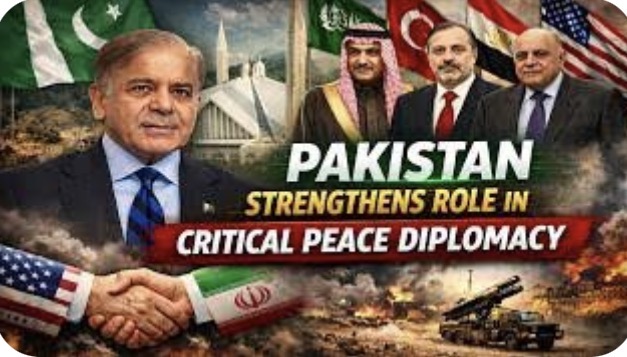
Winning Peace, Not Wars: Pakistan’s Emerging Role in Global Diplomacy.
Pakistan Redefining Victory in a Changing World.
In an age defined by conflict, rising geopolitical tensions, and power rivalries, the traditional definition of victory is being challenged. For decades, nations have measured success by military dominance—territory gained, enemies subdued, and wars won. Yet history repeatedly shows that wars, even when “won,” leave behind destruction, instability, and long-term resentment. True victory, therefore, lies not in defeating an adversary on the battlefield, but in establishing lasting peace.
The Current Crisis: A World on Edge
Today, as tensions escalate between Iran and United States, the world once again stands at a dangerous crossroads. Military actions, threats, and strategic maneuvers dominate global discourse. The Strait of Hormuz remains a flashpoint, global markets are shaken, and the risk of a broader regional war looms large. This is not just a regional issue—it is a global concern with far-reaching consequences.
Pakistan’s Unique Position: A Bridge Between Powers
Amidst this uncertainty, Pakistan is attempting to carve out a unique and principled role. Rather than aligning rigidly with any single bloc, Pakistan is pursuing a path of balanced diplomacy. Its relationships span across diverse and often competing powers:
- Close ties with Iran due to geography and shared interests
- Strategic engagement with United States
- Strong partnership with China
- Deep-rooted relations with Saudi Arabia and Gulf nations
This rare positioning enables Pakistan to act not as a participant in conflict, but as a bridge between adversaries.
The Islamabad Accord: A Step Toward Dialogue
Recent diplomatic efforts, including the development of a proposed framework informally referred to as the “Islamabad Accord,” reflect Pakistan’s intent to facilitate dialogue. Although still in its preliminary stages and not yet finalized, the initiative aims to:
- Encourage immediate de-escalation
- Open pathways for ceasefire
- Address critical issues like the Strait of Hormuz
- Build a foundation for sustained negotiations
Even as a draft, this initiative represents a bold step toward peace in an otherwise volatile environment.
The Challenges: Trust Deficit and Global Interests
Despite these efforts, the road to peace remains difficult. The divide between Iran and United States is rooted in decades of mistrust and conflicting strategic interests. Additionally, global powers such as Russia, China, and European nations have their own stakes in the region.
Peace, therefore, is not dependent on one country alone. It requires collective willingness, compromise, and a shared vision for stability.
The Philosophy of Peace: True Victory Defined
The idea that “winning a war is not true victory, but establishing peace is” is not merely philosophical—it is practical. Wars may deliver short-term results, but peace ensures long-term stability, economic growth, and human security.
Pakistan’s approach reflects this deeper understanding. By choosing dialogue over confrontation, it is promoting a model of diplomacy that prioritizes humanity over hostility.
Pakistan’s Global Significance: Beyond Regional Politics
If these efforts succeed, Pakistan could redefine its role on the global stage—not just as a regional player, but as a credible mediator in international conflicts. Its ability to engage with multiple sides simultaneously positions it as a country capable of influencing outcomes beyond its borders.
In a world divided by alliances and rivalries, such a role is both rare and essential.
Conclusion: Peace as the Ultimate Victory
In the final analysis, nations that win wars may achieve temporary triumphs, but those that build peace shape the future. Victory is not the silence of guns—it is the presence of justice, stability, and mutual respect.
At a time when the world stands on the brink of greater conflict, Pakistan’s efforts serve as a reminder that the path to lasting success lies not in destruction, but in reconciliation. True victory belongs to those who prevent wars, not those who win them.
Syed Ali Raza Naqvi Bukhari
Unity of Peace, Economic Reform, and Global Unity
Founder & Chairman of Tehreek Istehkam Pakistan, and the author of “Law of God” and “Social Democratic System.” advocates for truth, social justice, and reform in all sectors of society.


Comments
Post a Comment